HENS SEE GRASS FOR THE FIRST TIME S4 ● E30
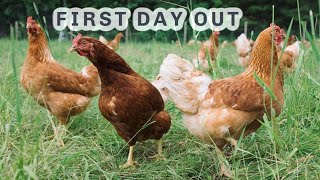
Video by Richard Perkins showing chicks/hens being introduced to pasture from Eggmobiles, describing typical shy behaviour (hiding under the Eggmobiles), use of a sheepdog (Miso) to herd birds, and practical husbandry (water, heating, roosting). Gives concrete feeding schedule and feed-conversion remarks, reports garden plantings (peas, beets, brassicas) and tree/hedge layout, and describes ongoing barn/roofing work to meet fire standards.
Questions this video answers
23 grams per bird per day.
250 birds in each pen.
About 43 grams per bird per day.
About 100 grams per bird per day.
Up to 3.0–3.5 to 1 (industry can be as low as 1.82 to 1).
Chapters
So it's now 5 o' clock in the evening and the beds have been open all day, but we'll go and have a look. There are a few out now and they're underneath the Eggmobiles and they haven't ventured very much further than that today, which is to be expected. First bird was just coming out of this eggmobile. We put water and feet just outside where they can see it to encourage them to come out. But it takes some hours before they take the courage up to come out. And after a couple come out, they start more and more coming out, but they usually just hide under the egg mobile. They don't like to venture out. There's three birds out of this pond pen after a few hours and a lot standing at the door who just a bit unsure of what this big wide open world is. So this is the new Eggmobile, the lighter one, and the birds didn't come out of here for a couple of hours later than the other birds. They came out of this one quicker. And I actually was sat here one watching them when they first came out. It took about eight minutes for one bird to come down the steps and visit the waterer and the feeders. We just put some feeders outside with water to encourage them. You can see they are a little bit startled when anything new comes in. I am actually going to take the drone out for the first time and fly it over them. And I imagine they will be spooked and get straight under the egg mobile. This is very normal behavior. I mean, I would expect the birds to behave like this for a couple more days, but they will probably more and more come out, but still spend a lot of time sheltering underneath the egg mobile. And it's going to be interesting to see if they naturally go in on their own. But Miso, our sheepdog, who's not actually much good as a sheepdog, she's scared of sheep, but she is pretty good at going underneath the eggmobile and rearing them round to the door. And she helped a lot last year with getting the hens back in at night, because the hens don't roost until the sun goes down, which is about 8, 8:30 now. And in the middle of the summer, it's not until 11 o' clock and nobody really wants to be awake at that time to put the hens back in. We got the fence right up to the lines of young chestnuts that we've planted here, and we're actually coming in here to put in strawberry every 30cm along here. This year. And we'll graze. We always graze right up to the edge of this sheeting. It's just tucked in. So when we planted the young chestnuts, we just came along with the keyline plough and did a rip down the centre here. It's still very nice and soft in the middle of this. And we put down by a char that had been soaked in urine and. And some other rock dust and things and left that in anticipation of coming along and putting in the strawberry this year. There's some curious birds coming to say hello now. Now, these birds have never seen an electric fence before either, and so it'll take one or two of them to realize that gives them a little shock. It's nice to see their curiosity is peaking now. Chickens covered in feathers, obviously, so they don't get shocked when they're. Unless they're touching the area around the beak and sometimes their feet. But you notice when they do get a shock, they get pretty startled. Beautiful birds. Chickens are some of the closest relatives of dinosaurs and you really get to see that when you spend a lot of time with chickens. They're almost like velociraptors, their gaze, or how I imagine velociraptors would be anyway. But it's a nice sight to see. I wouldn't have been surprised if most of them had stayed in all day, actually, but there's definitely a couple of hundred birds underneath the eggmobile, and they started using their roosts last night and so I think they will naturally take to that. So we're at the top of top field and the birds will be starting to move down in a staggered way. I just startled Reuben here, who was having a little nap, I think. But I think the pigs are quite curious of the chickens. They're sitting up here today along the edge of the fence line checking them out. Hi, Mama. Hey, Mama. Very happy for the pigs. They're having a nice time in here. Yeah, it's really nice to have the birds out. The weather is getting a bit warmer. It's still been cold. The chicks are okay. Their brood has warmed up a bit with the extra heating we've put in this year. And we've been working on the barn. We're starting to install gypsum on the roofs to make that up to fire standards so that we can use it as a day space. First buds are coming on some of the trees in the silver pasture lanes. There's hazel on the back with fruit trees every eight meters. And then this is Aronia on the Front these little bushes. Top field is a different assembly of hazel. On the back row, because we're kind of facing east to west, we put fruit trees every 8 meters with hazel in between. And then we have aronia, gooseberries, black currants, red currants, white currants, stuff like that. And it's a bit different field. Our fields are very different in their soil makeup. And this field is very sandy and very silty. Low nutrition up at the top here. And so the trees do very well up here. Chick's doing well. We've had the gas heater on as well as another heater to keep the temperature up. And they seem to be doing fine because they're changing water and feeding right now. We change the water really regularly. Like the quality of water is highly related to how well the birds do and the mortality rate. Like young birds need exceptional quality water. The water we have out of our well here is. Well, in Sweden we have some of the best water in the world, so it's never an issue, but it's really critical to clean the water out. You see that they're raised up on their little wooden plinths there just to keep sawdust out. People use nipple water systems and they're definitely better if you can get them to work. We haven't been using them because we had pressure issues with them. And we like simple, robust solutions that you can just visually check really quickly. And they started to eat a lot. Now we've gone on to the restrictive feed program. What's the restricted feed program at now?
23 grams per bird per day.
23 grams per bird per day. We have a little feed sheet made up with some anticipated mortality on the vertical columns to allow us to quickly work out how many grams to feed each pen. There's 250 birds in each. And just to give you an example, on day five, they're having 23 grams a day. At day 10, that's nearly doubled to 43 grams a day. And at the age, let's see, three weeks old, they will be having 100 grams each a day. These birds have very high feed conversion ratios, up to three, three and a half to one. In the industry, they'll get that even to 1.82 to one in some places in the world. Obviously those birds are not out on pasture and burning off energy, and so the feed ratio is a lot higher, but it's very efficient for a chicken. Now, things like geese and other pasture raised animals would be far more efficient, but it's pretty impressive in its own right. A lot of work to care for these birds in the very early stages when they're most fragile. And we visit them at least five times a day at this point. That will go down to three servings of food a day, as well as their daily moves on pasture and then moving twice a day as the birds get older.
Gardens are going very well.
Yeah. What's out in the gardens now?
We have four beds of kale, four beds of spinach, four beds of kohlrabi. These are 10 meter long beds. I guess viewers know that now. And we've got four beds of peas. That's about 4,000 pea plants we've just seeded yesterday. Just under 2,000 beets.
Nice.
First of the beets, first of the beets. And we've just taken out some Asian greens, different types of Asian greens for hardening off and they look fantastic.
Super nice. And the crew is pretty awesome now.
The crew is great.
Yeah.
Everyone's happy to be here and getting involved and doing what they can and, you know, last year we had two people and then sometimes three and now we have four. So, I mean, it's just exploding with effort. It's great.
Yeah, yeah, yeah. We got enough hands to take it. It's cool and steady standing in front.
Of this new windbreak. Protect our new north beds from the wind.
So we've got windbreak all around this one now. Super nice. It's been a very windy day actually, hasn't it?
It has been, yeah.
It's a bit more sheltered here. We've got buildings that shelter the farmyard, but I've been up watching the chickens and some of the trees have been arching over several meters at the top. Strong winds we get here and this.
Weekend we're going to be putting all the salad in our new salad bars.
Nice. I'm taking the weekend off. I'm going fishing. So we started a big project up here to put up gyps on the roof. And the boys getting into this project, it's quite cool with this lifting device and panels are going up. Super nice. It really brings back the space again, which is nice. We've got a lot of about 300 square meters to do to totally line this space, but we're moving it towards fire regulation so we can use this as a day space and it's such a wonderful space to have. We insulated it the first week we were here actually, and we just haven't really used it since. Getting it up to standards now and then. It's going to be a wonderful addition to the spaces here, But start from this side. You have a lot of less Easy that's it for today. Quick update. We're having the weekend downtime. Get to know the crew more. Thanks for watching our videos. Click subscribe if you want to keep up to date with the farm and share the videos with your friends. If you think they'll enjoy them, find out more in our book, Making Small Farms Work. See you next time.
More from Richard


A review of short and intensive season on a mixed farm and restaurant/event space in Sweden






Alskade Kyckling Exploring complexities of poultry production in Sweden and what we stand for


