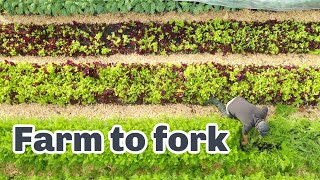
A Richard Perkins YouTube farm-tour showing how Bridgerdale moves produce and animal products from field to customer. Covers hands-on harvest and packing practices (bunching by eye from packing lists), tool choices and knife care, wash/pack workflows and banding, egg production and packing (pastured eggs, eggmobiles), poultry weight-sorting and labeling for fresh vs frozen, refrigeration solutions (homemade chiller), delivery equipment, and business impacts from COVID (shift from restaurants to direct sales). Also mentions an upcoming Joel Salatin course (fully booked) and scaling considerations for eggs and market planning.
Questions this video answers
350 hens in both the eggmobiles.
Chiller: ~19 cubic meters running on a Coolbot (European max ~18–20 m³); currently run at ~5.5 m³.
Homemade chiller built for less than €2,000.
Joel Salatin (visit/course confirmed and fully booked).
Delivery trailer made by Neptun.
Chapters
Today's video, we're just going to look at the process of bringing food fresh from the farm direct to your fork. Bridgerdale has become one of the most renowned regenerative agriculture farms and training centers in Europe, where we demonstrate a whole bunch of solutions. From pasture raised livestock moved daily onto fresh forage agroforestry, keyline design, slaughtering on farm, meeting all the local regulations as well as innovative ways of selling. We've got a fantastic team here this year doing an amazing job. So we'll go and catch up with the gardeners who are harvesting everything fresh for the RICO today and look around at the other things going on to get food out to the customers. So for small farms, the leverage points that you've got over any industrial producer, freshness, locality and quality. Things that can be achieved by hand, by dedicated, skillful people that just can't be imitated by machine or robot at scale. And so a lot of handwork goes on here to produce the most epic, nutrient dense food you can buy anywhere in Sweden. Off to Stockholm city. Long day. Just the bearings. What did you catch in the pond? Everything.
I'll tell. I'll let Raggy explain. Seiya owned a huge bugly saw. It was a giant water boatman. It was on the land walking and it was like this big. Literally.
Whoa. You today you have rescued mice, grass snakes, grass snakes, eggs, toads and water boatmen. You are like little adventurers.
Toad is gone. Looking for food. No, I saw it. It's actually in the home. We made one come down.
Whipping cream.
He's whipping cream to pour on raspberries.
Good picking yesterday. Look at that. And growing and growing and growing and growing and growing. And Gracie's now all the way up here. You're doing quite good right now.
You're growing a lot, but you just like this. And the other one like that.
So kids are all here. Hey, Gracie. Hey, Ragnar. Gracie, when was the last time you were at the farm?
No idea.
It was a while ago because of the COVID thing. You haven't been able to come this year.
Yes.
Ragnar, how excited are you to have Grace here? You're so excited.
I think it was one year ago.
It was a long time. We missed you very much. And you have grown up so much. You're nearly ten now, aren't you? So it's time to start moving boiler pans in the morning. So for picking, packing vegetables, list come out summer. Do you want to tell us how that system works?
So Joanna gives us a list with all the orders from Reco and Raskins. So this is for first day. And then we have the one from yesterday. And then we have the number of bunches for the day that we have to pick and the equivalent in grams. But we bunch most of the stuff in the field, so it's just about knowing the weight, like memory.
So you have like a total yield that you harvest in that amount and bunching by eye, as it were. Once you know what the bunch size.
Is, most of it, except restaurants. And then if it's something new, we try to have an idea of what the bunch weighs.
When are you excited about coming out the garden today?
Beets. Beets and broccolis.
Also.
It.
Victoria Knox serrated harvest knife. These are from Johnny's. You can buy them anywhere for most things. Push cut knives for lettuce, etc. This is actually a polystyrene board knife that I use to chop the end of bunches to get stalks all the same length. Sama, what do you like using them for?
I really like for salads, Pak choy, fennel, most of the stuff we use it for. And then these ones for everything else. They're like perfect knives. I don't dare to use this one.
The hacker.
I'm a bit clumsy. But these ones are great for all.
Around versatility, even broccolis.
We pick the broccolis with this one and it's perfect.
Never put your knives in the ground folks, because it's very hard to sharpen a serrated blade. You need a little diamond file. It takes a long time. Keep your blades sharp.
These ones I really recommend for salad. Like it's really changing everything.
Like it's way faster like this and more ergonomic. Right. The idea being that you do this a thousand times rather than this.
Yeah, yeah.
Which will give you funny wrists.
Yeah, super comfortable too.
So this is where water from the wash pack station comes out and feeds as Baileys. Look, groves us apples. Beautiful. Primo. No dig. Carrots. Always a pleasure. These are small bunches of baby carrots. But Brian, who is a florist from Cork, shows us a really cool banding technique for big bunches of things.
Okay, so you grab a single carrot, grab your elastic, make a little loop around, tie it like that. And then you just turn around and come back on the carrot.
Back on the same carrot.
Back on the same carrot.
Beautiful. That's easy for big bunches. So veg is all harvested on the delivery days like you saw from those packing lists. And then we obviously have eggs, we have frozen Chicken, fresh chicken, smoked chicken, bits of chicken, any other meats that we have on the farm. Although we've run out of beef, lamb, etc. As well as pork now. So then that's all put into the truck just before leaving straight to deliveries to the restaurants and to the customers. At Rica, pretty much everything is being sold through Ricoh at the moment. We have very little restaurant sales due to the COVID situation. And it seems like some of those establishments can be really hard hit. So it might be wise for us to continue to just focus on Rico and private customers for the resilience in uncertain times. But it does mean we have a big glut of salads. We have restaurants who would typically clear a whole bed in a week or two. And we've been planning for normal restaurant sales this year. We haven't adapted our plan accordingly. And so we do have an excess of a bunch of different crops.
Sam.
Feed in ex out.
It.
Eggs. Look at these beauties. Eggs are undervalued as a source of protein, amino acids, vitamins. Nothing like the taste of pastured eggs. And we use these as a gateway for all our other products. I think eggs are one of the most complementary products that people can't turn away from once they've had amazing eggs. So 350 hens in both the eggmobiles. Next year we're thinking to bring back the third egg mobile. We have massive demand for our eggs and we just wanted to keep things a bit quiet this year because I wasn't planning to be here. But we're known now for our pastured chickens, pastured eggs. And we're the main egg seller in our region. So plenty of scope to bring back the original eggmobile. So that's just the morning collection. We've got afternoon collection and feeding as well, time controlled grazing. So we feed the birds later in the day as well just to get them hungry in between. So they forage well. And what we've done here is pack the eggs so these are all clean. Check for cracks with a pointy side up because you store eggs flat side down. So if they're all clean and good, they go in the egg packery flipped over into a paper carton. Just visually check them again, make sure there's nothing on there like blood, spots, feathers, etc. Then they get stamped good to go. And I like to always sort out any eggs that need attention. This one's got some dirt on it for example. Just with a piece of sandpaper we can just take that off and then any Cracked eggs I throw through the floor for the hens. Some people think that that causes the hens to start eating eggs. That's an urban myth. I've done that for years. No problem at all. Hens will naturally pick at their eggs because they want to sit on it for 28 days. They need to know it's. It's good. So they're sonically testing the shell to see if it's a good egg, as it were. So it's a natural behavior. Boilers on the daily move. So these won't be taken until the day after the Joel Salatin course. We've just heard confirmation that Joel is coming, despite all the COVID she nambles that are going on. Joel Salton will be here and obviously he's been a major inspiration to me early in my pathway. Super excited to have him here. We're going to be running a training that's more like an open conversation and dialogue between him and myself as opposed to going through the technicalities of how we run individual enterprises. Because all that stuff is out there in our combined books and videos. And so we wanted to run a training that's a little bit different to what people might be expecting or used to. And so we're really excited for that. It's totally fully booked out. We've got a waiting list as long as the course. So I'm afraid there's no option to join us for that. But hopefully there'll be more collaborations in the future.
It.
Let us know when 100 birds are in the slaughtering. So these are all weights, they're put in weight category when we actually slaughtering big chickens here, for example. And that means that as we pack, we have them stacked in grey food crates in their weight order. Some of these are going out fresh, some are going out to the freezers, and they will be stored in their weight categories. And so we're doing. Are we doing fresh first? Fresh ones first? Fresh birds first. So we're doing all the fresh ones. And the reason we're doing that is they have different labels. So fresh birds have a fresh label and frozen birds have frozen labels, obviously, and that's important. So we have to be a little bit organized. The weights are recorded. So once I pack the birds, I put them up on here, they can read that on the scales, put it onto the label and also put it in into a spreadsheet that we can record as Lauder data. Once we've gone through the different weight categories, we'll do the organs down below. So that's Livers, hearts, and we've kept a few gizzards for our own eating. So like everything, this is about workflow and organizing the most efficient, minimal hand movements to get the job done. Okay, birds all in weight orders. Good, that's a wrap. So things a little slow up here. 59 degrees north. We've got lots of tomatoes coming on now. Lots of beautiful basil, but too shady in here to grow any tomato crop. Any salad crops underneath. So we've just got basil sitting under. Lots of tomatoes coming. But it's very, very slow up here because we're so far north. It always feels like it's barely worth doing tomatoes. First one's ripening up little cherries. But we've got no idli this year. This was meant to be idli. Now, if you've followed our channel for a long time, you'll know the incredible dense blossoms that we get from Italy. But this was purchased as idli, but it looks more like a plum tomato. Very strange. Now we've actually got one plant on this row that has flowers a bit like Italy here. So we would have trusses of like 800 flowers and maybe six or eight trusses per plant. But this is not actually Italy, it's a cherry. So I don't know what's going on here. It might be the fact that I've been promoting Italy that they've sold out and they've conned us with some other seeds. I don't know what's going on, but very strange. We just do not see Italy in the way that you've seen it in the past. Video. So looking forward to some good tomato crops, but it'll take a while still yet and we'll be topping these plants off in a month from now. So it's always a bit late up here without heated tunnels. And that's why for me, tomatoes are an essential part of the market garden, but are a low value crop, relatively speaking, in this climate. So Ridgedale's really been responsible for pioneering this approach to no dig, commercial market gardening. Wood chip pathways that we see all around the world now for great success. Less work, less weeding, less water. Healthy crops mulched with their very nutrient source. And it's great to see how many people have taken our model and run with that. It's a real pleasure to see as well as with our eggmobiles and approaches to innovative ways to raise boilers. It's amazing to see the ripples of this little farm in the middle of Sweden travel out around the world. And great to see the response to our book Regenerative Agriculture that's led so many people to renovate their business or start a business from scratch. It's really touching to hear those stories.
It.
Fabian, what veg are you excited about at the moment?
Mostly carrots.
Beautiful carrots. Do we have any of the beautiful purple ones left?
Yeah, just down in the west bed.
And really nice carrot.
Yeah. White person. Beautiful.
What do you think of them? Blue washkins?
Yeah, they're great. It's good. But you can only use one at a time because otherwise it's not enough pressure. But anyway, we have one. We have a pretty good setup now. Like one is washing, one is preparing all the recorder and typing for restaurants. So yeah, it's one person at the washing station. So just a quick soak in the water so it's refresh nicely the leaves and then we put them, drain tiny.
Bits, cooling down the leaves and then getting them straight in the chiller to keep them in primo condition. Baby cats. Got the very first watermelon out of the Huger swale compost toilet. So super excited to tuck into that and see how that is. So harvest and packing is done. Everything's in kangers or crates ready to go out. So last minute pack, everything's organized for where it's going and that keeps things really simple. Nice to have the space in here. It's 19 cubic meters running on Coolbot. This is for Europeans, the biggest AC unit that you can put in, up to about 18 to 20 cubic meters. We're only running at five and a half. That's fine for veg, but you can put this one in yourself because it's not. Not needing a technician. It's got gas filled pipes that connect it to the compressor outside. Good to have space in here so you can really move around and stack things in an organized way. So this chiller has been a game changer this year. Homemade for less than €2,000. Beautiful smoked chicken. Okay, so for this year we've bought a new delivery trailer because we've got two vehicles going off at the same time. But this has got liftable sides and back all the way around. So it's a really nice delivery platform. It's ergonomic. Do you like it, Christian? Yeah, it's very nice. You have easy access, you can set up everything. So you can basically pack all your bags before handing them to the customers. And you've got a table in the back and a canopy there for rain.
Yeah.
So you don't get rain in your neck when you're standing as well. Pretty good investment. Pretty cheap trailer made by Neptun. Pretty low cost, but we've been very happy with the outcome of it. So eggs and veg chickens going off to suner. That's how our veg and products get to customers. It's a wrap.
More from Richard


A review of short and intensive season on a mixed farm and restaurant/event space in Sweden






Alskade Kyckling Exploring complexities of poultry production in Sweden and what we stand for


