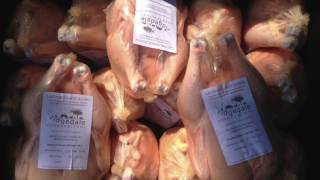
Richard Perkins walks through processing pastured chickens at a European facility, covering stunning and plucking, then the evisceration table: removing oil glands, extracting the crop, opening the cavity without contamination, separating organs, and checking for damage. Scalding takes 35-40 seconds at 63°C.
Questions this video answers
2015 at Ridgedale.
About 63 degrees Celsius for 35–40 seconds.
About 30 seconds.
In Europe, birds must be stunned before they are bled out.
Every 50 birds.
Chapters
So we're outside what is one of Europe's lowest cost approved poultry processing facilities. We built this in 2015 at Ridgedale. I just wanted to make a quick video to show you the process of eviscerating a chicken correctly. We're focused on premium pastured birds. We follow our chickens behind our cows and sheep and laying hens. So in Europe, you have to, legally, you have to stun the birds before they're bled out. So we use an electric stunner. The birds are bled pass through into the dirty side of the slaughter unit and here they're scalded at about 63 degrees Celsius for 35, 40 seconds before having feet removed, going on to the plucker, which is a turkey plucker in this case. So it's quite a powerful machine. They're plucked for about 30 seconds before being handed onto the evisceration table.
And then we start by facing the bird away from us, lifting up the tail, because we're trying to remove the oil glands. So that's all birds have oil glands to oil their feathers, but it taints the meat if you leave any of that intact. So I am using a sharp chicken boning knife and I am cutting straight down on the line of its rump and I am holding up the tail with my finger to avoid the risk of cutting my fingers. And it is a simple slice that gets down and separates the tissue, but without going into the backbone. Because I am going to be doing this hundreds of times, I don't want to blunt my knife. Then I turn my knife flat and start cutting upwards and I start to see the oil glands. So I pinch the skin here and I cut below this and I can pop up the oil gland that goes in the bin and I flip the bird over and I'm pinching up in the thoracic cavity here. And my objective is to cut through the skin and initial membranes without cutting into the breast meat. At this point, I will rip the skin downwards with my finger, securing the breast meat. And my objective is to release the crop, the sac that the chicken takes its food into before it moves down to the gizzard where it grinds it up. I need to separate that from the breast meat because it's attached by tissues here. And the way I do that is to roll it onto my finger. It's very slippery, so I roll it onto my finger and then grab it with my thumb and I rip downwards. And then I pull it back up by switching hands to separate it from the neck skin. So that's the crop, the sack that the chicken takes its feed in. And when you've just fed chickens, you'll see a bulge in their neck here. Then in the same motion, I dig. I've got the crop in my fingers here and I dig underneath the windpipe and the esophagus and separate them by pulling from the neck. And then I do the same with the neck. So now I've released the front of the bird that when I get the bird, everything should follow through. And I've then placed my hand on the keel of the bird and use my fingers to create tension. And I'm making a horizontal cut between the keel and the butt hole. So I do that with a sharp cut and I'm cutting through this layer of fat to this membrane. But the guts are just below here. So you have to be very careful not to pierce the guts or you get feces. Contaminating the inside of the bird. And processing a chicken is a lot about ripping. I get fingers in here and I rip the cavity here. And I do this towards the edge of the table that if there's any feces, I can just wash them straight off. The next job is to separate the fat from the gizzard, which I do by running my finger over the top of it. And then I reach my hand around to the right hand side because I'm right handed and I'm trying to pick up the windpipe and esophagus from the other end of the bird and I tease out the insides, keeping this off the table in case I break the gallbladder, the bile duct, and if any shit is coming on, you can wash it off the table like this. Typically, we save the livers and they need to be teased away from the gallbladder without piercing it. If you pierce the gallbladder, you will get green liquid everywhere and it stains the chicken. You can't sell that chicken as a premium bird anymore. So you tease the liver away. And my responsibility is checking the health of the bird. So I'm looking for any red spots or white spots on the liver. That's a very healthy liver that could be eaten. So we would then put that into cold water and every 50 birds we would push them through to the freezer unit. We often separate the gizzard by ripping. And the gizzard is the muscle sack that a chicken will use to grind up its food. It's just a huge muscle and inside you can see it's been eating grains. And it's also full of little stones that it's using to grind up the food. Obviously, a chicken has no teeth. If you wanted to eat the gizzard, you would peel this away. You peel the inner membrane away from the skin, which usually comes away quite easily, like so, and that would be a gizzard ready for eating. But all the time I've kept tension on here so that there's no risk of feces entering the body cavity. And then my job is to cut very tightly to the pubic bones to keep all of this fat on the bird, because that's what makes chicken taste good. So I make a vertical slice on both sides of the vent. Oh, I've broken it there. And then I come and cut down underneath and that goes straight in the bin. Now, I didn't get all the insides out because my hands are a little bit big for processing these little birds. So I take the heart and I check the heart for any red or white spots. And if it's healthy at this point, I can determine the bird is fit for human consumption and it can go further down the line. If there's anything suspect with the bird, it would go straight in the bin. We can't have birds moving through the slaughtery beyond this point. This is a male bird. So I'm taking testicles out which lie up on the back of the spine. And then my next job is to take the lungs which lie up against the ribcage and you scoop them out first, the right hand side, that's one of the lungs. They can be eaten also if you wish to, and then I take the left one. So that bird is now ready to be washed down once I've taken the neck, which I take with secateurs to avoid blunting my knife, and that could be saved for eating too. So that bird is technically safe for human consumption and ready to be further processed. And if I keeping the edibles, they will go into ice water and move along in the process.
So there we go. That's how I eviscerate the chicken. Thanks so much for watching and we really value our support. We love what we're doing here and we love being able to share that with you around the world. Don't forget to click subscribe like the video if you enjoyed it. We're going to be putting out a lot more content in the coming months. Thanks so much for watching.