HOW TO START A FARM WITH NO MONEY S4 ● E1
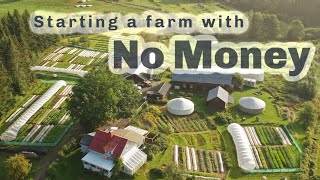
Richard Perkins started a profitable farm in Sweden with minimal capital by focusing on fast-return enterprises like pastured broilers and market gardens, avoiding debt, and tracking every cost and hour. He emphasizes starting small, keeping detailed spreadsheets, and building systems tied to local markets.
Questions this video answers
About €2,000 each.
About 12 tons of eggs a year (combined).
A few hundred euros.
About €30,000 in its first year.
The farm was profitable since year two.
Chapters
So let's get straight to the point. You can't really start a farm without money. It takes a lot of investment to build up infrastructure and your way of getting products to market, processing them, etc. It is possible though to do that on a very low cost. Now we've set up our farm up here in Sweden, which is one of the most expensive and highly regulated and taxed countries in the world. And we've done this on a shoestring budget. We spent about as much on the farm and doing it up as people spend on the average house here. And so I wanted to share a few of the key points that I think are important if you're looking to set up a farm of your own, because there are clever ways to go about it. And I think there's opportunities that exist today that didn't exist in the past for people to get rolling in an intelligent way quickly. The nature of farming is changing in many ways. The nature of marketing and distributing products is changing a lot. I get a lot of young people coming to me who don't have much money and don't have much access to land. Here in Europe, access to land is a big issue. And that's partly because we have an aging farmer population who have most of their capital locked up in non movable assets, as it were. And so it's very hard for them to get out of farming and for young people to get in the game. The first point is to not get into debt that you can't afford. I mean, there's nothing wrong with taking debt. And we took some loans to be able to kick start the farm, but we took very small loans, the sort of sums that people would spend on a car typically, and we could afford to pay them off with our business plan. So having a really good plan is important. And it all comes down to many hours of sitting and planning with spreadsheets and making sure that the accounts are up to date. And we're monitoring the plans that we make. So there's nothing wrong with taking on debt. But. But you need to be really careful because farms are a bottomless pit. You can just keep throwing money at them. My advice to people starting out is to really focus on enterprises that immediately make profit. So here at our farm, we've focused on three main enterprises in the beginning, and that's been our pastured boilers and our pastured layers and our eggmobiles and the market gardens. And all those enterprises have paid their investment costs in the first year. From an accounting perspective, you typically write that off over sort of five years or so. But in reality you need to pay those investments up front. And so we've designed enterprises that are specifically scalable, replicable. That's allowed us to build up a market. Because we're in quite a rural location here. We don't have a very big market. There's a town of 80,000 people about 50, 60 kilometers away. And that's about as far as we want to be selling our produce from the farm. So even here in this rural situation, we're able to make a good go of it. And we've done that by really starting small and building up with the market and building up a reputation for really good, high quality products and building up trust with relationships with customers and restaurants who buy our products. And that's worked really well for us. We've just continually been upscaling productions each year. And the farm's been profitable since year two. And now this season we've had two employees that will continue next year. And we're already making a good living from the farm produce alone. We also here have a lot of help from interns and core team. And we also have money coming in from education. But the farm is working totally on its own feet already. And that money just allows us to be a bit more creative, like putting in some of the systems that we wouldn't prioritize if we were just farming alone, for example. Examples of that are the tree systems here. They will produce some viable crops and a low input production once they're established. But it takes a very long time for them to be coming into fruit, as it were. So you want to be careful by not putting money into investments that don't return money, like building water features, et cetera. It's really important to design them in and plan them in from the beginning. But if you don't have any money, you need to be investing in enterprises that make money immediately. And that's why we focused on the enterprises that we have here, because they're all very doable. They're all creating familiar products that people naturally eat a lot, like eggs and chicken and vegetables. It's very common in the diet here. There's the guinea fowl roosting up the tree here. It's beautiful sunrise this morning. And yeah, it's. I mean, we could make our living just from our broilers, pastured broilers, and we could make a living just from eggs or just from vegetables. So it doesn't matter if you're just choosing one enterprise on a small scale. What's important is you do the planning and get your spreadsheets in order and really monitor those plans. So each enterprise has got its own detailed spreadsheet that we build up records each year and keep adding to the detail in those spreadsheets. And then we have a monthly income and outgoing from that spreadsheet that's fed into a main control sheet. Because one of the hardest things to do on the farm is to manage the cash flow. Typically all your expenses are coming at the start of the season, and a lot of the income is coming either in dribs and drabs throughout the season or in a load at the end of the season. So that's a really hard aspect for people to manage often. So you need your spreadsheets in order. It's really important that you then monitor those plans and really put time into the accounting. And I'd say, you know, a few hours a week. It's not the most exciting subject in the world, but having your accounts up to date gives you a real confidence in how the business is going and also informs your decision making where to take money out of a project and where to invest money to address any log jams you might be experiencing. So planning, planning, planning. A big part of what we've done here that's been successful is to really utilize waste resources. It's amazing what people throw away here. So we've been able to convert buildings for accommodations or for storages and create things like our mobile slaughtery or our eggmobiles. So here, you know, the eggmobiles, up here we've got two eggmobiles that can produce about 12 tons of eggs a year. Both the eggmobiles cost about €2,000 each. The egg packery cost us a few hundred euros for a certified egg egg packery and suddenly we're off. You know, it's an enterprise that brings in €30,000 in its first year. So a big part of the whole thing of making it work is being able to sell the produce. You know, selling, harvesting, distributing takes up a lot of time. So finding really efficient ways to deal with selling produce, you need to start that from the beginning. And we've done that via creating our own farm currencies and developing customer relationships to allow us to cultivate these drop off points. So we sell all our produce in advance. We have egg subscribers and they will buy eggs for six months in advance. And we'll deliver once a week to one venue and once a week to another venue over the winter. In the summer, when we have a Lot more production and our vegetable boxes are going on, etc. We'll do three different drop offs in the week, but those drop offs, we've got them down to half an hour now. So we can take two and a half thousand eggs, go to town for half an hour and drop off all those eggs. Customers are happy because we're on time, it's efficient, it works well, and it saves us a huge amount of time that we need to be doing other things. And so it's quite key to keep a record of your time, how much time, different activities taking you. And we do that very carefully here because we work with a lot of young people that are going into farming for themselves. And so we keep very accurate records of how long things should take, how long things do seem to take. And that's really important in the decision making process. When you want to analyze an enterprise of how they're doing compared to another enterprise, you can't just look at the incomes, you need to look at the time involved as well. So start starting that record keeping from the beginning and challenging yourself to find the most efficient ways to do tasks. We're running quite a diverse mixed farm with animals and tree crops in our agroforestry systems as well as our annual cropping. And to be honest, you don't need to start that diversely. I wouldn't if I was starting on my own for us, because we have a lot of people coming here and we're a demonstration site. We really wanted to hit the ground running because it's very inspiring for the people that come here to see all of this going on. But it involves a lot of risk too. I mean, if I was starting out on my own, I wouldn't take on more than I could handle. I would just start one enterprise and get that really rolling. And whilst we could do that with any one of our enterprises to meet our own family needs and personal costs, it's not really the quality of life that we're looking for here. We really love having people here and we love to share this, particularly this early stage in the farm's development, because it creates quite a unique learning opportunity for people to really see how to start this stuff up from scratch. I mean, we've all seen incredible examples from around the world, but people are usually stuck in my experience of where to get started, like how to go from a blank state to something that's functional. And so I really advise people to focus in on one or two things and specialize in those until they've mastered them before getting more diverse and building out different enterprises because it's a high risk way to go about it and we have a cushion that allows us to do that with people coming here. But if it wasn't, if that wasn't the circumstance and it was just myself and Johanna farming here, we would probably just focus on the chickens. In the first few years, we wouldn't have planted any of the tree systems, built any of the irrigation systems, the big pond there. These are investments that we've made because we can afford them and we can see in our planning that, you know, with the tree systems it takes time for them to get established. So it's really important to get them in early in my mind, in our cold climate here, just to get that started. But every single one of our enterprises, be it the market garden, the layers or the broilers, has paid off its investments in the first year and has brought profit in. And you can't really expect to start in a better way than that. But you can only do that by planning a lot of planning, putting a lot of time into the management side of things, the decision making side of things, keeping very accurate records and keeping track of time as well. So I hope you found the video useful. Click subscribe below right now if you did share the video and if you've got any comments or questions, you can post them below and I'll answer them. Thanks for watching.
More from Richard


A review of short and intensive season on a mixed farm and restaurant/event space in Sweden






Alskade Kyckling Exploring complexities of poultry production in Sweden and what we stand for


