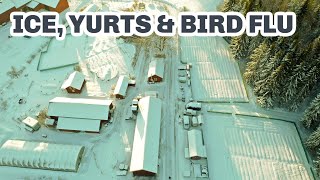
Richard Perkins marks yurt sites in a frozen Swedish forest and plans foundations for spring building. He also weighs bird flu risks for pastured poultry and considers moving birds indoors if the outbreak worsens.
Chapters
Welcome back to another episode, folks. Now it's starting to warm up. I can hear the birds singing. Every day it's a little bit warmer and hopefully in the next week it'll even peak above zero. As you'll know, we bought the forest land that the market gardens on the north beds here that are located on. And I've got seven massive platforms to build. Two for the massive teepees that are replacing our yurts. We're putting the yurts in the forest and three smaller 7 meter diameter platforms for three other teepees that we'll be renting out there. It's too frozen right now, but I've got to start laying out measurements and getting the spaces ready. So many animal tracks. Elk, deer, foxes, dogs, looks like little pine martins. Super cool. Flooded forests. We're on our way to the lake where you've seen many times where we've come for barbecues and swimming, etc. But it's just turned into a sheet of ice that extends all the way through this forest. It's always an odd feeling walking on ice. This is the corner where I start fishing normally and I head down around over here. People have been driving their cars around. As you might remember. I've got a huge pile of timber to move up into the forest and cut down to shape and get these decks together. It's really important this year for hosting as well as being able to see start out rental and have other people running trainings in a beautiful setting could be really nurturing. Now this is what I'm going to use to put down the stands that the platforms will be built out of. But it's too frozen right now to do that. This is the timber that I'll be building the subframe with and then building all the decking with some nice decking boards and a simple decking tool, just a perfectly flat floor with hidden screws, etc. It's a huge amount of work to do and I'm hoping to get it done before the team arrive for the spring. So the reason I'm going for these is that it's probably the quickest and easiest way to do an install. These are built for 90 x 90 cm wood and they allow some drainage down as well. So wood is already treated. It's going to last a very long time. But I was originally just going to put some telegraph poles in the ground. That's a lot of digging in stony forest land and I don't actually have enough telegraph poles. So I went with this option because it should Be quick and easy, except the ground is frozen. Now, if I do hit stones, I'll be able to cut these down to some degree. I'm not worried about having the full length of it in the ground if it's hitting bedrock, because the platform is going to be quite mighty and stable. Now, I've printed this off. This is an excerpt out of the Ridgedale Builds book that gives us the precise locations for the cut and build of the nine metre yurt platform. And I'm going to use this to start marking out the space on the ground. Now, we've obviously built these kind of platforms before and these are on quite a slope. So this is where we're replacing them with 13 meter wide teepees and 11 and a half meter wide bases. So we'll be taking this frame down and building another. That's also the case here in our teaching yurt. Now, I can't really save the timber from these because this was all made of free timber when we were picking up a lot of free timber, and it's not going to be easy to pull that up and reuse it again. It might get salvaged and used in another project, but I'm going for treated timber this time. The reason I'm doing that is every year we've had to be very careful with tarpaulins to keep the structure covered and waterproof and that's worked fine. We've had the tps, sorry, the yurt platforms up here for a very long time now, totally protected and we leave the yurts underneath that mass just to save having to move that around. But the benefit now is going to be with all the treated timber that we can just leave it out in the forest. It's very easy to clean it down in the spring and it's going to save a lot of these tarps. A big tarpaulin of high quality like this size is pretty expensive and too much for all the structures we're going to build. So it's going to be sad to see these structures go. They were one of the first things that I set up building when we moved here seven years ago. They've served us really well. But it's time for upgrades and so I'm sure we'll find a use for that timber in some other project soon. Well, the forest is truly beautiful at this time of year. The streams are totally frozen. This is the stream that supplies our market garden pond. But I've set aside spaces on this side of the forest for the smaller teepees and the yurts because they're so large, I want to put them up on this side in the sheltered spots between the trees. I do have some trees to cut out, but I can find two relatively flat spots with good spaces between them that I think is suitable for up here. To get all the timber up here. I've got this track here that crosses the stream that I can bring the tractor and the trailer in. And I'm thinking one yurt platform is going up here and the other up on the top of that up there. And so as long as I can get it close enough, I can use the machine to do most of the heavy lifting for me. And I'm thinking somewhere up in here is going to be ground and it's relatively flat. There's probably a 25, 30 centimeter height differential across the platform and probably only two or three trees to remove here. So we've got 13 supports that hold up the frame, five along the centre line, and then it's essentially an octagon. Now, there's different ways I could mark this out, and something that's important to consider is that if I'm on very sloping land, I'll need to laser level and I'll need to set up strings so that I'm making very precise measurements on a flat plane, however, I've got a bit of wiggle room in the seats that I'm using and the vertical posts I'll have a few centimeters wiggle room, but on this kind of slope I'm not too bothered. All I want to do for now is just mark things out so I can start chopping trees. And when the ground thaws up a bit in the next week, hopefully, certainly if I clear some spots of snow, if I've marked my little places where the feed are going to go, I can bring a shovel up, clear the ground a bit, and as the warmer temperature comes next week, it'll help me be able to get those screws in the ground. I'm hoping the ground underneath is not totally frozen. It's probably got 20, 30 centimeters of ice before the snow came and insulated it, but we'll soon find that out. So what I intend to do is mark out a center line and I've got the measurements between my posts. And then the next step that's got some difficulty is to make sure I mark this line precisely perpendicular to the line I've just drawn. Then at that point I've got measurements out to my corners of my octagon and I can use the length of each side of the octagon to make an arc so I can cross reference those measurements against each other. Should be fairly straightforward. I, as I said, I'm just going to do it on a flat plane and I think I'll be within a couple of centimeters of accuracy. That's good enough for what I'm doing. Okay. I don't know how easy that will have been to follow. And there's possibly many ways to go about this. But we've now successfully marked out the octagon. So we've got the five support posts with the center posts here and then the eight sides of the octagon going around. I just put some chalk down so you can see them. So just to recap what I've done is marked the straight line and then measured inwards to find all these points. Then I've taken a right angle and you can use a big square to do that or you can triangulate against the center point to find the square. And then you've got your length of your side. This is 3.42 meters. So I can swing around and measure tape and arc that as well as measure out from this post half of the width, not the, not the radius of the actual shape because it's not. Again, so obviously this distance is shorter than this distance. In this case it's 4 meters 13. So I've got a measurement out this way and an arc that meets it. And then I can do the same here and here. And then I can check the distance between them all is the same and then we're all good. So at that point we can put the feet in as soon as the ground thaws up. And then it's a case of. This is not a very good printout, But I'm using 170 by 45 mil treated timber to build a platform. This is all square cuts at this point. But then when we get to the full frame, obviously there's 45 degree cuts and shorter wood to fill the base. And then we'll be laying decking in this direction and then cutting it down to a nice beautiful circle. Now, like with everything, I expect the way we use this will change over time. I had a nice vision. It's quite swampy down here. This is the back of the market gardens. I thought it'd be really cool to have a snaking boardwalk that comes up through here and maybe even excavate some ponds. But that doesn't need to happen now. But this is a good flat setting. Only two trees to be removed. These two and Obviously, as I said, we can cut back more trees if we want to get light, but we'll see how that goes. They're quite strong trees. There's been a few blown down in storms, but it's actually they've broken off at the tops of the trees, not down low. And then I was thinking the other yurt will go up in this side here. Maybe we'll even build a bridge to get over this ditch if we want to. And we've got the timbers for it that we're cutting out here, so we could use whole logs and make a cool bridge that goes over there. Who knows? We've got plenty to do though before spring. But yeah, just another little job to get going and I can't wait to get building and doing a whole load of carpentry. It's going to be really nice. So a subject that's been coming up a lot this year is bird flu. Now, bird flu has been a risk every single year that we've been farming and it always seems to clear up. It's coming in from wild birds, especially on the west coast of Sweden, in their migratory patterns. But once the ecology starts warming up and the season gets going, it typically lifts in March or April every year. Now it seems a bit worse this year than it has been. There was one of the biggest farms in Sweden, had to cull a million and a half birds after an outbreak here. And it feels a little bit more troublesome than previous years. What to say about it? Well, there isn't much to say about it, of course. It's a big risk for any pastured poultry producer and probably something we're likely to see more of in the future. It's a big threat to our livelihoods and the passion that we have for doing parsley poultry in the proper way. But the thing is, you've got to decide really early on, are you up for raising birds inside if you had to. And that's as simple an answer as it could be. A few years ago when it felt like quite a big threat, we'd actually had a thousand meat birds pre ordered and, and we actually took them on earlier than we normally would. And so we really, you know, making up a big part of our annual economy, we really had to face that question full heartedly. And we decided for us that yes, we would be willing to do that because economically we didn't feel like we had a choice. And we did anticipate that even in a worst case scenario, probably the birds would only be indoors for a few extra weeks before they could go back out onto pasture. So I, we took the risk and we were fine. We could get them out at normal time as anticipated, because the bird flu scare lifted. Now, that's not always going to be the case and this year it certainly feels like it could be a problem. So you've really got to ask yourself, have you got indoor space and provisions available? Obviously a lot of people are using that model of keeping the birds in the tunnel over winter. If you're running into the summer season, obviously that's no good. You're going to need to have those birds under shade net. If anything, that's not such a big problem. I mean, you can obviously rip off a polytunnel skin and put on animal grade plastic or shade netting so they're not getting too hot in there. But that's going to be a big cost, especially if you're using that structure for dual purpose. Like in our case. We would be able to manage to raise the birds and we can obviously stop broiler production at any point if we need to, if we just don't physically have the space. But it would mean sacrificing our cucumber and tomato crops, which would have an impact in itself. But that's the way it is. I'm sorry, there's no better news for you. You've got to see if you've got a barn space or any other kind of structure, a temporary structure even, that you're prepared to raise the birds in. And maybe it's worth talking to neighbors and collaborating to see if someone's got unused barn space. Like here in Sweden. So many people have big barns that aren't being utilized that perhaps that could work as a temporary measure. Now, the reason I'm saying this, some people will say, well, why just not raise them at all? Well, many of us are having to order our flocks 5 or 6 months in adv to get the breeders to raise those birds for us. And so you don't really have a chance to back out because you've already got to pay for those birds. You've got to make that decision based on your context. Are you willing to raise them indoors or are you not? And for some people that will be disastrous. And for some people, they're just going to have to grit and bear it. And that's exactly what we would do. So that's all I've got to say about that. It's a lovely but frustrating time of year. The days are getting longer and you can really feel it now. The sun, sun's out, it's a lot warmer. Even though we're in minus 10, minus 15 at night. The days are pleasant and it's quite nice just to be outside and absorb as much of the sunlight as you can. It's something that's really important here where we don't get much vitamin D in the winter. A lot's going on in the background. I haven't really got much to show for you, but Bruno's been super busy building these low cost rollaways. Now they look incredible and I can't wait to show you what they look like when they get here in a week or two's time. And I'll be fitting them into the eggmobile, seeing if I can automate them. Now, I've got to say, Bruno is not going to be able to take orders for those until at least May, June time. There's a lot of little nuances to work out to make it easier to manufacture for his sake. And also we need to test them and see that they are working right. And there's always little design kinks to iron out. But I'm really excited about that project. I funded it because I wanted to test those in our own eggmobiles, but I wanted to make a product available on the European market that's affordable because as I said before, those kind of nest boxes are typically €6,7000 and I just think that that's really excessive pricing for a bit of pipe metal and tin sheet, etc. So really, kudos to Greentech tools. Bruno does amazing work. I know that Bruno's going to open source the plans on his website for donation basis, so that if any of you are tech minded, you'll be able to take the plans, donate what you think they're worth, and you'll be able to build those boxes for yourself. So excited to show you more of that as we get on with that. And at the same time, I've been working really hard with my collaborator Moritz on the Ridgedale builds book, which is where the yurt platforms we're working on today have taken out of. And there's so many cool projects in there. We've got the whole detailed yurt building process, yurt platforms, we've of course got the eggmobile, the boiler pans, the roller pans, we've got slaughtery plans and documentation, we've got building your own smoker building, ergonomic stairs, all the kinds of things you need to consider to build around a farm. There's about 15, 20 more structures to go it's going to hopefully be ready by the mid of spring, I hope, and then it'll take a bit of time to finish, obviously. Getting to the good stuff. Clover Me. Well, that's it for this video folks. My ears have started getting freezing. Sorry there's not so much active content on the ground. Well, I live in Sweden at 59 degrees north, so this is the time for rest and recuperation. Before you know it, we'll be starting seeding and starting operations on the ground. I'll bring you along on the building projects and what's happening in the background in the meantime. As always, thanks so much for following our channel. Don't forget to hit subscribe if you haven't. You can find our book and everything that we offer in the links below. See you in a video soon. Don't.
More from Richard


A review of short and intensive season on a mixed farm and restaurant/event space in Sweden






Alskade Kyckling Exploring complexities of poultry production in Sweden and what we stand for


