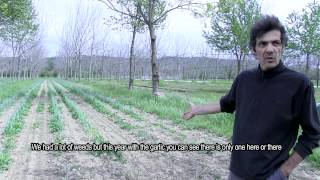
Episode 2 of the (IM)PERMANENCE film follows Richard Perkins as he visits multiple permaculture and low-input farms in France and Belgium. Central segments: Perrine Hervé-Gruyer and Charles (La Ferme du Becquelois) describe converting their Normandy property to permaculture, farm scale and production, and an INRA trial measuring whether 1,000 m² can support a living. Frank Ruhman presents a Belgian community ‘free economy’ farm that reuses surplus wholesale produce and materials. The episode also visits agroforestry sites and Jean Pain/Etienne’s wood-chip composting/chipper work, and seed-savers Kokopelli in southern France. Themes: small-scale intensive production, community exchange/giveaway economics, low-input agroforestry and controversial compost/soil methods.
Questions this video answers
16 hectares
Approximately 4,500 square meters (about 1 acre)
An INRA experiment tracking whether one person can earn a decent living from 1,000 square meters (data includes hours worked and economic viability)
A little more than 1,000 baskets per week (sustained for over a year)
Four people (Perrine, Charles and two hires: one hired last September and another last November)
Chapters
So our journey continues onto the continent where we've come to Normandy to meet Perrine and Charles Harvey Grohra who run La Farm Biologique du Bec Halloween, a highly productive and incredibly beautiful permaculture inspired farm.
So we're here at La Ferme du Becquelois in Haute Normandie in France, Western France. And we started this farm five years ago. When I say we, it means my husband Charles and myself. But nine years ago we moved in a little house here on this land. And our dream was just to be self sufficient. So we first started to grow vegetables for the family. We had a little garden and step by step, Charles kept on telling me, oh, I love doing this, I love growing vegetables, I really love it. He used to be a sailor before, so I think he had the same passion for the, for the soil, for the, the earth than he had for, for the sea. I said, okay, go ahead. I was not that much into it. I was okay with feeding my babies with very good food, you know, organ food obviously that we grew ourselves. I was doing little bit of everything by myself. All the cleaning products in the house, all my cosmetics. And so it was really a dream to be self sufficient. But then he wanted to go a little bit ahead and so I said, okay, go ahead, I'll do something else. I'll give you hints from time to time and then you know how it comes when you give one finger, it ends up with the, the full arm. So I got involved entirely in this adventure. We started to be real farmers. In France. You have to register to be an agricultural farmer. We had this piece of land, we wanted to grow vegetables, obviously we wanted to be organic, that was for sure. We already had a horse, so we worked soil with the horse, but that's it, that's all we knew. And then 2008, we read an article that a friend of us sent us by an email and we found out about permaculture. It was like, wow, this is what we've been looking for forever, ever. Even before, I mean, it seemed like everything in our lives, all the pieces of the puzzles would come into each other. You know, the puzzle was. And it just made sense, that was it. We found out after one full season, one year, one summer plus one winter, that it was extremely, extremely efficient, highly productive. So we were very, very happy about that. It was not all about techniques of things we shall do, even though we immediately started to do things. But I don't know how to say that, but it, everything made sense. You know, the philosophy of life and the philosophy of the Indians, because Charles, my husband, used to live with the Indians in French Guiana. So everything started to assemble. The global design had been made without knowing about permaculture. We started to work on those interconnections on those borders. And we found out that indeed all the borders are very, very productive, highly efficient when it comes to having some bees coming in, having some frogs, snakes to eat the slugs or the mouses or whatever. We find it very efficient to have several microclimates, several ecosystems close to each other, interrelated. The farm itself is 16 hectares, not acres hectares. Here we grow vegetables on only 4,500 square meters, approximately one acre. But we also do vinegar, apple cider, apple juice. We used to bake the bread, but we've stopped, it was too much. But we also sell, for example, jams when we have too much fruits, dried fruits, dried tomatoes. On this very small piece of land, we have several microclimates because several ecosystems, different environments. And we found that very, very efficient and surprising to see the differences between, between one ecosystem and another. So when we first started, it was just Charles, my husband and myself. Last September we hired one person and another one last November. So now it's the four of us. It's a lot of work still, since there was no proper design, as I said at first. So we still have to fix a few things. And even a design is always evolution. So we always have to spend time on things we didn't have to spend time on, like mulching, proper mulching. We had a huge slug problem, for instance. So we have to find the right way to avoid slugs. The information related to our method called terra vitae, because here on the farm, not only we use the permaculture principles, but also we were pretty much inspired by John Jevons, the American John Jevons and Elliot Coleman I talked about earlier. So we kind of mix up all those techniques. We are right now in the middle of an experiment with the inra, which is the French National Institute for Research in Agriculture. The goal is to get to know if on 1,000 square meters, so 1/4 of an acre, one person can get a decent living out of that. And I was very surprised because they are also very interested in not only the. The economic data, but also they wanted to know how many hours we would work. That has to be also viable for human being. How you work, do you have back pain or how do you feel about your work? Are you happy with your work? You know, and it's also about being part of the community. How do you interact with the community here, the village, with the people who come to see you? So I found it very interesting because at first I thought it was only just, you know, data. So what we do with them is that we write every single thing that comes in out. Every single person who works on this piece of land that we have isolated on the farm has to write down every single hours or even minute they work on it. At the end of this year, they're gonna get all those data. So they want to know if one basically, if we could create a job on 1,000 square meter, we think it is for sure economically viable. And they do believe it also because we didn't come out with the ones that square meter. It comes from the French vegetable growers in Paris in the 17th century. Of course, you had horses all over the place, so you had easy matter for easy organic matter. Of course, you wouldn't pay, I guess, a person the same salary than you would do it today. But at that time, they were able to work one man for 1,000 square meters. When you see how agriculture is in France nowadays, it's a revolution because at the moment it's one man for maybe 200 hectares.
Not only is this farm highly productive and very beautiful, they're also producing really valuable research data that's affecting agricultural policy. Preen goes on to tell us about the level of production they've been able to maintain here.
We were able to produce for over than a year, a little more than 1,000 baskets per week. And now we still have two groups of those basket schemes, one here, one in rouen that is 40 minutes drive away. And we are going to deliver one restaurant here in the village, one restaurant in the town nearby, one high school specialize in technical teaching, you know, technical teaching for cooks. So they have a restaurant where the students can practice and the people can come. So we're gonna deliver the vegetables for this restaurant, and we are going to deliver three restaurants in Paris also, and some organic shops here around. So we kind of tend to diversify the way we market the products. Not necessarily profitability, but mostly resilience, because the basket scheme thing is excellent. But you always have to adapt to the fact that the consumer is not used yet or reused, to the fact that you cannot grow in France, at least in Normandy, you cannot grow courgette in February. We wanted to make sure that, well, you can deliver to them, but also to other people. The restaurants, they ask us to produce specific vegetables especially for them. And I have to say I'm pretty happy to diversify and find people who appreciate different type of vegetables. And not only carrots, potatoes and leeks for instance. I think there should be a real relationship between the producer and the consumer, whoever is the consumer, maybe the people from the restaurants. But I think that's one of the key of agriculture because people don't know anymore who produce their food. We have more than 150 different types of herbs. I guess we have 200 different types of vegetables, a little more than 100 species of different fruits. I guess in 10 years time we're gonna have a pretty amazing ecosystem here.
We're super inspired by the BEC Kellogg and traveling on by simple means. We move forward to Belgium where Frank Ruhman's incredible farm has turned into a community practicing a very abundant form of free economy.
What I would like to share with you is bringing people back to common sense, teaching them also day rhythm, grafts, order and all these things. We try to produce as much food as possible. You will see that not much space is left. You will see also there's lots of materials. We are going through place. People bring stuff and we give it to people. And we are convinced that abundance and generosity will guide us over the difficult moments that the banks are creating for us now. Inclusiveness is really the basic drive of this community. We want to include people in our lives and we like people to include them, us in their lives. Giveaway shop. People can come in and just take what they want and that's. Yeah, there's nothing more to it. Here is the stuff where we, these are our, our treasury where we find stuff that we can use. Boxes and bicycles and, and wheels and electricity and plumbing and iron to build things with and wood to build things with and insulation and stuff to make preserves with. We are very heavily into preserving things also. All of this gotten for free. Bruce Lipton has a theory about nature being ordered around on the principle of mutual exchange. And he says that in a cell, when a cell exchanges something with another cell, it usually goes 150 times around other transactions and then only comes back but multiplied by 150 to the original cell. So this is the basic, the philosophical, basic, scientific basic for abundance, for generosity, against all this madness about competition and rat packing or rat fighting or whatever the name is. This is a really lazy garden. It hasn't been turned since 25 years. It hasn't been fertilized for 25 years. I've cut the place now because it was really infested with too much celery and so we started again, but we didn't do anything, it just came back. We multiplied the onions a little bit and we multiplied some of the chard, but that's it. And now the rest comes back spontaneously. Or we do things like we seed five, six salads together, maybe that's one. You have to get closer. We seed spinach and salads together with onion. And then, yeah, eventually comes out in what we eat. We eat and what doesn't, what we don't eat goes to see seeds. And so the seeds fall and then after a few years, the only thing that comes up when you let it germinate are edible things. The caravan is for people to. I always include a few alleys of 3, 4 meters wide where they have the fruit trees and the berries and everything. And then this kind of COVID for the chickens and then chase the chickens underneath the. The fruit trees. And so this way you harvest the fruit and the chickens clean you up for you and no more work for it. This is our version of the forest garden. It's a conversion of a wild thing. Because when we, I was away for a few years, all these trees grew and nettles and everything through the nylon, through everything. And so we fought what we didn't want and we kept the ones that we liked, the white ones, the birches. And we added nut trees and fruit trees. And we also added the strawberry plants now in the berries. But it gives three to five harvests a year of all kinds of vegetables. Now it's onions and spinach and we're planting salads and chard, two kinds of chard. And then after the onions will come the late beans and then after the late beans will come the. What do you call that one? Corn salad in English. So it will keep on growing and at the same time the strawberries will keep on giving. Because the strawberries are a special variety that we have made that gives from May to end of November, non stop. It's very nice, very big strawberries. So. If I go to my ex colleague, my ex colleagues in the wholesale business, organic, well, I get lots of stuff for free that they normally have problems getting rid of because they have to pay for it. And so yeah, we get it and we give it to other people and we use it. And as you see, the shelves are full. And then lots of stuff from the garden also has to be canned and preserved. And this is what we have the breeders for, which again, it's like the other things, it's all in a chain, all going around, all Networking. We get lots of alternative. How do you call that one? Cosmetics. And we give them to women and to women with babies and everything. And it's an unending chain. In a sense, of course, it cannot go on forever because the wastefulness of this society, this economy is absurd, totally absurd. Cannot go on. But on the other hand, it would be stupid to let it go to places where they crush it and destroy it or make gas out of it, as you say. I would think that's a waste. And here we can recycle it. One of the things that is also very special is that people have to put dates on everything now. Like olive oil. We got a few hundred liters of olive oil here and olive oil stays good for 2500 years. Yeah, it's good. It's good to sting olive oil goods till 30th November of 2010. But we fish boats out of the Mediterranean that have been sunken for 2, 500 years now. And we take the olive oil out, we unstop the amphora and we. Oh yeah, with a nice smell. It has still amazing. But that it's not passed through the European commercial. Okay. You go to as big the place, as big as possible. The producer is better than the wholesalers. The whole sale is better than the shop. Yeah, but all levels are good. Yeah. So wherever you go, you say, look, I see that you are. That your olive oil is out of date. What are you going to do with it? Can I help you? And they will say, oh yeah, we think we can still sell it. Okay, keep it. Okay, no problem. You come back half a year later, you say, did you eventually sell the olive oil? So now it's still on our hands. I'll take it off your hands. Deal. Done.
How much do you reckon it cost to run this place? And like on that, on the scheme of growing things and like having all this food you can get for free and skipping.
Ridiculous. Totally ridiculous. It's a few tens of euros for electricity and a few tens of euros for gas. Toilet paper. That's we have to buy also. What else do we buy? Rice, pickles, cereals up till now. But as you will see on the other field, we are now growing our own cereals also. So eventually that will phase out also. And that's about it.
I think what I'm amazed about is how much food that they've got today. I've just picked up a skip load. 40 kilos of asparagus. This is all organic. It's not from skips and chocolate muffins. That are processed. This is organic produce that's still totally good to eat. There's some cauliflower here, perfectly fine. There's nothing wrong with that at all. Then they've got about 60 kilos of tomatoes, some of which are squashed but still fine. There's about 20 or 30 sacks of red onions that are totally fine. There's about 60 kilos of broccoli that's, you know, totally fine. There's nothing wrong with that at all. There's 30 crates of potatoes, there's bananas that are just ready to eat. And this is just from one day at a wholesale market. And it's free food and more than they can eat. And this goes on every single week. It really highlights the power to us of cultivating relationships. And here it's the greatest example we've ever seen of really working a free economy. Packed up with olive oil and fresh fruit and vegetables. We're headed off to Luxembourg to pick up our dear friend Marco to head down to Vezenobles in the south of France where we're going to meet up with Dennis Flores who's got the oldest established agroforestry site site in front.
Of.
To do.
If I are mukuderos. Don't Cesar. To Matania in the north. Mayor saraska. Tv.
It.
Pure. The oppressive.
There.
Donalis ramona ramondo. System actual.
Me.
The kiwa.
It's really great to see another really well established agroforestry site. And this model really resonates with us because it's so applicable in so many conventional agricultural cropping scenarios and with really low capital energy and time inputs you can reap so many obvious beneficial rewards. And it seems that this is the kind of strategy that's going to be easily implemented to cautious and wary farmers who are often skeptical of new techniques. On the theme of controversial farming, we're close by to Jean Pan's company that's now run by his nephew Etienne, producing the world's best chippers and controversial wood based compost that baffle scientists even today.
The. Toxic porcelain.
Normal.
Debut. Animal.
Machine.
Champignon bacteria Microorganism. No comment. Energetic brute. Dong direction Microbiologic bacteria Champagne Bacteria Polashaler Champagne Temperature in evaporation low.
Whilst we regularly heat water with these piles, we've never found anyone producing reliable methane. I asked Etienne what considerations would be important.
See the count Climate. Plastic. He necessitated the compression. Non security. Electric correct. Carton.
I'm really intrigued by Jean Pain and Etienne's work. The quality of their chippers is definitely unparalleled in the quality of the compost that it produces is definitely good, even if it baffles modern agronomists. One thing is for sure, we know so little about soil, and yet we rely so fundamentally on it to produce the plants and feedstocks that we all rely upon. And on a fitting note, we're ending this part of the series by going to visit Kokopelli, who are famous seed savers also in the area in the south of France, dedicated to sharing heirloom varieties of seeds before before we lose them all to thwarting EU regulation.
La.
Duration Temperature. Objectives. The particular. This month. Mrs.
Months. Pop.
Distributed.
Sam.
Sa.
More from Richard


A review of short and intensive season on a mixed farm and restaurant/event space in Sweden






Alskade Kyckling Exploring complexities of poultry production in Sweden and what we stand for


