Incredible wind storms and super strong caterpillars...
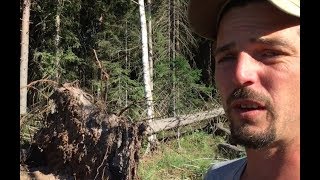
Richard Perkins documents a chaotic week slaughtering poultry, smoking chicken, selling breeding pigs, and running a market-garden training. A severe windstorm knocked down trees across the farm but left his caterpillar tunnels standing, which he credits to their solid build. He's selling the tunnels and watching for birds of prey as signs the ecosystem is recovering.
Chapters
So super busy week. We've got turkey slaughter, chicken slaughter tomorrow, turkey slaughter again. We just had a busy open day and we're preparing for our last training of the season. Next weekend, the market garden intensive focused on no dig, profitable market gardening. It's going to be awesome. So a little update from the last couple of days. Sounds like a mix with mustard greens. I think it's this. Well, it's blowing the gale. He's past like an hour or so. Some trees down here, big tree down over there. And just see here you see some arching, but it's not really blowing this second. The trees are going right over like this. Just checking all the animals aren't blowing away. We also lost the amalancha in the garden. Well, we're having a mighty windstorm. We get a few of these a year sometimes just blowing down this amalanche that's 25 years old. Caterpillar tunnels, no problem at all. Now all three caterpillar tunnels have had a couple of wind storms like this. That really makes us feel sure, Yeah, super impressed with the stability. And so I was starting to do some smoke birds for selling at the open day. I got 50 birds that I've brined overnight. Now I'm just letting them drip and dry off in the chiller and that's just to dry the skin out. Now I'm also conducting a bunch of research right now weighing some of the birds before they go in. I'm weighing them after brining, I'm weighing them after smoking, and then I'm picking all the meat off and weighing what flesh comes off, as it were. We're thinking of starting a new product for restaurant customers where we take the meat of smoked chicken off and pack it in kilo bags, offer that to private customers and then offer 10 times 1 kilo bags to restaurants where they can freeze it for up to a year. And then they can also just take it out and use it straight away. Some people ask why we do smoked chicken, thinking it's an unhealthy product. I think it's a delicious niche product. No one else is doing smoked chicken in Sweden and I really love it. I think it's a wonderful product. But the great thing about it is it's pre cooked and that really reduces the risk of handling chicken, which some kitchens can't cater for. Whereas with a fully cooked product the risk is much lower. You can simply refrigerate this for up to a month in a vacuum pack and then I think seven to 10 days once it's open again. And just put that in salads and things without any hassle or preparation. So it's an amazing product. And this is the beginning of experiments with that to collect data so we can anticipate weights and arrive at the price we want to sell it. So lit the fire again in the smoker and got some birds loaded in. It's not totally full, but these are for sale tomorrow, the open day. And I think they'll be done just as people start arriving so we can have a look and let them cool down. Beautiful. It's time for Reuben and the big sow to go. We're actually selling one of the breeding sows and Reuben, who's been our faithful boar for several years now, we're selling them off. We're clearing the farm of pigs. We need to regenerate the forest after cutting this winter. So we're really clearing out livestock this winter. It's a big change for us. But we need pigs out to allow trees to grow. Now these are some seriously big pigs. Reckon Reuben weighs 300, 350 kilos easily. Pure muscle machine. And big mama, I would guess she is 240. But I'll be very sad to see Reuben go. He's fathered a lot of pigs here. And what an amazing animal. What are you making? We're making levain sourdough buns for the open day for smoked chicken sandwiches. Now I'm gonna split the dough into three parts so it's a bit easier to work it. People are eating chicken. Smoked chicken dinner in the yurts. These guys are making smoked chicken and Rutsdale salads and homemade Nicholas's sourdough buns. Look at this. Epic eats for. Like. I don't know where to look. Check out this little fella. It's a young buzzard, probably just about to. And her mother just came and landed in the tree next to her and they took off together. I'm out just moving the turkey fence and bringing it back up to the farm to have the turkeys right in the middle of the farm ready for their one bad day. But it's really interesting seeing so many birds and insects and things coming back to the farm. If you've got breeding apex predators on your farm, something's going right. Every time you bring a species to a place, you support the conditions for at least seven more species to exist there. And we need to start judging the success of our farm by how well the predator populations are doing. Now. It'll take some people a decade to get their heads around that. But it's an important thing to consider. For me, it's totally okay to have predators around. And I don't even mind the occasional loss to a predator because I feel like it's such a fundamental part of ecosystem health that we need to really, truly appreciate and understand. And personally, I've got a massive admiration for birds of prey. I used to always want to be a falconer and I ended up living in a country where now, in a time in my life that I could actually commit to something like that. This is one country where you're not allowed to keep raptors. It's a childhood thing for me. I used to walk in the hills in the Salisbury Plain where I grew up, and I used to fly fish for trout. So I would take the heads and guts of the fish that we would eat and I would actually feed birds of prey. And I got a very nice relationship with the buzzard in the village where I grew up. And I used to get very close to it and developed this relationship with this wild bird which, you know, it stuck with me. I was quite young, I was a young teenager, but I always wanted to have a Harris hawk or something and go out hunting here. It would be good to hunt voles actually eating all our trees. Well, it was quite the windstorm yesterday. We get these windstorms a couple of times a year with gusts at 15 meters a second. And it's taken down a whole load of trees. We're felling this in the winter, but it's taken down. There's some leaning against other trees in the background. I'd say we've lost 20 full sized trees. You see how shallow the soil is. Here we are farming on. Basically the deposits left from this was all underwater 10,000 years ago. And so we have different soil types all over, but deposits of rock and silt. And this is just sand and stone. And this mighty tree is growing essentially in, you know, 15 centimeters of topsoil up on this stony ridge. But we've got trees down over our fences. One fell down, just missing the tree house. Now I'm gonna be cutting everything inside the fence over here to not include my tree house, which you can just see in the background. But one tree fell down, just missing that. So look, some mighty trees falling down. And this tree has ended right at the tree house. So I've just come down to the farmyard and I'm cutting up this tree. This is an old AMALANCHE that's probably 20 years old now, but that blew down yesterday also. Caterpillar Tunnels are solid. This is the 20 meter one. It's facing broadside to the wind and just didn't move at all. And we use rocks at the end there just to hold down the very end piece to spread it out to make it cover the ends of our beds. But we don't have any weights on the side. We just have our strings that go down to the anchor points. That's it. That's what we've got on all the tunnels. We'll go and check the other ones as well. But really impressed with the performance. So over on the north side we've got the 30 meter tunnel here and the 40 meter tunnel over here. And really no problem at all with the strong winds. Now these get a little shelter from the buildings, but actually it makes turbulent squalls after the air has come over the building. So they do get quite a hammering. We pull down the sides in strong wind events just so that it's not acting like a sail. But as you can see, it's not actually pulled right down to the ground. We don't use any sandbags, anything like that, which is an option for you if you are concerned. Obviously you want to observe the performance in winds, but super impressive. I mean it's just the strings holding it down, but because there's so many points of contact with the material, it's incredibly strong. We've not adjusted these in four months now through the initial setting up process, you're putting the string on and then you go back and tighten it all which gives it that zigzagging caterpillar look. But we haven't touched it since. Okay, this is called Walking The Turkeys Part 2. See how this goes? They're slowly coming. They want to forage. But if the leading ones see that they've got feed here, the others start to come. Bit of a traffic jam here as we come out of the field into a slightly wooded area. They quite like this environment, but we got to get them now over a bridge, up through top field and all the way up the road to Buckyfield, the orchard planting. So bit of an adventure. Russell in the undergrowth. So we're up in top field with Lucas the turkey whisperer. We're just steering them. We've got sticks in the hands and birds are very easy to steer. If you show them one direction, they will turn the other direction. So our job now is just focusing them on heading the right way. We've got a long way up to go up near that caterpillar tunnel and then we'll Come back and get the energizer and waters and the gobbledygo and they'll settle into their new residence for the next couple of days. They'll all be processed before Tuesday, hopefully. Home stretch about 80 yards to go. The white one's in the lead. Okay, it's the final approach. 20 yards to go. The neighbours trying to get through. Some of them want to sit down and rest now, but I think they'll make it through and then we'll go get the gobbledygo and some water and refreshments for this lot. So we're putting them in here just for ease of catching them for slaughter. We start slaughtering tomorrow and we'll do chickens Monday and the rest of these on Tuesday. People are camping in here for the market garden course, which is happening next weekend. So we don't want them to leave too much manure. But I'm going to cut the grass anyway, so. So half the turkeys going this morning. So Reuben and the Big Sal are in here eating apples. They're off to a farm a few hours away. So big chapter change today, seeing these folks off. It went smooth. We got them in no problem. Which we weren't anticipating it to be easy because Reuben's big enough animal that he doesn't want to go anywhere. Not a lot you can do about it, but it went quite smooth. So we're doing turkeys today, then. We try to keep the turkeys between four and a half and six, seven kilos dressed. Obviously a big differentiation between the hens and toms, but that's the feedback the customers give us on what they can actually fit in their freezers. So turkeys are a little bit different to chickens in that we take off some of the larger wing feathers and tail feathers before it goes in the plucker. But the process is very similar. I use a slightly different knife. It's like a hunting knife for cutting down the stomach of big animals. Front end is the same as any other poultry the crop is stuck on with a lot more fascia. See this spider? Webby fascia in here? It really sticks out together. So we separate the windpipe and esophagus, like so. Take the neck out, just like with the chicken. But then this process is different. I lift the leg of the bird up and cut just below the keel there. And then I use this knife. You can use a normal knife. If you use a knife like this, you need to run it backwards so you're not cutting down into the guts, you're cutting along. You can open with your finger, fingers and pedal on. But this knife has a protective edge so you can just chunk down the side and then I'm straight in there. And turkeys are much easier because they're so big. You get your hand inside and you can take out and check the heart etc. To see that it's all healthy. And then the next are quite substantial. So these are delicious roasted. So we'll be putting them and roasting them up. Beautiful big birds. Gonna pack them tonight because we've got to get the birds out the chiller to be able to do chickens tomorrow. Nearly 300 broilers to do tomorrow and then we're doing the rest of the turkeys the day after. So it's a pretty full on week and it's quite intensive. A lot of interplay with life and death on the farm. It's always interesting, you know, it's a big part of our season and what we do and just had Reuben and the boar, sorry, Reuben and the sow taken away today to another farm a few hours away. And that marks the end of a chapter for pigs at the farm. We're gonna have no pigs after probably October time hopefully. So, yeah, things are moving along. We had a great open day with not so many people coming out as we've had in the past. But it was a lot of new faces, which was amazing. It's mostly new faces and a couple of old friends at the farm. But the weather looked like it was going to be quite poor. So I think that put some people off. But we had fun and nice talk about what we're up to and show around the farm. And we were serving some freshly smoked pastured boilers and lunch made entirely from the farm as well as selling a bunch of products from the farm. And yeah, it was really good fun. I really enjoyed it. It's always nice to open up the farm gates and let people have a look into what we're doing and why. But yeah, we're just having a week getting ready for the market garden training that's coming up and I'm excited for that. It's quite a busy training. It's just a weekend intensive, but it's the last training we're offering this season and yeah, winding down a bit. The nights are getting drawing in. So now putting poultry to bed at 10 o' clock at night, it won't be long before it's, you know, early bedtimes for all of us. And with that change of season comes this change of rhythm in people too. It's when we start taking longer hours of sleep and it's all quite natural now. We have extremely long hours of sun in the middle of the summer and we work really long hours. But as I said before, it's like we've tipped over that midpoint of the season and the days start to get shorter and we start to get tired. And I'm looking forward to time out this winter. Good news is I got pricing on the Caterpillar tunnels now, so I'm actually working on getting that information out in a couple of weeks. I hope still that people can start ordering the tunnels anywhere in Europe. We've still got to work out shipping costs for every different country, but it's really awesome. I think it's going to be a really high quality product with lots of optional extras. And yeah, I'm excited to bring that to people and still working on a bunch of other suppliers for things, but excited to keep you updated with these other projects that are coming about. So thanks so much for watching, folks. I'm just having a bit of rest before we go and pack some turkeys. And I'm actually just inspecting the tree house where this tree just missed the tree house. Look at that. But quite a lot of trees. I've got to decide what to do with these. There's maybe 15 big trees that have come down pretty crazy. We've had a lot of storm winds and typically in Sweden you have this domino effect when someone cuts their forest and then the next forest falls down. But these trees are actually older than the surrounding trees, so they've had many wind storms like this. But this was an exceptionally strong one. So, you know, it really gave us a little show of how well the. The tunnel stood up. Look at this. This is the top of that tree. Count myself lucky that time.
More from Richard


A review of short and intensive season on a mixed farm and restaurant/event space in Sweden






Alskade Kyckling Exploring complexities of poultry production in Sweden and what we stand for


