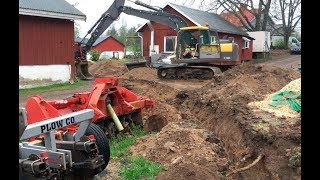
Richard Perkins documents installing frost‑free water taps for a slaughtery and a mobile kitchen on his farm. He demonstrates trenching about 1 m deep, locating existing buried services (fiber, electricity), fitting a frost‑free valve assembly (25 mm riser tied into a mainline using adapters from an old 28 mm pipe), and testing the self‑draining operation. The video also shows the new kitchen setup, plans for smoking meats, and brief farm schedule notes (chick and layer arrivals).
Chapters
So in today's video we're putting new water to the slaughtery and to our new kitchen in the little mobile behind us there. It's a big upgrade for the farm to have frost free water in multiple places this year. Digging water pipe. We are trying to find the connection between this tap which is a frost free tap, and the barn which is frost free tap over here to be able to add in a line. We want to put a frost free tap on the edge of the slaughtery and on the new kitchen over here. And that should allow us to smoke meats and do prepare meats in the winter and have water on the other side of the road. They come and they always mark out. This is fiber optic here and they mark out electricity lines and telephone lines etc. So firm fiber optic. But the cable that marks it should be about 10 centimeters above the actual fiber optic. And it was sitting like on top of it. So very lucky we didn't break that because a few thousand euros to fix that very tactile machine. All diggers in Sweden have these ankle buckets so you can totally manipulate the bucket in any way you like. Sort of a virtual sculpting machine. And I'm in the trench just getting rid of any rocks and I'll dig around the cable by hand just to ensure we don't get that. So we're going about 1 meter deep to put in cross free water. And this is where the water comes up into the slaughtery at the moment. But we'll be putting a frost free tap so we can operate it in the winter time. It makes it look easy. So this is what we have for frost free water here. This is a valve and I've just welded an old socket onto a metal bar to use. This will be underground inside a 120mil pipe vertically so you can turn the tap on and off here. This is just going to be 25 millimeter pipe coming up to the tap and then this is joining under the ground to the mainline. So that's just gotta go on like that. And that's how we do frost free water. We bury it about a meter deep and that's fine for us for our winters, which means we'll have access to water in the other kitchen and the slaughtery in case we want to be doing smoked chickens or smoked meats during the winter. But we can always turn it off and drain the system. So little simple things but big upgrade. Very glad we've got the machine because this would have all originally been dug in by Hand by some burley farmers. So I'm just welding up a little key. It's just a socket and welding stainless to non stainless which is always a bit silly. But you see that fits the tap nicely. So that will be the mechanism. So a quick cup of teeth and we'll get these installed. So we're leaving the road till last. This is the water from the pump and there's more water, more electric on this side. So he's been really careful to go past that. And then the old pipe is 28mil so we've had to use these adapters to get us down to 25mil which is standard nowadays. And this is going to run off to the slaughtery here and then we'll run one off this way. So I'm going to get cracking to keep up with him. This gives you a good sense of the soil type here. Now this has been addressed driveway for a while but we have quite a bit of clay topsoils to about here. Not very deep and then it goes into just pure sand here. This is just sand with a lot of rock. I'm hitting the sort of base gravel. This was all underwater 10,000 years ago. So it's new land. So you see from videos in the past where we've really built our topsoil in the past. This is generally what it looks like all across the farm. Like 18 centimeters or so the topsoil. Very different compositions around our feel. So frost free water. It'll pop up to the slaughtery there. And now we're ready to get the line in. As soon as we've gone across the road we'll get that crossing over. So I reckon this was an old well and there's a bit of a crisscross with an electric. It's a big electric line, water pipes, more electric. Fiber optics, more electric because they didn't mark properly the old telephone cable that's not in use. It's a bit of a jumble down there. And we're taking it over here now to the wagon which is becoming our kitchen. We'll have a look in there. Bit of a jumble but that gets us to the wagon. Okay, system is in. Just testing. We have water coming out this side now these frost free taps, they must be. See I've started turning it off and it starts draining itself. So you must have it fully on or fully off. Now the water is draining out of this section of pipe and that's how it remains frost free and winter accessible. So in a second that should stop running just Quite a bit of water in that pipe. And it comes to the end there. Beautiful. Time to cover everything up and we're good to go. So we've got a daylighting here. Couldn't get much closer because the big rocks now it's just covering up going. Need some more gravel on this drive but the road's back open again so soon. Done. It's not bad for a morning's work. Part of the reason to put water in this way to the slaughter is it has a backtrack around the back of the farm and the authorities wanted to have water directly to the slaughter for water control issues. We spent, you know, thousands of euros on water control issues just checking out the smoke. We brought back a lot of hams today from the freezer space and we are smoking ham so we can serve cut sliced ham for breakfast. So we'll be putting the smoke on again soon. I'll do a video about how we do hams shortly. So this is the end result. It's a little bit muddy. We're just going to let this settle down for a while and then we'll put some more gravel down. I expect A little bit muddy over here but pretty good going to get that done. We're a little bit far away from the wagon here, but that's okay. We'll just run a line out to here and this is becoming a new kitchen space in this wagon. Just to allow us more space. We've just been setting this up. It's just a small space but it'll do. Got an extractor in here and put our old sink in here. So we've just been fixing this up. Got to get the electric sorted. But that allows us to basically have this operational beautiful view. Vegetables coming straight from the garden to the kitchen and we've got a new little roof. We've just set up really low cost developments like we always do. But these little things that will allow us a lot more stuff space to have the washing up station down here out. It used to be right in front of our house and to have a kitchen in here so that the interns can cater for themselves makes a massive difference to us. And it's those little things that we're doing to create quality of life for ourselves after several years of just really working too hard, I think. So I don't know if that will interest some of you. I just thought it'd be nice to make a quick little video of some of the, you know, behind the scenes things that go on before we really ramp up productions it's this next week now we've got to basically get the yurts up. We've receiving all the hens, We've made the brooder. I'm going to go and show you in the brooder now. We've just basically lime washed the walls again and cleaned all the drinkers and feeders and put the lights in. Just got to sort the cables out, connect them up. We've just rebuilt this space. It's been empty all winter, but first chicks arriving on the 20th in here and we've got layers arriving on the 14th. So that's exciting to get the whole farm rolling again. And then basically this space is we're doing less poultry this year than we have done in previous years. But we're also going to be getting turkeys as five week old poults like we usually do. But then the second batch of turkeys we're getting as day old chicks. So they're going to take the extra brooder because we're not going to be using that for boilers. But just getting all these spaces set up. I'm not sure if today's video will interest some of you, but I thought it's nice to just make little clips in the time I've got. I think once the season's really rolling, I'll have more time to make regular updates with all the different things going on. But my days are pretty full at the moment. And a big change in lifestyle this year is I'm taking dedicated hours with our son Ragnarok every day. And so I'm off the farm for, you know, a dedicated few hours every day, which is a big shift and a big change for us. And that's, you know, part of addressing our holistic context, which has always been limitations on time. But I hope you found that useful in some way. Give it a thumbs up if you enjoyed the videos. Don't forget to hit subscribe if you haven't already. And we look forward to seeing you in the next video. It.
More from Richard


A review of short and intensive season on a mixed farm and restaurant/event space in Sweden






Alskade Kyckling Exploring complexities of poultry production in Sweden and what we stand for


