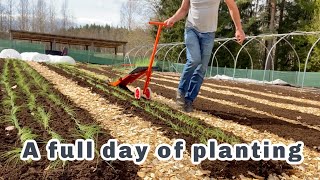
Richard Perkins demonstrates preparing and planting multiple garden beds using mechanical and manual tools: he rakes and tills beds, uses a bed roller to mark rows and provide surface compaction, and seeds with a Jang seeder (different rollers/gears for carrots and radish). He also transplants spring onions and leeks using a paper-pot transplanter and does hand transplants for brassicas and salad greens, covering beds with simple hooped fleece. The video includes practical settings, seed amounts, spacing choices, and logistical notes about farm tasks coming up.
Questions this video answers
16 beds to prep.
24 beds planted out outside.
Glazer rake, 75 centimeter.
About 30 grams of seed for the bed.
X24 roller for carrots with 11 cm (front) and 13 cm (back) spacings.
Chapters
Welcome back to another video, folks. Lovely sunny day. The transplants that I put in the other day are doing fine under the covers today. I've got 16 beds to prep and we're going to use the paper pot seeder, the Jiang cedar and we're going to do a lot of transplants too, so let's get cracking. So I've added a bit of compost and I'm just using a Glazer rake, 75 centimeter rake, to rake it out even ready for the cedars and transplanting and to just get the bed at the right width. Okay. Famous Swedish red paint. Yeah, Fallow rod five. So we've got all the barns and all the roofs to paint this here. It's going to keep us busy. A lot of people ask why all the buildings are red in Sweden. It's originally a byproduct from mining industry and well, it's pretty good. It's pretty pretty. So I've actually bought a sprayable version. It's not so good. It's thickly painted by hand. But if you figure how much barn space I've got to do the time saving, even if it only lasts half as much, it won't be five times quicker. So suits me. Got to keep this frost free. So I'm going to put this somewhere. Haven't decided yet, but too much to do in the garden. So you saw me just raking out the other beds, but there's some harder clumps and lumps in the compost. So in that case I just take the tiller. This is from Johnny Seeds. It's got a high powered Bosch drill that I'm putting on the slower speed setting, high torque and I'm just going to go over all the beds. I can actually use this back plate to form the bed neatly and then maybe we'll rake it afterwards, we'll see how it turns out. But that's going to break up those lumps really well. Then I'm going to put the bed roller over the beds to mark rows and also put a little bit of surface compaction back on, which really helps when using the Jiang seeder or the paper pot transplanter. So I just wanted to show you can be pretty accurate. I'm going down the center of the rows first to break up any lumps and then I'm creating one edge, then the other edge and you can see it's a pretty nice way to lay out nice straight bread. So that I basically don't need to use rake on this. So I use the bed roller to give a little bit of surface compaction which is ideal for using a Jang seeder or the paper plot transplanter. And it's also marking rows simultaneously. You can move these green bands. They're just simple quick connectors so you can mark different row spacings. But that little bit of surface compaction is ideal. It's going to allow the Jang seeder to get really good contact as well as the paper pot transplanter. And you can also put bricks on top of this. This is from Johnny's Tools in America. You don't need one of these, but I like it and so I use it when I'm prepping beds. It's a bit awkward to use with one hand but you can see you can really effectively mark out. And because it leaves these other cross shapes, you can see spacings along the row which is handy. So not a tool you need. This was actually an Elliot Coleman design from a tool he saw used in Germany that they don't make anymore. But because we're doing transplants with the paper pot for the leeks and onions and we're going to put in carrots and radish today, I wanted to get good surface markings on all these. So we'll run through, do all these, Ah, even more deliveries. This is a big box of microgreen seeds from Suba Seeds in Italy. They're a good supply of micro green seeds. And then this is dried goods for cooking dried pulses, grains, etc for feeding the crew getting from Biodynamic Products over in Yana where my books are sent out from. Okay. During cedars. So this has been set up for radish and you've got these different gears that will determine the row spacing. So carrots here I'm going with the X24 roller and I do 11 and 13 as the spacing and 11 on front, 13 on the back. But right now I'm doing radish. So that's using the F24 roller that goes into here and I'm using 14 and 9 on the back and that's going to allow me to get five nice rows of these per bed. So I'm putting about 30 grams of seeds for this bed and then obviously we can set the depth by adjusting the shoe one of a couple of centimeters. Compost can dry out quite easily and so it's important to get them deep enough. And also I'm going to put on a fleece cover directly on the ground flat and use that to hold water in well and just take care of watering them every day. So we'll get the first beds of this in and then we'll switch the gears and the roller, get the carrots in. All right. Next up, paper pot transplanting. We've got. I'd rather spring onion and leek to go in. Okay. A few things to consider. This tool's 45 years old on now. It was designed for planting onions. Normally I will trim spring onions. It helps encourage them to bulb up. But we have a lot and actually not so many people do eat them. So I don't need them to bulb up. And so I've been lazy this year. I haven't bothered trimming them at all. Just using pegs to pin the first row in. Three rows to a bed. That's two trays, four beds of that, three beds of leek down here where you set the depth. I'm on the third notch in composted beds. Pigs. I'm collecting tomorrow. Maybe gonna have to delay that till the weekend because we've got the wall to finish building in the natural swimming pool. My neighbor's gonna come help me with that. I've got to go and pick up the kids now. And then there's a bunch of hand transplanting to do afterwards. On to transplanting. So. So onions and leeks went in. Leeks needed a bit of patchy covering up. They didn't go in like the spring onions, which were perfect. They just take a dream. Two beds of green cabbage, purple cabbage, and we've got more spinach. And then this is a mix of scarlet frills, mustard greens, mizuna lettuce. Just scraps. I'm going to fill these up with cabbage. Three rows at 30cm. I've only got 64. Technically I need 72, but that's no problem. We'll just space those out and then we'll get some of these rows covered up. You can see simple fleeces. I use 11 hoops for each bed. This is just 4 millimeter wire. So you don't need to go out and buy yourself expensive cloche hoops. What you want is just 4 millimeter galvanized wire. Comes in kilometer rolls. Cut it into a meter and a half and that creates these tent like structures. Different fleeces. Got lightweight and heavyweight fleeces. I'm just using up the materials as I find them. And then we've got to get some water down. I'm just using the, don't know what you call it, this water because I haven't got the pond system set up yet. So we'll get these in and that'll do for today. It. All right, that's a wrap. 24 beds planted out outside. And tomorrow we're getting all of the squash for storage for the tunnels put in. And we've already put in the cucumbers and all of the melons, watermelons and other melons. That's super exciting. Just a few days till people arrive. I hear the pigs. I'm collecting on Saturday. Tomorrow we've got a hard day's work finishing off the brick wall in a natural swimming pond. And that will then facilitate once the insulation arrives. Putting in the insulation, shoveling the soil, leveling that out into a perfect pond shape now and that will really start coming together. Then of course, the really big job of putting in the liner and underlay. That's going to be origami on an epic scale on very heavy material. So for sure going to film all that when we get to that. Thanks for following along as always, folks. Hope you find that interesting, inspiring, useful in some way. I'm growing a lot of food, even though there's only going to be 5 adults, 12 kids here this year. But it's very easy to grow the food for a family, four or five people, it's pretty easy. You don't need a lot of space. Ten of these beds would be ample. If you plan well, you can grow pretty much all the fresh veg you could actually want. Thanks as always, folks. See you in a video soon. Don't forget to check the links below, like subscribe, blah, blah, blah, blah, blah. Ciao.