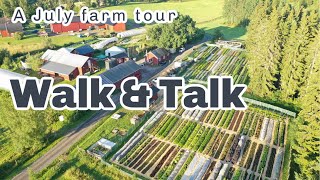
A narrated farm tour by Richard Perkins (YouTube video) in mid-July showing the farm’s state after permaculture/regenerative agriculture training. Covers composting, garden yields (leeks, squash, beans, berries), livestock grazing and rotation, tree and hedge planting (willow, spruce, alder, chestnuts), pond maintenance, and considerations for crop choices (e.g., aronia). The video mixes practical tasks with planning and reflections on farm progress and documentation.
Chapters
Welcome back to another episode, folks. It's the weekend and I think I'm finally recovering after the farm scale permaculture and regenerative ag training. It's always quite exhausting experience, but we had a great time. I thought I'd take some time to show you around the farm how it looks in the middle of July. Empty and quiet at the farm. It's very different after the huge amount of influx of people and energy. Okay, off to the forest tomorrow. Just cutting the grass down up to the pond. This little one's an escapee. Watch out. What's up? So top fill. Couple of weeks later, we laid this down. This was up at shoulder height and you see new grass coming through. But under this is just thick litter there that we've laid down and it's nice and moist. The spider in there after a hot sunny day. That's perfect. We want that on the soil. No wastage, is there? So compost base. It's time to flip this, which is this year's wastage from the gardens. And some bedding and old silage. And we need to flip this over now into the new pen. And that will have a couple of turns before that's ready. And then we want to sieve this one. It's just covered up with old sheep wool. But this has developed into really nice material. Full of worms. Really fine. But it needs a good sieve because there's bits of gunk people have thrown in there by mistake or bits that are just too big. But there's probably 6 or 8 cubic meters of very beautiful compost under here. So we'll be getting sieving through that soon. So you might have seen in the aerial flyby. Gardens are looking in full abundance at this time and we haven't been irrigating at all because it's just been so much rain recently. Leeks developing nicely. Lots of paddy pan squash coming out of here. Lots of really nice carrots. Purple carrots have done extremely well. Lots of beautiful onions. We actually ended up getting some more wood chip just to fill in the edges that we cut out this year just to get things neat and tidy, how they should be next. Succession of crops ready for the autumn has gone in. Still got more weed than normal. We've got a lot of tree seeds, but I think you can see it's pretty tidy in here. Despite that little spruce seedlings that will come out when the beds are turned over. Hopefully we get a late summer again. Got really nice purple beans coming out of here. Beautiful kales, Few cherries coming. But it's berry time now. Here's the tree line in front field. Just look at the loading on these. Been picking some and they're not perfectly ripe in places, but now they're really coming on. There's a huge amount of berries along here. We'll probably sell some at Rico. We've already filled our freezers for enough to last us eating fruit every day till next year. A lot of strawberries and berries, but too much to harvest just for ourselves now. Not a huge amount for commercial use. We've already taken red currants out of here. A lot of berries. If we go crashing through the windbreak, You see that the neighbour's land has all been cut now for our winter haylage. So There's a good 5 hectares down here cut. We left the small field that we come into straight from the neighbour's property just to make sure we have enough grass to let our land recover. But all the bailage is done now, finally, and all our winter feed secure. So this is Salix and it's a Viminalis, the big one. It's the hybrids biomass willow. Just have a look at this. This was cuttings seven years ago. Put on a huge amount of growth down here. It's really creating a nice windbreak already. Now we were starting to cut, but we've decided to leave this up because it does provide really good windbreaking. Just cutting straight into black plastic and zero attention beyond that. On the inside we've got this spruce. Pretty much the only time I would choose to plant spruce. And they're designed to grow up big and tall and bushy to give us winter protection when the leaves have obviously fallen off this. Then alder on the inside that was planted later as little whips and they're growing up to 5, 6 meters now. They will hopefully create an arch ramping our predominant wind right over the field where it will hit the riparian and a hedgerow and keep buffering us from the wind, protecting all of our fruit tree blossoms in here in front field. So cows and sheep did their job very nice. Now I'm thinking of clearing some of the pond weed in here because it's starting to really smother the pond. I'd like to have some good open water for the trout in here to be feeding. So I'll probably take a rake and pull some of the material out, leaving the lilies. Cows have gone off up into the forest paddock. So every year is very variable with the weather up here. This year seems to be a great Year for tree growth. You see on the aerials from the other day, the nut trees really showing themselves now in nutfield, and really good growth this season is pecans and black walnuts, English walnuts, sweet chestnut. And really starting to see the structure of the savannah now. One day this will be full of woolly mammoths or a woolly mammoth if I get my way. There's some really nice big trees now, just for reference, this tree is way past me now. So last batch of broilers out. Little chestnut there, another chestnut here. So we've got these birds out young because they seem to be a bit crowded in the brooder. The chicken's been selling really well. We basically have no stock of chicken, so could have done more this year, but we wanted to take it easy because I was not planning to be here. Layers are doing great malicerversii here, the original Kazakh apple, more chestnut, more walnut there. And the second flocker up on the hill behind us. Something we've been really looking at during the course is just how. It's really hard to describe how good our grass has become compared to the neighbors, because there's only really the field up here that I sometimes reference in videos to compare it to. But we've grazed through here multiple times with cows and sheep, had broilers and layers through here multiple times, and our grass is still much better yielding even before it's fully recovered, than the neighbours. It's. It's pretty unreal, the power of chicken, as I always say. So top field recovering very nicely. That clip is from the bottom of the field where they were last. But add another 10 days to that and you start to just have beautiful flowers. Flush of grass. Now, this isn't recovered yet. There's only perhaps two, maybe three true leaves on these plants, so we want to give them time. So we've got them in the forest paddock and we're going to take one other forest paddock, then the neighbours land before coming back through here. Been talking a lot about what to do with the tree lanes where we've suffered hazel damage. If everything had not got hit by voles, we would have a bank of hazel at the back here. But you see, they've devastated a bunch. So we're thinking to put maybe aronia in larger numbers along the back of these lanes because it does really well, it requires no care at all and it would give us a very abundant yield. And whilst aronia is not the most useful crop on its own, right, it's typically made into jams and things There is a big market for it for distilling locally. So we're looking at the possibility of putting in a lot of Aronia to have a low care but high yielding berry that is easy to pick and comes at a later time than the rest of the picking and give us some commercial yield there. Not sure yet, but that's thoughts that are going on. Just look at this, sitting down on all this laid down mulch. Beautiful. So we're using animal impact as well as grazing and this is armored and active however hot it gets during the day. And we're going to have beautiful pasture growth well into the late season, into November, early December, hopefully. See if we can get close without disturbing them all. This is the second day for them up in the forest paddock. This is a perfect environment. Look how chilled out they are in here. Bringing their pastoral guts, flora and fauna up here. Hello, young one. We're going to actually separate the rams out here, the young ram lambs, and leave them up here as we move everything off to the next paddock. So all the boy sheep will stay here and we'll move everyone else on. What a sight. Hello. As I've said in many other videos, they're taking the leaves so you get a clear view through the landscape and that allows a bit more light down to the ground so we get a bit better forage material. Some of the forest species like raspberry here, but all of the pastoral species, vetch and there's buttercups coming in here and dandelions turning this back into useful species of trees and lots of forage underneath, using livestock. I love this patch. It's really nice and they will take a lot of the willow bark for nutrients. And we've been clearing, maintaining fence lines to get them into the laneway in the paddock opposite here, which was the last one to have pigs in. We're not going to take them up to the clearcut because there is some regrowth there, but not particularly useful species for them. And so this year I think we'll just take them through the forest for as long as there's forage for them and then we'll put them on the neighbor's land then back to top field when that's properly recovered. Perfect habitat for these animals to have mixed brows, mixed nutrients, some shade, some scratching areas to get away from the flies. That's what we want. Here's a couple of chestnuts done from seed and put in as very small like 20 centimeter whips. But they seem to have adapted well and that's part of the strategy of selecting these trees. Obviously, no one grows chestnuts anywhere near here. And it's, you know, it's not certain that they will survive every year just takes one bad year to undo years of work. But these trees have done extremely well considering they've had zero care. Part of the avenue planting along the road. But that's what we want. Things that thrive on their own with little care to make sure that we're finding the genetics that has potential here. It's been really nice just seeing how much things have grown this year, really noticing that. And I really urge people to document your farm because it changes so dramatically. Just looking back at old videos of the riparian and how much that has grown up and all the trees we've planted, sometimes it just feels like painstakingly slow here because growth is much slower than it would be further south. But when you look back, you just see, wow, this, you know, it was just empty. And it's. It's amazing to have a record. And one thing I regret is not having more photos because nowadays I just take video clips in order to share what's going on with you folks. And I end up with very few photos of the farm. So it's a bit of a shame. And I would like to actually make more of a conscious effort to have more photos because it's never the same when you're ripping images out of video, but just quite breathtaking to behold the amount of change that's happened in this little place over the years. So this is the old experimentation beds, formerly pig paddock. And this has just gone down to squash for winter storage for ourselves. You can see some forming under there. There's a nice big one here. So this is a zero input storage crop space this year. Should have filmed in here in the evening sun. Just gorgeous. But the herb garden always looks pretty, pretty beaten up and dead in the spring. And you just always forget how quickly this turns back to life. The oregano is really spreading around. So many insects. This is a great spot for ragnar to get in and have a look around. Edible flowers that go into salad mixes as well as a lot of tea plants. And we try and store a lot for tea supply. Lemon balm really going off beautiful. So over here in south beds, lots of onions. Gonna have to pickle some of these because there's an overabundance. Leeks coming on nicely. What a nice back garden to have. Hey, more brassica crops. This bed is deficient and it's had brassicas in last year. Need to address that. More squash. Pumping out squash now. Beans. There's a young walnut forest. This tunnel has always given us trouble. It's very wet, very weedy, heavy clay. And so we just tarped it off for now. But I'm thinking to do a lot of blackcurrant cuttings, strawberry suckers, more propagation, and use this more as a propagation space. Maybe build some heated tables in here for bringing out things to harden off or to expand the size of our transplants early in the year, because that's a big advantage point that we can get here. One thing we've discussed is putting these west beds down to perennial crops. Chives, rhubarb. We've put in asparagus and flowers over here. And I think it would be useful to transition this over. Also want to dig out these ponds. But I've said that every year now for a couple of years. These were used for growing rice from northern Japan. And we actually got it to seed. Just the seed didn't mature. So this is filling from the house roof to the top pond here, down through these ponds, off to the ditch down there. And it was pretty amazing. I think probably this is the furthest north anyone's got rice to set seed. But it's only half the fun if it doesn't mature in our short season. Talking of Aronia up in the field, these are bushes planted from little whips behind the espelas here. And just the amount of fruit, these will be bigger than my thumbnail. Take them late after a frost to get sweeter, but easy to pick whole handfuls and massive yields off these. So I'm thinking this would be a great choice for replacing all the hazels that have been taken out by voles in the tree lane. And hazelnuts are not very reliable here, even the wild ones. This is the second year I've seen some nuts and the neighbor said they hadn't fruited for 10 years. But this is an interesting crop worth developing, I think, for our cold climate. I think this is Viking. The variety is very productive, so might be we put in a lot more of these. Okay, that's it for today's episode, folks. Don't forget you can find out a huge amount of information from up and coming regenerative farmers in Europe over@farmlikeahero.com as well as finding out a load of information about what we do, how we do, and all the numbers and data in our book Regenerative Agriculture. See you in a video soon. Don't. Don't.
More from Richard


A review of short and intensive season on a mixed farm and restaurant/event space in Sweden






Alskade Kyckling Exploring complexities of poultry production in Sweden and what we stand for


