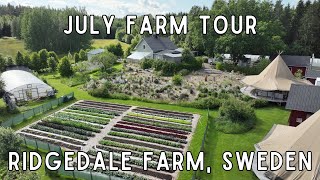
Richard Perkins walks through his Sweden farm in July, showing vegetable tunnels with 1,000 San Manzano tomatoes planned for canning, a cleaned and refilled swimming pond, eggmobiles for broilers, and rotational grazing across multiple fields. He covers current livestock, hay logistics, and selling produce at the local RICO market.
Questions this video answers
July 6, 2025.
About €15,000.
A $15 build guide (PDF).
About 1,000 plants.
Siligorden: 6 hectares total, about 4 hectares of fields (plus renting ~2 hectares from neighbour).
Chapters
Welcome back to another video, folks. It's mid season here in Sweden and I thought it's high time I gave you a video tour going around the entire farm, showing you what's going on this year. So first thing to tell you about is what's going on behind me. The swimming pond that we built a few years ago, we just drained that to clean it out. It started to get some algae and it had a lot of stone dust from when we bought the gravel, which I wanted washed gravel. I don't want any nutrients in the pond. And that's what leads to algae and dirty water. And so there was a lot of dust when we filled it up originally that went down to the bottom and we had a lot of leaves go in the pond last autumn and winter. So we decided now it's a very wet part of the summer and we've got dry period coming up. So we've got lots of water filling up our damp. And so we decided to drain the pool. And I've used really strong hydrogen peroxide to spot treat any of the algae blooms that started to appear. And now it's filling up and it's looking fantastic. So you can see the water is a little brown tinged. And that's because we're filling it from the market garden pond down at the bottom of the farm and the water is coming out of the forest. It's got a lot of tor of the peat moss in the water. It's exactly like when we filled it up originally. And I think that maybe has something to do with the antibacterial properties that we haven't had algae issues and things like that. I'm not sure if that's true, but it will settle down and clear up pretty quickly now. Takes about 20 hours of pumping to fill this up, but it's looking fantastic and I've been really enjoying it already this spring, so I'm looking forward to having a swim later on today. Now the water's filled up again. Now it's worth saying I've got a $15 build guide in a PDF that you can find in the links below. If you want to build one of these for yourself. This cost about €15,000 to build this beautiful pool right in my backyard. There's my back door and we use this all the time. And it's also worth saying that we have a whole backlog of 700 odd videos from running the farm over the years, including all details of decision making and the enterprises we run in meticulous detail. And they're free to watch and you can go find them and look at different topics. My aim today is just to walk around, show you the entire farm, and you can look back and see how things have evolved and changed over time. So starting at the start of the farm, this is where the original eggmobile rests. And we've got the tunnel here full of peppers. This tunnel has multiple functions and that's been for birthing sheep and lambing in the spring for hardening off crops. But it's also full of shishito and padron peppers. Now, I'm not going to talk much about siligorden in this video. That's been taking up a lot of time. It's been the most intensive and stressful three months start of the season that I've ever had. But originally we were going to do pizza and we wanted to grow padron peppers and shishito to be able to freeze them and use them as starters and appetizers in the restaurant. Plans changed totally when the chef quit on us and we don't serve pizza at all. Although we may bring that back and have further openings later this summer to develop the concept there for next year. We're growing a thousand San Manzado tomatoes in the other tunnel. That was for pizza too, for canning and preserving for next year. But let's not talk about siligon today. Something that brings me a lot of joy is the sandgarden. And this place has really come alive this year. I've got you on wide angle lens so you can sort of take it all in. But this place is just alive and buzzing with insects and there's little flowers hidden away everywhere and there's so many sights and smells and textures. The grasses are really growing up this year. So we planted this last spring and if you look back on videos, you can see the entire process of how we built this from start to finish, as well as the swimming pond and all the other things on the farm. So it's worth checking out those resources. But beautiful color schemes. And this has really come into its own this year. A little bit of horsetail coming in in areas that had horsetail before. But other than that, it's just spot weeding, mainly on the paths. There's a lot of things that pop up on there, but I think you'll agree, totally beautiful. We'll have a look at the gardens on the other side and talk about gardens this year. So we finally have peacocks back at the farm. They're very shy. They come out most mornings, most evenings, but they've Imprinted on this barn, which is good, but a male and two females. He's starting to get eyes, but it'll be next year until he develops his sort of characteristic tail feathers. But I'm very happy to have them back at the farm. Those of you that followed over the years know that Mr. P was one of my favorite farm animals and would follow us up to boilers and layers every day. And he met a sad demise on the high voltage power lines one year. They've buried those in the ground now. But it's been some years since we had peacocks and they had been causing trouble with the neighbours so we had to get rid of them. And yeah, it's something I've missed greatly. So I decided to get peacocks again and try and really imprint them here on the farm and make sure they're not causing trouble. So here in the big tunnel we've got some slower growth than normal with tomatoes, cucumbers. We've still got a lot of side crops of basil and lettuce and there's carrots and spring onions in here too. But slow growth this year we'll see in the north beds. So it's been a bit of a topsy turvy start to the year with Silly Gordon and a few difficulties with a couple of people. But everything seems to be flowing better now. But it's been a lot of work as Silly Gordon is a full time thing that takes a lot of time and energy besides running the farm. But we had our internship and the spring internship was an amazing group that bonded really beautifully and we've just been trying to keep track on things after all the changes at Siligorden. We're basically just trying to keep afloat this year. It's losing money, it needs a lot more input and we need to be open a lot more. But we just decided because we'd already booked artists, we need to open up because we have to pay their fees regardless of whether we run the concerts or not. So we just decided to keep it a little bit more relaxed and try and keep a little bit of balance. There's been a lot more landing on me than I would have liked. And that's people based thing, but that's just the way it is. And so we've got ideas that I'll share later in the season of how we're going to do next year and onwards. But it's been interesting. I've noticed the gardens have been five, six weeks behind this year, which is unusual. It's nice to have the 40 meter caterpillar tunnel up. These are the tunnels I designed with first tunnels in the UK. You can still buy them at caterpillar tunnels.co. but we've been having trouble this year with the weather and a lot of crops just very slow to develop. Like you can see the squash disappearing in the bottom right here. We normally would start having squash already, so I'm not totally sure what's going on there. But things are starting to come in now and so we're looking forward to getting more veg boxes out the door on the RICO rinks. So the admins have been very kind to let us back on to the RICO rinks. We set them up years ago and we made a rule that if people aren't selling all of their produce then we can't let in other producers. And they're pretty full with egg producers and veg producers. But I felt a little bit entitled as we did a lot of the work in setting up and establishing and promoting the rico. So they were very kind to let us back in. And so we're selling eg and veg and chicken and smoked chicken there in the Karlstadt ring. I'm gonna take you down to the hens. We're selling our incredible eggs once more and of course we get to eat a lot of incredible produce. During the last internship we've been eating 140 eggs every single morning. It's getting close to feeding time. But you all know the drill with Richdale Eggmobiles. These are automated versions using cattle from Heatherhill Farms Automation. He's just released that on his YouTube channel. If a ridgedale style eggmobile, it's 4 or €500. And he's released his little online course of exactly how you do that for yourself. I think that's an incredibly generous gift to the community. And so that's automations running off a solar panel to a car battery that open and close the nest. Boxes open and close the door, put lights on and off automatically. And you can also run an energizer off that too. Hens are looking beautiful and we've had salmonella inspect. The inspector always comments on just how healthy our birds look. And it's like, yeah, it's a no brainer. We're raising them, moving them every second day. A lot of people have copied our model around the world, get a little lazy with this enterprise, I think, and tend to move them every three, four, five, six, even a week. But that's a different product. By moving the birds every day or every second day, you're giving them much better access to forage. They'll take 20, 25% of their diet from the pasture, so it's really critical to keep them moving for hygiene and for keeping everything working in terms of laying in the nest boxes, keeping that constant in their moving environment. And the birds show themselves. They're just super vibrant and healthy. We've always had a super high food budget on our trainings. We're eating the highest quality organic and biodynamic and farm food. And we have an endless supply of meats and vegetables and eggs. So we like to spoil people with eating better food than they eat at home. Now, we've still got a couple of spots on our autumn internship, as well as our nine day regenerative ag design training and the short courses in pasture, poultry and market gardening. So check them in the links below if you want to join us in the later part of this summer. So that's the pump house and we're pumping out of here here, filling the swimming pond. You can see the water's still overflowing in the overflow there, which means water is coming in faster than it's going out, which is good. And it's been pretty wet, so I'd expect it to. It's beautiful wet and humid days this week, but then we're going back to full sun. We're going to have a pool party next week. So we zip around the farm really fast with the cows and sheep and then we went down to the neighbour's land where the cows are right now. I'll take you down there soon. And then we're working more with total grazing. So we're really grazing quite heavily with the cows and sheep, as you see. This is drone footage from maybe a week ago, just to illustrate what's going on there. But now we're up in top field and this is the Ridgedale roller pens. It's just a small batch of 450 birds, but they are trained and ready to move. They think they're moving now. You see they just come running themselves. Now, I don't want to stand here too long because they will think that they're coming out, which they're not. But you can see this is a model that works extremely well for larger batches. And the birds get much more space, much more exercise, so they get much stronger leg development, much healthier birds. And we can have automatic water. So we have one feed down the middle. As we move the pens and the birds in the first few days, they learn to move themselves. We have Automatic water all day. And when you get to this scale, it's much easier than this would be the equivalent of seven salatin pens. And you see the birds are way more active. It does translate to slightly lower feed conversion, but not enough to be economically problematic. And the birds are way healthier. You see how much more active they are. And they just behave more like real chickens. So I use in the old videos, I used to say this model really comes into its own when you have a thousand birds in the batch. And then you would have four of these mobile shelters, but it works pretty good for 500 too. And after the first few days of training, they really learn the drill, you see, they'll start heading back this way again. So one person in the morning can move a thousand birds in 10 minutes flat. So it's a very nice way to raise these birds. We're going to try and process these birds in just two weeks from now. And then we've got a trip away, going to the States for a brief visit. And then we're in the second half of the year with the second internship program. We're going to do a lot of work over at Silly Gordon, putting up animal fencing as well as getting that ready for receiving eggmobiles and cows and sheep over there, and of course running more boilers and all the other things that we're doing here. People always ask if we have issues with predation with this. And the answer is no. We've never lost a broiler on this farm to a predator in the Salatin or these models. We do have bears passing through. One of the crew saw a bear in the forest not far away the other day, and they're just passing through. They're not living here. It's a grizzly bear that's much smaller than American grizzly bears, but they can be bears. But we do have wolves and we do have lynx and we do have pine martens and we do have foxes that live on the actual farm. But we've never had a problem with the electric nets we have. Aerial predators would be a bigger threat. And there are three nesting pairs of predator birds. We've got buzzards, we've got the white tailed eagle, but we don't have a problem. And I think, as I've always said in videos in the past, it's a matter of animal density. And when the birds are young in those roller pens, we keep the net right up to the side of the roof there, so no aerial predator could get in. And then they seem to be fine. You have to obviously check your own predator pressure before making big risks. When you have that much chicken in one space, that's a high risk activity because there's a lot of value there. Current prices in Sweden, with all the expensive life conditions that we have and feed prices, we sell chicken at 140 crowns a kilogram. Now, smoked chicken we sell for 195 crowns kilo. We sell our eggs for 145 crowns per tray and that's relatively cheap. For example, the broilers from this other organic producer. We were the original organic producer in Sweden of boilers, but there's now a mass produced organic bird and they sell for 165 crowns a kilo in the supermarket. So our artisan product is cheaper still, which is I think I'm very proud of and I think it's fantastic. So now we're up in Nutfield and this black walnut and many others are growing fantastically. This was grazed pretty heavily a week ago and so this is starting to reboot again. But something nice up here is we've got a lot of English walnut that's starting to produce nuts and chestnut that's flowering as well as the black walnuts, which produce nuts quite easily here. These are planted on a savanna planting, double planted. If you have no more than 30% canopy conifer in this environment, you don't get any loss of yield in nuts, sorry, in the grasses. Just trying to find some nut development. There you go. There's an English walnut growing in Vermland. Very happy about that. There's a few on some of these other trees. And the black walnuts produce. Well, chestnut is producing fruit again and that's really nice to see. So we have 6 hectares of land over at Silly Gordon, about 4 hectares of fields. But we're also renting the neighbours who was the previous owner's father. They have about 2 hectares more. We cut 60 bales off that and we should get a second cut of a similar amount. We're also buying a few bales off the neighbour and that should give us our winter supply. So that's a really nice development, having more pasture land. We're going to actually sell some of the heifers. We have too many cows, which we'll see soon, but we want to keep that down to the supply needed for the restaurant as well as on farm. We're not selling beef. Occasionally we do, but it's not really a mainstay of the farm. We're here in the pig paddock and this is where the cows and sheep were for the winter. You can see it's greened up nicely with nice pruning to let light through. We just got a couple of pigs, let's go find them. Well, there's the last two pigs. Happy as a pig in muck. So we've been slaughtering a few on the farm for our own use and we've also taken sheep and pigs to slaughterhouse for use in the restaurant. We're also selling chicken in our dishes now and doing a lot of farm to fork beautiful recipes. Jonty has been an angel. He was our replacement chef that came in last minute and has just been an angel. He's rewritten a menu that's totally farm and did all the paperwork for the authorities and just jumped in and has been doing amazing. We're just constantly getting compliments on the food and we're offering top quality organic and biodynamic products at really affordable prices. And people have been giving us really great feedback. So last couple of pigs there and we'll take them with the next intern so people can learn about butchering, making sausage, preserving, etc. And we might take two or three more for putting in the freezer for the winter later in the year. So you'll have heard me say before, we got the nicest grass in the village, having started with the worst pastures around that hadn't had animals for decades. And that's through the impact of high density multi species grazing and using the key lime plow. And it's quite remarkable you saw in the drone footage that we're grazing quite heavily. But if you look at the quality of the grass that we have, super nutritious and about five or six times the biomass than when we moved here just from making money doing farming. Right. But we're up at the neighbours right now. Let's go and check out their grass. So that grass you just saw has had poultry over it twice and has been grazed a couple of times already. But now we're going up to the neighbors that I always show you a comparison with. And the sheep are up here and they're grazing this land for the second time this year. So these are Gotland and the white are the Reophor, an old Swedish breed, very hardy, not very big, about 1819 kilos for a year old lamb. Or turning to Hoggett, but very climate adapted. No troubles, no problems lambing and just a good sheep really. But you see the difference in the grass here. It's a very different story here. And this is what our land looked like when we moved here 10 years ago. Although even in Topfield where we just were, half the field wasn't even grass. It was different forbs and not so palatable species. But big difference in the landscape that we've created through our actions of farming. Nicely. So we didn't have any lambs this year because we knew we were going to have quite a lot of cows in terms of animal units. But next year we would like to have lambs and have less cows and just trim that down a bit for our supply. Much easier with sheep to do epic adventures at the restaurant with like whole cooked animals etc. And just easier to handle than too many beef cows. We always want to have beef, I love eating beef. But we don't need as many animals as we've had. So here we are just at the end of our dirt road, so a few hundred meters from the farm and we're grazing six hectares here. Not the best forage, but with the amount of cows we have, we need to be able to graze more than just our farm. So we're using the Kiwi tech to subdivide this field up into day paddocks. This is the road that goes down to the lake that we like to swim in. Bit of a hassle having to bring water. We don't have field lines out here obviously. This forest behind is the peat swamp between our farm and the lake where we go to swim. But we've got a little bull calf that we might keep on. But there's one cow and a few heifers that we might sell on. Now if anyone's interested locally in Fial CU then these are wonderful cows for small farms or homesteads. So you can contact us if you're interested in purchasing an animal or a group of animals. Well, that's all I've got time for in this video folks. I hope that's nice to see the farm. You can go back on old videos and just see how things have changed and grown in over time. If you want to join us for a life changing six week internship, there's a couple of spots left on that people from all over the world and it's a transformative kickstart that people use to jumpstart their own businesses. And a lot of the most exciting farms that I see on social media have been from people who have come on those trainings and it's an amazing time to spend deeply embedded in this environment with like minded people focused on farm planning, business, how to run these enterprises effectively. There's only so much you can do in theory. We have a nine day regenerative ag training and that's a wonderful introduction that we teach all over the world, thousands of students now. But if you want to learn about designing and running a farm, you need to do that in real, not in theory. That's not how we design farms. None of the nuances come out in that, and it's that that makes a difference and makes this place such a powerful learning hub. You can learn more in our books, in the links, in the bio. There's free trainings in there too. Look forward to seeing you in another video as the season progresses. Thanks for watching folks.
More from Richard


A review of short and intensive season on a mixed farm and restaurant/event space in Sweden






Alskade Kyckling Exploring complexities of poultry production in Sweden and what we stand for


