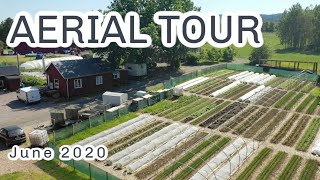
A mid-June aerial tour of a regenerative farm hosted by Sam and Richard Perkins. They narrate drone footage showing rapid growth after warm weather (about 30°C), compare current conditions with early-May footage, discuss irrigation (a pond with low inflow), animal systems (pigs, cows, sheep, and 500 broilers housed in three roller pens designed for up to 1,000 birds), crop tunnels, windbreaks, and landscape recovery from rotational grazing. The video closes with promotion of the authors' book Regenerative Agriculture and a paid membership (Farm Like a Hero).
Questions this video answers
Mid June (video metadata: June 15, 2020).
About 30 degrees Celsius.
500 birds in three roller pens.
Designed for about 1,000 birds.
€100 for six months.
Chapters
So welcome back to another episode, folks. It's now mid June and things have been growing like crazy with the spell of warm weather we've had. So I thought it's about time we did another aerial flyover. You remember, we did one back in.
Early May and it'll be great to.
Compare this and just see how things have grown in such a short span of time. I can see a butterfly even.
I didn't even. Well, it's definitely dry. If we think back to just a month ago when we put out the May aerial tour, we had just been putting in the first spring onions and salads. A lot of beds still undercover now, but the crops are really filling in. You can really see on the surface how dry it is. It's been 30 degrees Celsius. That's quite hot for us. A lot of good growth, particularly these beds. They get a lot of shade from the trees, certainly the big oak trees that you see over here as well as the barn at certain times. But these beds protected by the oak trees here, staying moist and shaded to our advantage. I think often people worry too much about shade. It's actually quite beneficial to have. We're going to be getting the yurts up this week. We've had no need for them smokers on with chickens at the moment, but the yurts will be going up. We've got our farm scale design course and we've also got the masterclass with Joel Salatin coming. Egg collection time now. Very scared of the drone, so I'm cautious to go too close, but they've been working their way down through front field. Front field got a bit of a battering this year because the cows were in there over the winter bale grazing. And a couple of days when it thawed out, it just got too muddy and wet in there. And some bit of machine work to bring bales in at an inopportune time meant the ground still recovering there. So we're just grazing lightly through here and we're at that point in the year where the rainfall is very important for filling back in this pond. This is how we irrigate the market garden. And while the pond is in good health right now, the inflow pipe has virtually no flow of water going into it. There's a pipe on the left hand side there and it's virtually come to a standstill now. So it's actually filling from about 60 meters up here in the riparian. Some of the grapevines putting on the growth for the year, growing up the alder. So the Boilers are out in their roller pens. We put them out this morning. They're a bit scared of the drone, I expect. So you'll probably see them start running under their shelters now. So 500 birds in three of these roller pens. That's equivalent roof space to six of these Salatin style pens, which we've moved them from. So we just put a poultry net around the back of them and basically released them all and shooed them in. But once they start getting used to moving in this poultry fencing, this system becomes a lot quicker. It really comes into its own when there's a thousand birds, which is what we actually built it for. It only takes two minutes to feed and service a Saladin style pen. But it's when you have a thousand in here that it's, you know, then it starts saving time with the moving. But actually these pens are more about giving the birds more space to run around and forage. And also it saves a lot of time with water and feed. So you can see there's one waterer there that services them all. And in the first days we give water to them at the ends. We'll phase that out when the birds are a little bit bigger in a week or so and they'll all be able to make use of the automatic water. Also, you're saving a lot on the feeding because we're just weighing out one batch. I know some people do unrestricted feeding for a restricted amount of time, but we prefer to feed on specific weight calculations through all our research to get optimum growth. Just give you a sense of the landscape around, how it looks right now approaching midsummer. Longest day of the year. Good day to go down, swim in the lake. It seems as we spin round now, you'll see the fields of our neighbours beyond our limits. That's where we're going to be cutting haylage this year, so that will be soon. So we've left that out of the grazing plan. And because the cows and sheep have been through nut fill now, they've actually moved up to the old pig paddock here and you'll be able to make them out. We'll go and have a look at what that looks like in there. It's really nice for them to be in here. You can see the calves just sleeping a bit and relaxing. There's a lot of shade and a bit of respite from the insects. Obviously can't see the sheep. I think they're probably off under the taller trees over here. But this is where we've brought through pigs and we can also see some sheep. We can also get a good comparison here. There the sheep are. They actually browse in the lower branches. But if we just move to the turning circle here. Just look at this land on the other side of the road. This is cut at the same time. Still got brash lying around you see there. Still got blueberries on the ground. Much smaller trees, much less grass and forbs. Our trees are much bigger now, quite a few meters taller. You can go down to ground level to see that a bit better. And you see no brash. So the pigs really turned the brash over, helped it decompose. And then bringing the cows and sheep in to bring their gut flora and fauna from the pasture. It's really transformed this space. And then they graze the lower branches which really helps you to get a bit more light down into the floor and that really facilitates the grasses and forbs. Really nice environment and way more productive. And the species coming back are oak and ash lime. Really nice species. There's obviously birch and willow in the beginning but very nice to see. Lets have a look at the neighbour's land because this is just up above this here. This is what our land looked like before we started grazing. You can see it's very stunted grass plants all going to seed. It's really dry and that's about all the production this field is going to give this year. Pretty poor. A lot of moss still covering the ground between the grass plants and actually there's a lot of young trees popping up it looks like. So just for comparison, let's turn ourselves around and we'll go over to. We'll pass over the cows and sheep and we'll head to top field. We've had broilers over this, we've had layers over this already and we've grazed it as well and it will be grazed again now after the cows and sheep come out of the forest patch. So massive difference. This is the area of the farm when we moved in, this top portion here was all ladies mantles. There's very little grass and now it's thick, dense sward and that's up to my wave halfway up to my waist now. Very different response from having animals moving on pasture. Some black walnut and strawberry there. What a difference it makes. Coming back up to the yard. I'll steer clear of them chickens. I don't want to shock them. Got a compost out the back of the tunnel there. Tunnels full of tomatoes and cukes. Well the drone is beeping at me. Doesn't like Being close to obstacles. It's got cameras all around it looking at the environment, but give you a sense of the tomatoes and cutes coming up in there. Give you a look at the windbreak here from the other side. So this is where our predominant winds are coming. So these were little willow cuttings that we took and put in in keyline rips in the first year. That's established very nicely. It gives a lot of protection already from the wind there. So you can see the neighbor's land for comparison with ours. So this will be adequate for winter feed for us. But you can see, I suspect you can see quite clearly on the bigger screen just how different this grass is to ours. Way lower yields. Well, that's it for the tour for now, folks. Hope you find it interesting to get that bird's eye view. I really enjoy seeing the farm from that and learn a lot from doing that. But hope you're having a great summer so far and things are growing well. Animals doing well for you and we'll leave it there for now.
All right, that's it for today. Hope you found that enjoyable and interesting to see the farm from above. Really gives a different perspective on things and I think it's great to take.
That view regularly throughout the year so.
You can see how things are developing. As always, you can find out a whole bunch more in our book Regenerative Agriculture in the links below. That's a PDF and a hard copy that are sold through the farm directly without publishers involved. And you can also join our low cost membership site, Farm Like a hero. It's €100 for six months of hundreds of hours of content, weekly Q and A with myself. We've got people from all over the world in there and it's a great platform for hearing about about 75 of the best regenerative young farmers in Europe. So come and join us there in the links below.