Kimchi, No Dig Veg and Artificial Intelligence
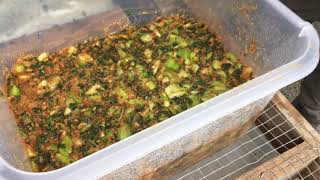
Richard Perkins makes pak choi kimchi from market-garden surplus, salting and fermenting it for 5-7 days. He also tests an AI camera called Obspot that recognizes his hand gestures to start, stop, and tilt recording automatically.
Chapters
So in today's video we're interfacing with artificial intelligence. This little robot is programmed to read my face and it can even find me in crowds of people and I can command it using gestures with my hands. So it's going to change the way we make videos. But it's a quick little video looking at some of the produce coming out of the market gardens today. And we're making kimchi with some of the scrap packed choy that started to bolt and it looks delicious. Chris is getting strawberries. We've been moving things around in here. So root trainers coming in. These are the old root trainers. This is American chestnut. You can have a look. These are in tiny root trainers. For now, it's time to. We've been stratifying these this spring. You can see these old style that we use have a tap root that goes right down and prunes at the base only. So with a few spare. I want to pop these up now in the big root trainers just to see the comparative growth. We're going to put the grapes on strings rather than sticks because they will outgrow them pretty quickly. And this will fill up this entire row with these beautiful root trainers. That's an example of a sucker that was rooted this spring. These are suckers that didn't make it. Probably just two little root. You can see they've had a go but probably not enough water to take. But having said that, we have a lot so it's enough to fill all the holes in the tree line. So I like these for small things, vegetables or very young cuttings or whatever. But having a larger root trainer like this is much more suited to growing on bigger trees. Chestnuts. Okay, so making kimchi pak choi. This is pak choi that went bolting a bit and it's got a bit of flea beetle damage. So I'm not selling it, but we may as well not waste it. And hakari turnip in place of traditional daikon radish, spring onions that we have plenty of right now. And then we'll need ginger chili fish sauce. Going to basically weigh out the pak choi which we're just rough cutting into inch long pieces like so. And once we've weighed that, we will liberally apply salt and stack it into another basin. Leave it for one hour to start extracting the juice, mix up a paste, blend up these pakari with chilli and ginger and onions and all the yummy stuff and then smudge it all into a container and submerge it under its own liquid for five, seven days. So it goes through basic fermentation and then once it's yummy, we shall basically put it in jars in the fridge and we can save it long term. Important to wash the salt off. We're going to be using a large amount of salt, but we're going to be washing that off and that's the key to making it yummy. If it's too salty, he didn't wash it off good enough. So salt is very liberal. It's needed to extract the juices. We roughly scrunch it in and that will help to start extracting water. We're going to leave this for now and it's important to help kick start the fermentation process when we set the whole thing together. So this is the base of the sauce in Spanish with ginger, garlic, fish sauce. Going to mix the chilli in. Still a lot to make though. Okay, that's the finished sauce. So chilli and hakari turnip and we've got spring onions in there, lots of ginger. And there's a recipe appearing here and we've just scaled this recipe up. So cabbage is sitting, Pak choi is sitting for an hour and we'll come back and mince all this together. After thoroughly washing all the salt off the pak choi and then basically press it all down to submerge it under its own juice and we'll let it ferment away in the cellar for five to seven days. So after an hour it gives you a sense of the amount of liquid gathered here. Now we need to rinse this off whilst scrunching it even further, get rid of the excess salt and then we'll be packing it in with this beautiful sauce. Okay, so rinsing and this is the way we decide how much salt to take away. It's easy to have too much salt and spoil the whole batch, but we want to have enough salt that it's yummy so you can taste it. Okay, so we've rinsed this really good. So you want to be really careful testing because it's easy to have too much salt. As we said, we rinsed this probably four minutes, squeezing as we went. And that softens all the stem cell walls, but it's still crispy and crunchy in the middle and that's how we want it. So we're going to mix that up with this beautiful paste and we'll squish it down into this nice clean container. Chuck it in. Kevin, let's go that bit. That looks beautiful. So this mix we're going to really smoosh it together, high pressure and twisting and grabbing. And then we're going to compact it all down so it's really going to get covered up in its own juice. And we're going to leave it, maybe tasting it after three or four days and up to five or seven days, we basically determine when we want to turn off the fermentation and then we can store it in airtight jars in the fridge for months. But we'll probably eat it really quick if it turns out good. And when you're fermenting, you obviously need either an airlock or with kimchi, you can get away with a lid that's just not on tightly. Obviously gas has to come out and it's a very short fermentation, so that's good enough. Okay. Pak choi kimchi 2. We'll put it in a room temperature in a cool room and that will ferment away. Beautiful. It. Where the wheelbarrows that. This is a new camera I've just got. I've bought it from, well, I supported a Kickstarter campaign and it's called an Obspot. And it's a true AI camera in that it's not just doing facial recognition. It can actually recognize me in a crowd and it can follow me around. I'm walking around the room now, and it can recognize me in a crowd of people. And what I wanted to get this for is hopefully I can do some more interactive YouTube videos, as if I have a cameraman with me. And you can control it off your phone. I haven't learned all the controls yet, but I can actually start it recording with different hand signals and stop it recording. And I can program it to read my hand signals, to zoom in and do all these kind of things. But it seems to be quite effective. And what it means I'll be able to do is go around and show you stuff that I'm doing and look at what's in the drawer and then come and see what's in this container. And you see it's going to be a whole level of functionality to be able to do YouTube videos where I'm not just walking around trying to film myself all the time. So I think it's going to be really awesome. It seems very impressive. And so, yeah, we'll be seeing more of that in videos to come. It wasn't very expensive and I just like the concept of being able to basically film without having to have someone with me, but be able to be more interactive with my hands. So I think it's going to be really cool. It's going to take me a little while to learn to use it and I'll need to plug in a microphone to this camera. It has a little like headphone jack that you can plug in microphone with. But I think it's going to be super cool to be able to move around and really show you things in the field in a much closer way. And yeah, we'll see how that goes. But I think it's going to be opening up new possibilities for making videos for you. So that starts the video recording and you can see on the little screen here it's recording away and I can then move around and do whatever I'm doing. I can lock the screen with different gestures too if I want to leave the screen at the end of a scene or whatever it were. Likewise, I can stop recording like that. Now I can also lock the screen and tilt of the camera if I want it to stay in a certain angle or shot. But super cool. Really excited about testing this out and then bringing a new dimension to videos. Okay, that's it for today folks. Just wanted to share that recipe with you. I really love spicy kimchi. It's really good for you fermented foods mainstay of most cultures all over the world. And it's really nice. Way to up value some of the waste coming out in the garden and store it over time certainly when you have gluts in the summer season. So looking forward to sharing more with you soon. Thanks so much for watching our videos, for your likes, comments, shares, etc. And we'll see you in the next video soon.
More from Richard


A review of short and intensive season on a mixed farm and restaurant/event space in Sweden






Alskade Kyckling Exploring complexities of poultry production in Sweden and what we stand for


