LAWN TO NATURAL SWIMMING POND Planning begins
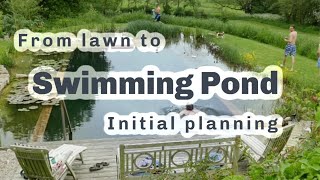
Richard Perkins outlines the planning stage for converting a lawn area by his sauna into a natural swimming pond. He explains the David Pagan Butler–style approach (a single butyl liner, regeneration planting area equal to swimming area, geotextile protection, gravel and timber ledge), marks the proposed pool footprint on-site (about 3.5 m × 10 m) and explains key technical choices (deep swimming area ~2.2 m, low-power bubbler/pump plumbing, materials and likely costs). He also describes logistics (soil removal, timber from on-site larch, hiring an excavator and trailer) and invites viewers to upcoming on-site training where full technical detail will be provided.
Questions this video answers
About 3.5 metres by 10 metres.
Approximately 2.2 metres.
About 25 by 10 metres (to cover excavation and folds).
120 mm drainage tube.
Probably four bubblers.
Chapters
Well, when you come out on a blustery February morning, you don't really think about jumping in the swimming pool. But that's exactly what I'm thinking about.
Today because I'm marking out what's going.
To become our natural swimming pond. Natural swimming pool. What is a natural swimming pool? Well, let's just have a look at a few images for those of you who aren't sure, and we'll talk quickly about how we're going to plan to build ours. So if you Google natural swimming pond, you see varying designs. Now, some, like this image at the top in the middle here, are built.
Into concrete lined pools. You can retrofit normal swimming pools, but.
The type we're using is very much championed by David Pagan Butler, who wrote a really cool book. I have an ebook here. This is an ebook he sells very.
Cheaply@Organicpools.Co.Uk this is a manual of basically how to build one of these things.
So these are built.
I'll just bring this slideshow over so.
You can get a sense of what.
We'Re looking at achieving. So this is basically the finished pool.
And you see it's quite dark inside and that's because it's using a Butyl.
Pond liner, so it's actually black inside.
And he developed a really cool way of folding this.
So basically this is what it looks like. You're digging a great big pool that's lined with concrete blocks and this is not the water line. Obviously there's going to be sleepers, wooden constructions, and we're going to use larch from our forest that we'll cut with a bandsaw here to create a ledge that holds back the gravel that the regeneration layer is built upon. That's where all the plants are that keep the water clear and free of algae, etc. And so we're going to cut larch from our forest patch and put that on top and that marks a boundary for the swimming zone that keeps it free of plants, etc. Then you're grading a shallow regeneration area that holds all the plants. And the key is to have about the same area regeneration as you have for the pond to deal with the nutrients. You see here, they put down a geotextile to protect the pond liner. And then the pond liner has a special concertina fold. It's not finished here, but it's a very neat origami fold to get it tucking into the corners nicely. And then you can see the sleepers are put on here or people use sandbags. Gravel's filled in and the plants are put in.
Well, there's nothing to see other than a few posts in the ground and some string. But I thought I'd like to bring you along on the process of what goes on for planning, because I think that's critical. The actual building is fairly straightforward once we've worked it all out in detail.
So ever since we bought the farm and even before we've moved on to the farm, we plan to have a natural swimming pool down by the sauna area, just to be able to wash people really well.
We have a lot of visitors coming, obviously for traffic trainings, etc. And so the sauna has been an invaluable part of the farm. We never ended up building that swimming pond because we have such a beautiful.
Lake just a short bike ride down.
The road with a sandy beach that's amazing for barbecues and swimming there.
And so we decided that we were going to actually build this swimming pond for ourselves in our back garden. And so today I've just got back.
From holiday and I'm marking it out because I need to plan well ahead if we're going to build this during the summer months.
Now we're actually going to run a training for either six or eight people.
To build this from scratch, but the planning starts now. Now, I know in England to build.
This kind of pond you don't need planning permission and that might not be the case in Sweden. So I want to get some measurements.
And go and talk to them about that. But also, most importantly, I want to dig test holes because the center of the swimming area is going to be 2.2 meters deep. And I need to know that there's.
Not solid bedrock under here. And you never can tell because they.
Typically build houses on top of exposed granite rocks.
Here in Sweden, however, they dug down.
Our heat pump for our heating system and they dug 175 meters down just over here.
And they said for that dig next to the road there, it took about 15 meters to get to the bedrock, but I want to be sure. So I'm going to be digging here.
To find out very soon.
So I'll just walk you through what's going on here. I love visualizing out projects like this. It really helps you visualize the space and think things through and visualization and careful, step by step planning to anticipate problems that might arise and eliminate them. Through planning is how we like to do all kinds of building and farm planning. Now look, here we are at the house and we pretty much only just started renovating inside the house. We've been so busy on the farm that the house has been kind of neglected. We're going to paint the house and one thing we've decided we'd like to do is open up this area of the decking and have steps coming down to some decking out here. And this would be the lip of the deep water. So you need about the equal size of regeneration area as you do the swimming pond. And that's to ensure you have enough plants to oxygenate the water and to eat the nutrients that are naturally present, rock, minerals, and in the rainfall, etc. So you don't get algal blooms and, you know, it creates clear, nice water for swimming. So this is the actual pool shape we're settling on. It's about three and a half meters by 10 now. I would have liked it a little bit longer, but we're limited by size. And you can see what I've done is by putting out these fence posts, I've actually marked water line all the way around. It'll be hard to make it out, probably, but I've done that to get a sense of how much I'm gonna have to bring the garden up over here. So Johanna wants to actually plant up a perennial garden. Hey, Ragnar. Ragnar's having a lot of fun being back on the farm, finding all his toys again. And, yes, Johanna wants to turn this area into a natural sort of perennial garden. I hate these bushes. I want to pull these out. So I thinking right now we would start pulling some of the soil from the excavation here and bringing the garden up a level to get that water line, as it were. So that's not going to use up all the soil at all. So we'll have to take a lot of soil away in this process. But it's really helpful to, you know.
String and mark things out when you're.
Doing big constructions, whether it's building or water bodies, so you can really get a sense of the landscape. You can really see. Because our eyes are really bad at measuring height, we're really good at measuring.
Distance with our eyes from our hunting past. But it's very hard for us to judge height differentials. And whenever we have a training here, I get people to use different levels. Like here we have a rotating laser level that we use all the time around the farm. This is, you know, a couple hundred euros. It's one of the best tools you could have for laying out farm plans.
Whether it's building or waterworks, etc. And it really helps to just get.
A sense of how much soil is needed to be moved around.
Now I could get into technical detail and do volumetric calculations because it's very easy to work out how this deep.
Partlr pool is in volume. It'll be quite easy to work out the size. Now you could do that on CAD very easily too.
But basically I already know that we're going to need to take a bunch of soil away and that's not a problem.
We have areas on the farm where.
We could use that. So we'll just need to hire a.
Tractor trailer with the digger driver.
So materials for this would be basically 10 meters by three and a half.
You would need to put concrete bricks and that's to make a vertical side. Now I did think about plastering concrete.
Blitz like a bit like a normal.
Swimming pool and then using GCL liner so you get a clean pool like you see in some of the photos online. But it's much cheaper and more effective I think in our climate just to have one solid liner so we don't have to worry about freezing, etc.
So we basically have to buy concrete.
Blocks to do the walls.
We'll cut the timber which will be.
Maybe 2 foot high all the way around. Big thick whole trees from our larch, because larch is actually very good underwater. It's what Venice was built on. It doesn't rot very quickly when it's submerged. So we would get a bandsaw down.
Here and chop all that in place.
And put it up.
And then we would need a liner probably for this pond you would be looking at 25 by about 10 meters.
So that's one of the biggest costs and the most expensive bit of plastic I'll have bought.
And then we would have a liner.
Of Geotexa underneath that.
And we would need to bring some gravel in.
You can use soil back in there, but it will take a lot longer for the pond to clear and there'll be a lot of nutrient in it, so you're much more likely to get algal blooms, etc. The goal of a swimming pond is that you have a deep, straight sided swimming space that's free of plants and daebus, so you can dive in, etc. And very clean water and healthy ecosystem at the same time. I think it's going to be an amazing asset for our family, but also the people coming here. But it's also a great investment for developing a property. Every, you know, euro that you put into this is quite a few euros.
In value added to the property.
We'll have to get a lot of pond plants in and we'll be looking at all the species you can use for that, etc. And following through with all the lists of materials we use and we'll show you the costs, etc when we actually get to building this. I'll be putting some updates on YouTube when we actually get to building, but the full technical resources I'll save for our online training.
So that's what it's looking like for now. It might tweak around a bit, but I just wanted to get these main corners of the deep swimming part in so I can take one of my hand augers and dig down 2 meters here and just see if I get clear digging in each corner then that's probably enough testing for me. And we've dug here before and it's, you know, it's just yellow building sand. Certainly when we dug away for the lean to greenhouse here, it's just yellow building sand pretty much like this. So that's what we're going to do now and I'll go and speak to the planners at the same time and see what they think about the idea. Obviously we need to be aware of keeping away from the house, but this is just a few concrete posts for the decking. House foundations are right back here, so that's not a concern to me at all.
One thing I love about David Pagan Butler's designs and he's got a really nice YouTube channel if you're interested to find out more. Lots of great information on his channel, but they're super low powered with their pump system. Basically what he does is he puts perforated drainage pipe all the way around the regeneration area. And then down here in the deeper swimming zone, you can have a vertical plumbing tube, like a 120 mil drainage tube that connects to those perforated pipes. And then you put basically a really low power sewage pump like we use for making compost tea, if you've seen that in those videos. Very cheap pump, maybe €60 and you put an aquarium bubble stone down a meter and a half into that pipe and the rush of bubbles coming up through just pulls a massive amount of water through the whole pond system.
So we'll have probably four of those.
Bubblers along here and they'll be oxygenating.
The water but also sucking over the.
Water from the entire pond every single day.
So the entire pond will be circulating within a day. And all that will be done with very low wattage compared to something like a swimming pool pump that uses a Lot of power. This can all be plumbed in but ourselves and it's super easy to maintain. Now, as far as the chemistry goes and all the detailed science of how to make swimming ponds, that stuff is a little bit more technical and we'll.
Be covering that in the training we.
Do here on the ground in July. Now, I'm choosing that time because I'm back from my tour to do a.
Farm scale permaculture design course. We'll be getting into all those technical details. We'll be filming all of that and.
Putting it into our online training, but I can't speak to it all now. You can find out a lot more on David Pagan Butler's channel and on his ebook if you want to buy that. There's other ways of building natural ponds for sure. This is the way we're going. It's low tech. We can afford to build it and I know how to build it. I don't see any major complications or hiccups and so that's what we are choosing.
But have a good look online if.
You'Re interested in how they work, because there are other ways to build, build them. But if you go out and buy or pay for a company to install a pond like this, you would be paying between 30 and €80,000, depending on where you are in Europe. We can build it for a small fraction of that cost and so that's.
The way we're going to go for it.
Okay, that's it for today, folks. I've got to get myself in here and start seeding the tomatoes for the year very soon.
We're on to spring onions and leaks and getting all the seeds ramping up.
As we kick into production. It's still cold, ground is frozen. It looks sunny and lovely, but it's pretty crisp out here.
But as always, you can find out.
A bunch more in the links below. Buying our book, our online training, the most diverse and complete comprehensive farm planning training online today and details about our 2020 tour.
Thanks for everyone that's been filling in farms I should visit for that.
So an update on that is we're.
Not going to run any trainings during that tour. We're just going to film as many farms as we can on the way and I'll be going through all of those farms in the next couple of weeks, getting my route in detail and I'll be updating everyone that's invited me in a short while. It's very complex planning process. All right, see you in the next video, folks. Bye for now.
More from Richard


A review of short and intensive season on a mixed farm and restaurant/event space in Sweden






Alskade Kyckling Exploring complexities of poultry production in Sweden and what we stand for


