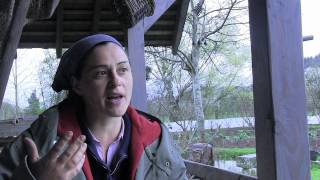
Perrine Hervé-Gruyer describes La Ferme du Becquelois in Haute-Normandie, a 16-hectare organic farm using permaculture and mixed techniques. They grow vegetables on 4,500 m² and sell through AMAP baskets, restaurants, and schools. They're testing with INRA whether 1,000 m² can sustain one person.
Questions this video answers
16 hectares
Approximately 4,500 square meters (about 1 acre)
2006
An INRA (French National Institute for Agricultural Research) experiment studying whether one person can earn a decent living from 1,000 square meters and tracking hours worked and wellbeing.
Four people total (the couple plus two hires: one hired last September and another last November).
Chapters
So we're here at La Ferme du Becquelois in Haute Normandie in France, Western France. And we started this farm five years ago. When I say we, it means my husband Charles and myself. But nine years ago, we moved in a little house here on this land. And our dream was just to be self sufficient. So we first started to grow vegetables for the family. We had a little garden. And step by step, Charles kept on telling me, oh, I love doing this. I love growing vegetables. I really love it. He used to be a sailor before, so I think he had the same passion for the, the soil, for the earth than he had for the sea. I said, okay, go ahead. I was not that much into it. I was okay with feeding my babies with very good food, you know, organic food, obviously, that we grew ourselves. I was doing a little bit of everything by myself. All the cleaning products in the house, all my cosmetics. And so it was really a dream to be self sufficient. But then he wanted to go a little bit ahead. So I said, okay, go ahead, I'll do something else. I'll give you hands from time to time. And then you know how it comes when you give one finger, it ends up with the full arm. So I got involved entirely in this adventure. We started to be real farmers. In France, you have to register to be an agricultural farmer. So we started in 2006. At first, we didn't know anything about permaculture, so we had this piece of land. We wanted to grow vegetables, Obviously we wanted to be organic, that was for sure. We already had a horse, so we worked with the horse, but that's it, that's all we knew. And then 2008, we read an article that a friend of us sent us by email and we found out about permaculture. And it was like, wow, this is what we've been looking for forever, ever. Even before, I mean, it seemed like everything in our lives, all the pieces of the puzzles would come into each other. You know, the puzzle was full and it just made sense. That was it. We found out after one full season, one year, one summer plus one winter, that it was extremely, extremely efficient, highly productive. So we were very, very happy about that. It was not all about techniques of things we shall do, even though we immediately started to do things. But I don't know how to say that, but everything made sense, you know, the philosophy of life and the philosophy of the Indians, because Charles, my husband, used to live with the Indians in French Guiana. So everything started to assemble. Very first thing that we did, as I said, was to create raised beds. And the fact that you were not supposed to touch the soil anymore, to let the life coming out from the soil was, I guess, the. The very first discover the most important one for us. So when you spend time weeding, and God knows we spend time weeding because that was just grass before we had cows on this piece of land before. So we spent a lot of hours, long hours before, before we found out about permaculture weeding. And it just didn't make sense. The global design had been made without knowing about permaculture. We started to work on those interconnections on those borders. And we found out that indeed all the borders are very, very productive, highly efficient when it comes to having some bees coming in, having some frogs, snakes to eat the slugs or the mouses or whatever. We find it very efficient to have several microclimates, several ecosystems close to each other, interrelated. The farm itself is 16 hectares, not acres hectares. Here we grow vegetables on only 4,500 square meters, approximately one acre. But we also do vinegar, apple cider, apple juice. We used to bake the bread, but we've stopped. It was too much. But we also sell, for example, jams when we have too much fruits, dried fruits, dried tomatoes. On this very small piece of land, we have several microclimates because several ecosystems, different environments. And we found that very, very efficient and surprising to see the differences between, between one ecosystem and another. So when we first started, it was just Charles, my husband, and myself. Last September we hired one person and another one last November. So now it's the four of us. It's a lot of work still, since there was no proper design, as I said at first. So we still have to fix a few things. And even a design is always. So we always have to spend time on things we didn't have to spend time on, like mulching, proper mulching. We had a huge slug problem, for instance. So we have to find the right way to avoid slugs. The information related to our method called Terravitae. Because here on the farm, not only we use the permaculture principles, but also we were pretty much inspired by John Jevons, the American Gender Jevons, and Elliot Coleman I talked about earlier. So we kind of mix up all those techniques. We are right now in the middle of an experiment with the inra, which is the French National Institute for Research in Agriculture. The goal is to get to know if on 1000 square meters, so 1/4 of an acre. One person can get a decent living out of that. And I was very surprised because they are also very interested in not only the economic data, but also they wanted to know how many hours we would work. That has to be also viable for human being. How you work, do you have back pain or how do you feel about your work? Are you happy with your work? And it's also about being part of the community. How do you interact with the community here, the village, with the people who come to see you? So I found it very interesting because at first I thought it was only just, you know, data. So what we do with them is that we write every single thing that comes in out. Every single person who works on this piece of land that we have isolated on the farm has to write down every single hours or even minute they work on. At the end of this year they're gonna get all those data. So they want to know if one basically, if we could create a job on 1,000 square meter, we think it is for sure economically viable. And they do believe it also because we didn't come out with the 1000 square meter. It comes from the French vegetable growers in Paris in the 17th century, of course, you had horses all over the place, so you had easy matter for easy organic matter. Of course you wouldn't pay, I guess, a person the same salary than you would do it today. But at that time they were able to work one month for 1000 square meter. When you see how agriculture is in France nowadays, it's a revolution because at the moment it's one man for maybe, maybe 200 hectares. AMAP is a non profit organization in order to maintain small scale agriculture. And so through that scheme, you sell baskets directly to consumers. And we were able to produce for over a year, a little more than 1,000 baskets per week. And now we still have two groups of those basket schemes. One here, one in rouen, that is 40 minutes drive away. And we are going to deliver one restaurant here in the village, one restaurant in the town nearby, one high school specialized in technical teaching, you know, technical for teaching for cooks. So they have a restaurant where the students can practice and the people can come. So we're going to deliver the vegetables for this restaurant and we are going to deliver three restaurants in Paris also, and some organic shops here around. So we kind of tend to diversify the way we market the products. Not necessarily profitability, but mostly resilience, because the basket scheme thing is excellent. But you always have to adapt to the fact that the consumer is not used yet. Or reused to the fact that you cannot grow in France, at least in Normandy, you cannot grow courgette in February. We wanted to make sure that, well, you can deliver to them, but also to other people. The restaurants, they ask us to produce specific vegetables especially for them. And I have to say I'm pretty happy to diversify and find people who appreciate different types of vegetables. And not only carrots, potatoes and leeks, for instance. I think there should be a real relationship between the producer and the consumer. Whoever is the consumer, maybe the people from the restaurants. But I think that's one of the key of agriculture, because people don't know anymore who produce their food. We have more than 150 different types of herbs. I guess we have 200 different types of vegetables, a little more than 100 species of different fruits. I guess in 10 years time we're going to have a pretty amazing ecosystem here. It is hard work. I believe it is the way we do it at least. But it is so rewarding on a daily basis that we have no regrets. I wish permaculture and its ethics and principle could spread all around the world. In the fields, but also in schools, in politics, in companies. Well, I guess far more people would be happy in this world.