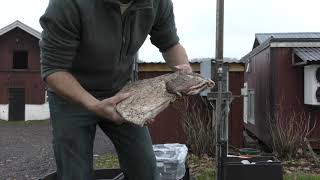
Richard Perkins cures and smokes bacon from his forest-raised pigs. He uses a dry cure of 2% salt and 1.5% sugar, turns the belly daily for a week, then smokes it at 80°C until the internal temp hits 65°C. The result is thick rashers he freezes for later.
Questions this video answers
2% of the weight of the bacon.
1.5% of the weight of the bacon.
About one week (turning daily).
Approximately 80°C (175°F).
About 65°C (150°F).
Chapters
So today we're making bacon, and I'm an eggs and bacon kind of guy. If you work physically hard, then a good breakfast with protein, fats and carbs is super important. And so today we're making about €800 worth of BAC. The process of making bacon is pretty straightforward if you have a smoker. One thing that's really important is making sure that the side of the belly had the skin taken off, because the skin doesn't allow the smoke or the salt and sugar to penetrate the meat. And then we're going to basically rub all the meat down with about 2% salt. So 2% of the weight of the bacon in salt. And I've got about 150 grams of pepper also. And then we've got. Hey, Ragnar. We've got one and a half percent with salt. So today we're going to unpack all this and rub it down with the mix. Bam. So this has been first, the thing about making good bacon is raising pigs in the forest exactly how they're meant to be raised. Pigs are climatic triggers of the forest systems. And their nose is designed to be a little plough. They're designed to live in forest systems, dig up, eat roots and shoots, and even catch more mammals and things. So we raise our pigs in the forest. And these are actually side flasks. You call them Swedish, but this is the side of the meat for bacon prepared by the butcher. Now we often home slaughter for making our own supply, but these have actually come from our butcher who supplied his pigs. Now these are beautiful sides of pork to make bacon. And we have over 30 kilos here. And so this is a lot of bacon. And once this has been smoked after curing for a week and cut down and frozen, this is enough supply for the rest of the year, even if I eat bacon every single day. Now, Ragnar likes bacon too, don't you? Do you like bacon? Yes, yes. For breakfast. Now, Ragnar is a great help in the kitchen. What we're going to do is rub each other these pieces down. Now, you see, the important thing with bacon is that you take the skin off because it's too hard for bacon. But you can see the fat. Now, these are from Linderud pigs. And so the fat is characteristically very thick on the back and it's very good for charcuterie. But these have been very nicely prepared. And the ribs are all cleared here. So we'll be rubbing salt and sugar. So 2% salt per weight, 1.5% by sugar. That's the Ratios I like if you put too much salt then it becomes too salty and then you have to wash the bacon before you eat it and that's a hassle, I don't want to do that. So I like to cure it for a week. Now I don't use any nitrates or anything like that. I like to just go straight up with salt, sugar and pepper. And we will coat and just rub it into the flesh on each side and on the fat on the back. And put these in a plastic bag, maybe in two containers. So three of these in each plastic bag, totally covered. And then the process is turning them every day for the next week. We're going to leave them for about a week and then we're going to smoke them, to cook them and also to impregnate them with the smoked flavour. So we're going to put salt and sugar on them now and put them in plastic bags in the kanga boxes in a refrigerator for a week or so. And every day we'll be turning that over because the process of putting salt onto meat will extract some liquid out and that's essentially brine. So you want that covering and massaged into the meat over the next week. So it's important to turn it every day. And then once it's been through that week's curing, we'll take it out of the refrigerator, wash it down and then put it back in the refrigerator to dry off for about four hours. And then we're going to put it in the smoker, going to set the smoker for 80 degrees Celsius. That's 175 Fahrenheit for those of you in America. And we'll probably smoke it for about three or four hours, maybe a bit longer. We'll see how it goes. We're looking for an internal temperature of 65 Celsius, which is about 150 degrees Fahrenheit. And then once that's cooled off back to room temperature. We'll slice this and I like to have thick cut bacon. When you go to the store and buy bacon you often get really thin rashers. But it's very nice to make homemade bacon from premium forest raised pigs like half inch thick. And you can either fry that up in the skillet to heat it up or you can put it under the grill and cook it like that. So we're going to cover these now and put them in the refrigerator. Okay. So we've mixed up sugar, salt and black pepper. I've got quite a lot of black pepper Because I like black pepper. But now I'm going to portion them up into six equal amounts just to make it easy to apply the right amount on each of the sides. Now we're going to be piling three in each of the kanga boxes. That goes into the fridge and this way we know we're getting the right amount on each and it gives us a little bit extra to play with. Okay, now we're going to sprinkle some of this on the back of this one. We're going to put half on the back and then a pinch more and we're going to rub it in like this. And this helps to draw out liquid and it starts to flavour the meat really good. Yeah, look at that. Yes, we're going to turn it over now and put the other half on. Going to just apply a little bit to the sides and then as we turn this over, we'll put the other half on. Now this one sits at the very bottom, you see. You want to rub that one in. Just rub it into all the little cracks. This is going to be our bacon for breakfast. Yes, super nice. Then the next one we put on, we'll take half of this because this will bring out all kinds of juices. So that'll be all piled up. And so each day we'll turn it over and add some different ones to the top. So we'll change the order of each of them. See, we really rub it in like this and this helps cure the meat. Then we take the last one here. This is a big one. So we're going to add some extra. And half of this, really rub that in. So we're stacking three up at a time just to make space in the. In the refrigerator. But we'll be turning these every day and adding. And, well, like massaging this mixture into the meat and changing the order that they sit on. So each day a different one will come to the top and we'll do it like. So that looks fantastic. So rub a bit on the sides. Then this bag will get nicely tucked around them all. I'm going to transfer this to the kanga butts and that can go in the fridge. Then the next one is coming in. So first we start to put the salt, sugar and pepper on here and really rub it in. Now some people like to use nitrate, but we're going to only be keeping this for the next few months. So when it's all reached temperature, no problem at all. Put the rest of that salt on. Some people like to use a bit more Salt, but you have to be careful. If it's too salty, it makes it a bit unpalatable. So we want to be quite careful with the amount of salt we use. And so 2% is what I found is the best. And one and a half with sugar. Some people like to use maple syrup or things like that, but we're just going straight up simple. Okay, we're back to baking now. I'm working just out in the little cooler room that we have, so it's important to have clean hands when you do this job. The bacon's been sitting, and you might just be able to see there's some liquid formed at the bottom. So my job is to come along and just massage this and get the juices in there, because this is essentially brine, and we want that all over all of the meat. And it's starting to firm up, which is a good sign. And so we just really massage each piece and change the order and put them back in. So it will have the piece that's sitting in the middle up on the top this time. And you just repeat this process every day for the week. And you'll notice the meat starts change and it will firm up over time, but all that juice is normal. That's what you want. So I'm putting this piece down on the bottom, this piece up on the top, and that's going good. So it's been here it's the third day today, and so soon we'll be ready to take it out and rinse it off and dry it ready for the smoking. Smells wonderful, all this black pepper. Okay, so it's been a week now, and the job now is to rinse the bacon off. You see, the meat has hardened up really nicely. Oh, look at all that fat. So. So I want to just wash off the excess of the salt now. And I'm just doing that under the outside tap because I'm actually going to leave this to dry for some hours in the smoker, just because it's more practical to hang it up in there than it is to put it back in the refrigerator. We haven't got a fridge that's a big enough open space to let it drip out without putting the really big chiller unit on in the slaughtery. And that seems unnecessary. So I'm just going to let it dry in the smokery before I light it up because it's pretty cool outside, so it's no problem. But you can really feel how the meat's firmed up. Lovely amount of fat on the back of these Linderud pigs. So my job now is just rinsing off all the excess salt and just rub it over. And a lot of the black pepper will stay on there, which is nice. And all of that salt has infused into the top section, so don't worry about washing off. Goodness. A lot of it has sunk in. Cured the meat with the sugar and too much, and it won't taste very good. So I'm just getting the excess off, and then I'm putting these in trays to transfer them over to the smokery. That's what we're talking about. This is my winter supply of bacon for Ragnar and myself. It's a treat for the eyes, let alone imagining breakfasting on this. It's a beautiful thing. You just got to make sure you hook it up in the smokery well and through the meat, because obviously it gets softer as it's cooked and smoked, and so we don't want it just hooked through the fat and falling off and losing it into the fireplace. That would be a disaster. So this is how the smoker is looking after hundreds of kilos of chicken going through. You see, there's a thick layer of fat on here, and this guard has been stopping it going into the heater. But the wood is really nicely impregnated with smoke. And the chickens that have been coming out have been glorious. So time to get this pig in. Now, some of these pieces are quite heavy, so I might want to employ two hooks. But essentially, you just want to nice and firmly put that in. I'm going to put one in this corner through the meat, And that's going to hang beautifully in here. Now, these are the heavy pieces, and so I'm going to put a couple of hooks through them, working sideways. I think. Just like with smoking chicken, it's important that the meat all sits at the same level, so you evenly cook and evenly smoke the whole lot. That's easy enough. We have the whole metal frame on the roof there. That means we can just hang things exactly as we please. Last one going in. Okay, so the meat's been sitting here for about four hours now, and it's developed a pellicle. It's like a tacky skin on the outside as it's dried off. And that's important to really get the smoke to a deer. So we're going to light the smoker now. 80 degrees Celsius. We're looking for an internal temperature of about 65 Celsius. So if we can get the smoke up to heat, I Think it'll take about three, four hours maybe to impregnate it nicely with smoke and cook the meat. But they're quite big chunks, so we'll be testing the internal temperature to see how that goes. So I'm using birch bark as the ignition for the small fire. And it's just a small fire. It's just to get the embers glowing. And then this is alder woodchip, and that's what's commonly available for smoking in Sweden. It's a riparian tree that's common in the riparian zones. It's not really grown commercially for any reason, really. This initial fire will get the temperature up in the smoker and only then I'll put the thermostat for the old sauna heater on to save on electricity. And we see that when we've been smoking chickens, it will get up to temperature. And then when the fire goes out and the embers start smouldering, the temperature will drop down again. But then the thermostat quickly brings it up and keeps it at temperature. You've got to be a little careful. We've got a metal plate that we keep against the door, and then it's concrete sides up to about here, so nothing's flammable here. And it's important to have drip trays to catch the fat. There's a lot of fat drips off and you don't want that in the fire because it makes a really acrid smoke. I think that's good. And so I'll close this door up a bit now, Leaving it a bit of jar. So now when the fire's gone out and I've closed the door up, I can plug the thermostat in and I set that at the temperature. I want to get the nice, even smoke. Just opened the smoker. Look at this. What do you think, Ragnarok? Beautiful. So we're going to take this in and slice it up and prepare it for freezing. So this is the bit we've been waiting for. It ended up being several hours till it got up to temperature. Just look at this. And so I left it sitting in the smoke overnight. And my job now is going to be cutting this down into usable pieces to go in the freezer. And, of course, eat some today. That is real bacon. The smell is amazing. It's really caught the smoke well. Proper farm eats. There's a really good sweetness on the skin and it's not too salty. I think the last one I made in the summer was a little I've left too much of the salt on. I think this is perfect. Now I measured the internals on these big pieces and this got up to about 68, which is perfect. So this is already cooked and you can eat it just as it is, but we tend to then fry it or grill it to cook it again. So I'm just going to work to slice all this up and get it ready to put some of it in the freezer. These are particularly fatty bits. So this is very characteristic of the Linderhud pig, but that is proper eats. That animal fat is super nutritious and really good winter food. Now some of the pieces will be more meat focused, but I'm very happy eating a lot of fat over the winter. It's perfect. It's nice with homemade bacon to cut it really thick, quarter to a half inch thick. It's very unlike what you get in the store, but really delicious. Okay, so here's the result of the two belly sections from the two female pigs that we took to this laundry earlier in the summer. And so it was a very large 210 kilo female and a smaller one. And you see that in the bacon from really fatty chunks like so. Whereas we get nice side bacon from the smaller pig. It. Okay, all done, all packed, ready for the freezer. And that is the end of the video. I hope you found that interesting. See how awesome forest raised bacon is made. Thanks so much for watching our videos and you can find out a whole bunch more in the links below, including our book and online course. See you in the next video.
More from Richard


A review of short and intensive season on a mixed farm and restaurant/event space in Sweden






Alskade Kyckling Exploring complexities of poultry production in Sweden and what we stand for


