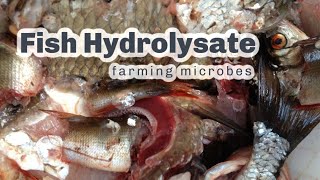
Richard Perkins shows how to make fish hydrolysate, a fertilizer ingredient for compost teas. Fish breaks down into a nutrient-rich liquid that boosts soil fertility and fits into regenerative farming practices.
Chapters
Okay, welcome back to another episode. Today we're making fish hydrolysate. And that's a very important ingredient for us for making our compost teas that we like to put on crops throughout the year. Now, it's a little bit more of a gruesome subject than perhaps some of our other videos, so viewer discretion advised. But I want to show you how we make this and why. So when we study ecology, we see that life and death are literally two sides to the same coin. Soil fertility is directly related to the amount of death and decay that's happened. Now, we use a lot of animal manures to improve our pasture or for making compost. And this is a recipe using fish, which is very high in nitrogen to make complex proteins and amino acids available to particularly fungi, which are a lot harder to grow in compost and compost teas, bacterias, you pretty much feed sugar and oxygen, and they will breed rapidly, the aerobes. But fungi are a little harder to breed. So we need to prepare certain things to enable us to make fungal orientated compost or fungal teas. So composting is a primarily bacterial process, so you can never really have a fungally dominated compost, but you can increase carbon matter and do different things in composting processes to help orientate it towards the fungal spectrum. And the right nutrition is important. So we make fish hydrolysate early in the spring to enable us to make compost teas in a few weeks as we start to really go into rapid growth. Now, fish has been used as fertilizer in agriculture for at least 10,000 years. It's a very important part of the Egyptian farming system. Now, this is a pike, and the reason I decided to use this is I was actually down in the mill pond last night searching out for the brown trout which grace our rivers here. And I have a theory that the brown trout population was hammered really heavily by the drought we had two years ago. If you look back at old videos of that time, you'll see both the streams that run to our farm were drying up, even the one that normally runs all through the year. And I was finding little pools with seven or eight brown trout slowly dying in there. Now, I rescued some and put them in our pond, and I actually just checked the stocks in there by fishing with a lure, and within three seconds, I caught a healthy and rapidly growing fish out of there. So my curiosity took me down to our local mill pond, and the reason I wanted to check it out is because I haven't seen any fish rising. Now, as the insects start hatching. And when we first moved here, you'd see 50 at a time. And I love these brown trout. They're wonderful eating, but they're just wonderful fish. And signs are very clear water. As I was fishing, I happened to come across this fellow. Now, pike are ferocious predators. They're the apex predator in the lakes here. And a neighbour walked up just as I caught it and he begged me to take it out of the mill pond because a fish like this on already depleted stocks will just decimate the young trout in there. That's primarily the food it will be finding in that mill pond. So given that we've just been catching some of these for the table, I thought we'll have a break from eating it and we'll turn this into fish hydrolysate. So the ingredients for fish hydrolysate are fish. Now, you could use the guts and heads and the waste materials and eat the fish and they're the best bits. And often that's what you see in nature and the hunter gathering societies. It was actually the offal and guts that were treasured and then the fat and then finally the meat. But given our conventions, we tend to like to eat the fish. But you can totally use fish waste for this. That's totally fine. I'm going to use as much of the whole fish as I can get through the grinder. And then the other important ingredients are chlorine free water. So whenever we make any soil prep or biological preparation, we use chlorine free water because chlorine obviously kills organisms. We need molasses, so that's sugar and trace minerals. And we need something with Lactobacillus. Now, I've got some red cabbage sauerkraut here. So that's. The juice of this is full of Lactobacillus. So that's perfect. What we're trying to do with that is lower the acidity. Sorry, lower the ph, make it slightly more acidic to control the decomposition. This is going to ferment in a little bucket with a simple gauze on top to stop insects getting in. And we'll leave it for two to four weeks. And then we will have soluble, high complexity proteins and amino acids and other things that will really help us to make thriving compost teas that we'll make later in the year. So first step is to try and fillet the fish, get away the main bones and then we'll put everything through the mincer and then I'll talk to you about the recipe and proportions of these Other materials. I did warn you, it'll be grizzly and gory. This is in the stomach and you can see the leg here of an adult frog. So this has been feasting on frogs as well as young fish. Okay, so we've actually got the whole frog and the guts and everything in here. I told you it would be a little bit gruesome. So hope it's not too much for anyone. But what we're trying to do here is get the fish into pieces that will fit through the mincer little bones. Okay. But you've got to be careful putting bone through a mincing machine. It can damage the motor, but there's no wastage. In fact, in ecology there's no waste ever. Everything's food for something else. The little side scraps can be boiled down and the cats will love to eat them. So this is what we need for our recipe. So we'll go ahead, we'll mince that up and see what that looks like afterwards. It. Okay, I can see there's a lot swirling around in the machine. So I'll take the machine apart and just scrape the rest out. Now this is perfect. We need liquefied emulsion at the end of this. So we want as much surface area as possible. That's why we put this through the mincer. Now I'm aware that this will be outside of some people's comfort zone and that's fine. We do all kinds of things on a farm that are outside of a lot of people's day to day things. But what I'm extremely interested in is farm ready technologies. Things that farmers can do around the world with materials easily accessible that can keep them away from corporations. And so I'm very interested in farm based fertility things we can do ourselves like biofertilizers. We've got videos on how to make this MPK replacement using like mimicking a cow's gut. You can find old videos on how we make that. That's a foliar feed that we will use to help plants photosynthesize stronger, thus release more sugars into the ground and get more nutrients back from the soil food web. So it's like a, almost like a homeopathic dose of MP&K and growth hormones, biostimulants that makes plants do more work. Now the reason that's important this is technologies that farmers can do with materials lying around on farms or near farms that can get them out of the grip of big agribusiness. And things like bioferts are used by over 90 million farmers, particularly in poorer countries, South America, Africa. And that's where we look to for our soil remedies, because people have had to be innovative out of necessity. Now, this might be a bit gruesome, but that's what we've got. The next part of the recipe is to mix 1 part fish to 3 parts non chlorinated water. So you can just weigh this on the scale and add three times the weight in water and then we'll mix that up. Okay, so we've mixed that up into a slurry. Next thing is to add 1 part molasses to 3 parts weight of the water and fish. Now, I'm going to eyeball it because I've made this a lot and so I can do that volumetrically. But this is providing sugars and also trace minerals, because sugar cane is extremely effective at ripping nutrients out the ground. So we can mix all that together and it will start to have a sweet, sticky aroma. Now, when this is fermented, it will actually smell quite sweet, like the byproduct of most fermentations, and it will have a fishy smell, but it doesn't smell putrid in any way, it smells sweet and inviting. It's like compost. You know, good compost smells like forest floor. Very inviting, natural smell that I have an affinity to at least. So then we've got our sauerkraut. So what I want to do here and see if I can get some juice out of here. We're looking for one tablespoon per litre, and I've got a couple of litres here, and this is full of Lactobacillus, So we are inoculating, we're adding something that can grow and the acidity of this liquid will help control the fermentation process. So once we've got a bit of that in there, we're ready to mix it up. That is how simple it is. Now, we will leave this for two to four weeks to ferment and then we'll sieve it through the mesh that's on top of it, and that will give us a stable, clear liquid that we can store forever then and use it as a direct fertiliser on plants on the surface of the compost around them. Or we can put it into compost teas, and that's what we like to save it for, because we don't make much of this. But this would be enough to make over a thousand litres of fungal compost tea of very high quality. So I'm going to put that on there and we'll store this in a cool, dark place. We'll check back on it in a month's time or so. And that will form the basis of some compost tea recipes that we'll be making later in the summer. Hope you enjoyed that. A little bit gory today, but I thought it's interesting to show you some of the processes that not only we can do ourselves to help optimize fertility on our farms and promote life, but some of the more interesting elements of, you know, working as chemists and biologists to support the ecosystems that we're managing. As I always say, we are micro farmers. Fundamentally, if you're focused on your end product, grass fed beef or lettuces or whatever it is, then you're probably asking wrong questions somewhere down the line. Our job is farming microbes and if we put our attention always on the soil and sequestering carbon and building soil, protecting it, building habitats, then we are able to observe wonderful interactions in the ecologies that we are managing. And that's really at the basis of what I would define as regenerative agriculture. It must be soil building and it's these kind of farm ready, low cost, low tech technologies that allow us to create the conditions that allow life to thrive. And this is the basis of regenerative. We can only really call our work regenerative if we can show that we are building, soil building, microbiology, and you need to actively engage with that and monitor and observe it over time. Simple things like a soil microscope, you can buy that for €150 and you can actually see what's in your compost, what's in your beds, and how your actions change things over time. And then you don't need any experts. You can see in your own direct experience what your work and thinking is doing to your land. So hope you found that interesting in some way. Let us know if you make your own fish, hydrolysate and what you like to do with that. And we will see you in another video soon. Bye for now.
More from Richard


A review of short and intensive season on a mixed farm and restaurant/event space in Sweden






Alskade Kyckling Exploring complexities of poultry production in Sweden and what we stand for


