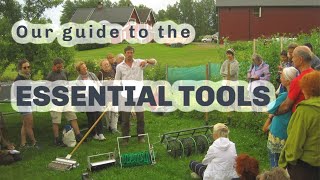
Richard Perkins shows how to build no-dig market garden beds by layering 400 litres of compost onto the ground instead of tilling. He uses 75 cm wide beds with custom tools like a 5-tine broad fork and a bed roller with row markers, managing fertility through annual compost top-ups, oyster shell, and crop rotation.
Questions this video answers
75 cm
10 metres
About 400 litres (initial application)
Approximately 200 litres per bed (every second year for heavy feeders)
40 × 40 centimetres rigid plastic trays
Chapters
So we're here in the north beds. It's part of the market gardens here at Ridgedale. And we're working with a no dig approach to market gardening, which means we form our beds by layering compost straight onto the ground. Now, this is the first season that we've been doing this here. We have some beds on the south side where we've been doing no dig for three years, so we can go and have a look under the ground there and see what's happening underground. Because by layering compost on the surface, we're using compost as mulch. Essentially. It's quite compost intensive. We're putting about nearly 400 litres on one of these beds as the initial bed preparation. And you'll notice all our beds are standardized in their size. We work to 75cm because this is what all the innovative new market gardening tools I'll show you that we're using are built for. And that's largely due to the work of people like Elliot Coleman and the arrival of innovative young market gardeners in America. And we work with our beds at 10 meters of length because that fits the overall layout of the garden spaces here at the farm. And I want to run you through the basic tools that we use in this approach. We're very excited about no dig. You can grow any vegetables in a no dig system. And really it's the best soil care methods for annual production that I've come across. We keep soil covered all of the time. We're adding a large amount of organic matter which we can then produce on farm through our animal systems to keep this system fed and hungry. Because bear in mind, when you're growing annual vegetables, you're growing things that have been bred to extract nutrient out of the ground very intensively and then you're exporting them off site when usually not taking that nutrient back to put into the cycle. So you really need a lot of feed. It's quite a lot of inputs for productive vegetable garden, and that will always be the case. But if you have a diverse farm, there's a possibility to create all those resources on site. So Initially, with a 10 meter by 75 centimeter bed, we put down 400 liters of compost. It depends very much on the type of compost and how moist it is as to the weight you will need. Every second year we will then put down 200 litres per ped for heavy feeding crops. So we have an approximate 10 year rotation in crops here at the farm. And every year there will be heavy feeders in one bed, and the next year, light feeders, so they will feed on the compost remains from the previous year. Now, it's important you get enough compost down to smother the ground if you want to do this. And it's best to build these beds in the autumn season when growth stops. And we've been using packaging cardboard that we find in 75cm widths and it comes in hundred meter rolls. And that's very convenient. If you've ever used newspapers or pieces of cardboard to create beds, you find it's very hard work to. To get enough material together at one time. So we put a little money into buying this material. It's made out of recycled paper and fiber, but it's very quick to roll out a 10 meter bed, snip it off, cover it up, and off we go. We can plant into that immediately. All of our planting happens in these rigid trays, which are 40 by 40 centimetres. We have 64 trays and 14 fours. And most of our crops will go into 64s. And the things that will stay in trays for up to a month, things that don't stay in trays for long, will go in 144s. And you can see those in the notes. And what I like about these trays, they're a rigid plastic, so they last for maybe 10 years if they're looked after. And you can carry a full tray with compost and seedlings out to the field without it bending and breaking. So for us, it's been really worthwhile investing in slightly more expensive but much better quality trays. And then in the start of the year, we must have lights on our plants indoors. We've got to start seeding. Things like leeks and onions get seeded in March, and then by the end of April, most of our seedlings have started. So we've built racking that I show you in a different video that takes three of these trays. And we'll have three fluorescent lights above each row of trays that can be moved up and down on chains. And each rack will hold 12 of these trays and we'll have 15 of those. Currently, they've been in our living room in the spring, and we're building a greenhouse on the side of the house to keep that spring production out of the land. So we have our seedlings going and then we lay out compost. Something that's important to consider when you put down such a high amount of organic matter, is you can lock up nutrients because of the role in soil chemistry you'll find in the notes. So we put down a calcium source and in this case we're using crushed up oyster shell because we have it in abundance for our laying hens. So in a bed like this we'll put down one to two kilos when we first initially make the bed and that's mixed all through the compost. We also put down rock dust for nutrition and then we're off. And the process of forming a bed is to first broad fork. Now this is a broad fork with five tines built for 75 centimeter beds. And we use this by standing down into the ground and just loosening the subsoil. We're not turning the soil over at any point and we'll work our way along the bed. Now this bed is very soft because it's been forked a couple of times this season. It's already produced two crops. And we'll do this about 15 to 20 centimeters apart. It's a very ergonomic tool. And I anticipate if we keep the no dig system together, then we won't really need a broad fork after a few years time. So that's done all the way along the bed and then we're either going to be transplanting or direct seeding. Now it's important to have a level bed. So we use these forks that are the right width for the bed just to scrape the surface and make it even move material along. And often if we've just taken the crop out, we'll have cut it down so that the roots of the previous crop are still in the ground. And that's really important and it's a really nice part of the no dig approach is that these roots that are left from previous crops are then decomposing and feeding the microbes in the soil food web. These forks can be used for row marking too, with simple plastic tubes that fit onto the rake like so at the desired crop spacing. Now we use pretty intensive crop spaces that you'll see in the notes. But this is one method where I could mark a row if I wanted to put a crop in at a set width. So we have very precise planting patterns for all our different crops that you see in the notes there. Sometimes we'll be direct seeding. This bed would be fine to transplant into, but if I want to use one of my direct seeding tools, then first I will use a bedroller which compacts the surface because most seeds need a little bit of compaction to be able to get a good germination rate. So this is a simple bed roller built for 75 centimeter beds. And you see the little green rubber bands on it are acting as a row marker so they can be unclipped and moved to the desired spacing. In this way, we can roll the bed flat so we get good seed germination rates and mark the spacings of transplanted beds if we want to. And we'll typically put a concrete block on here to add some weight and then offset the handle so we can push this along without walking down the path. And it acts like a crumble bar on the back of many farm machineries. It will create a fine tilt and a bit of compaction, but as you can see, it marks the row spacing. If we wanted to transplant crops. So that's quite a handy tool that we use when we're forming the beds.