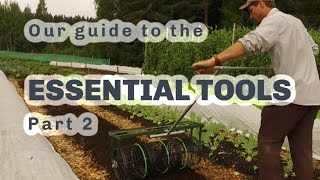
Richard Perkins (Market Garden Tools part 2) demonstrates small-market-garden equipment and techniques: manual Earthway seeder for larger seed, a six-row precision seeder for salad crops, construction of inexpensive hoop row covers from 4 mm galvanized wire, use of 18 g/m² and 40 g/m² fleece and insect mesh to extend season and protect against flea beetles, pathway management with 10 cm wood-chip mulch, weeding tools and tactics (Korean hoe, precision weeders, oscillating hoes), and a drill-driven salad harvester for efficient baby-leaf cutting. The narration includes practical calibrations, maintenance tips, and seasonal timing relevant to a short-season site (59° latitude).
Chapters
And then next we have our direct seeders. This is a simple Earthway seeder. They're not the highest quality tool, but they're good for larger seeds like peas and beans. And the basic components are different seed plates that fit into the back of the machine. I just pull one out here, and you see this is for some small beans and peas. And so that's what picks up the seeds and ejects them down the little shoot here, which can be set with a simple butterfly clip here so that we're putting seeds down at the right depth. And it has a little measure on here. So it's powered by the wheel and drop seeds at set intervals. So you have different plates specifically for different seeds. And then you even have a row marker, if you wanted to work with a row marker there. And so this first wheel is compacting the ground and powering the seeder. The machine is making a furrow, and the chain is then pulling soil back into that furrow. And the back wheel is compressing it to give us good seed compaction. And that little pressing is what helps make the seed have the right conditions to germinate. We use another type of seeder, particularly for things like spinach or rocket and mesclan. And it's a bit more technologically advanced. It's a six row seeder. And then you could use it every alternate row for seeding things like carrots at a wider spacing later in the year. It creates a very nice tilth with these tumble wheels. And again has the little shoes that direct the seed at the depth you would like. And you set the depth of this tool by unscrewing this. And you can lower the rear compression wheel up and down. It has little fine brush settings, and inside you'll see it has little machined holes that are designed for different seed sizes. And you adjust this using an Allen key and moving the bar in the middle along to suit the size seed that you're using. And there's information in the instructions about how to calibrate the brush settings and the plates for different size seeds. And it's powered by the rear wheel. And you can see there's different pulley settings. And by changing the combinations of the pulleys, you get different row spacings. So this is great for mesclim mix and for baby salad mixes, things like carrots, spinach and rocket. And it's very quick to use. This tool needs a fine surface to work on, but essentially you can roll 12 rows of baby salad in a couple of minutes, which Saves a lot of labour time, you'll see. We're approaching the end of the season here, so everything's going back under row cover. And the cheapest, most practical way to make row COVID support is buying a reel of galvanized wire. This is a 4 millimeter wire and I wouldn't recommend getting any thinner than that because it won't hold the fleeces or insect nets up off the ground. And we just cut these to 1.5 meter lengths, which is perfect for a 1 1/2 meter wide row cover with about 10 to 15 centimeters of COVID put into the ground. And so these are just placed in the ground every meter. The reason these nets are so important is we're growing very far north at 59 degrees, and we aim to produce 20 boxes a year, which is quite a stretch in our climate, where we have several weeks variability in predicting the seasons year to year. So in the spring and the autumn, everything pretty much becomes under row covers. And they're a fantastic tool for the market gardener because they can lift the inner air temperature by quite a few degrees and protect crops from frost. So we use two types of fleece. This is at 18 grams per square meter. It's a very lightweight fleece suited for late spring and early autumn. And then in the very cold times of the year, we'll go up to 40 grams a square meter. Quite a heavyweight fleece. And we put these in the ground over the metal hoops. So we cut these to one and a half meter strips and that's enough to arc over the bed for most crops using 4 millimeter wire. And we pin these down using metal ground pegs, which you can buy in bulk, several thousand at a time, pretty cheap. And it's a little investment. But we find these are very easy to work with compared to using sand, sandbags or clods of earth or other things that people use to row down covers. It's much quicker to lift them off and put them down again. One other thing we put over the hoops is insect netting. In this part of the world, we're plagued by flea beetles. And so the key with flea beetles is to get an insect mesh of adequate micron size straight onto the crop as soon as you transplant or direct seed it. But these are really important tool in our season because we have our Last frost, typically 7th to 10th of June, and then in the middle of September again. It's a very short growing season. And this is the easiest way to extend the growing season, other than something like a glass house or a polytunnel so once the seeds are in the ground, we have some maintenance to do. We use a couple of simple tools and they're very good for their job. We do minimize weeding by this no dig approach, but there will always be some weeding to do, particularly on the edge of path rows. But in the beds too, things will be germinating in those beds continually too. You see, we put wood chips in the pathways and we'll put them about 10cm deep and renew them annually as they start to break down underneath. And they're great for absorbing excess moisture and holding it underground. But also hopefully we'll start developing fungal mycelial networks around the garden. But it keeps everything looking clean and tidy. And that's something that we enjoy here, is having a very pleasurable working environment. So weeding we do with a few different tools. This is a Korean hoe. It's a fantastic little tool for transplanting. I can just pull the soil aside, whack in a little transplant. But it's also a very accurate tool for getting in around things for weeding purposes. Then we use some precision weeders. And these are fantastic for tight crops like a lettuce crop, where we can get in close to plants really quickly. And the key with weeding is to disturb the weeds before they grow their first true leaves. So when the first cotyledons come, that's the time to get in and disturb a weed. If you leave it too late, weeding becomes much more of a chore. You also have these oscillating hoes which are great for just cutting through the roots, just by disturbing the surface between the plants. And you can work very quickly with these in the early stages of emergence. They are a quality tool and they need sharpening regularly. And like all tools, they get cleaned and put back at the end of each use into the workshop. So that's a few of the basic tools that we rely upon. One more interesting gadget I can show you is how we harvest our salad mixes and greens. And this is a labor saving tool for cutting baby salad mixes. It's only made in America currently, and it's specifically for spinach, rocket, mestin mix, etc. It's got razor sharp serrated blades and a brush. And you use a simple cordless drill. And it uses this pulley system to cut and then put the leaves into this basket like so, which means you can harvest salad leaves walking at a slow walking speed. It's a very efficient tool. And then we just look after this by simple using a high pressure air to clean it off and give it some food grade oil ready for next use. So that's an interesting tool. It's a little bit of an investment, but if you're growing a lot of salad mixes, it's a worthwhile investment.