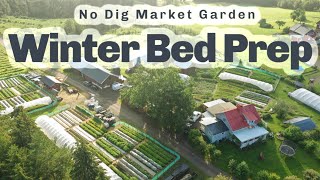
YouTube video by Richard Perkins explaining how he prepares market-garden beds for winter using a no‑dig system. He covers bed dimensions, compost application, and the use of non‑woven geotextile covers secured with metal pins to protect soil, reduce tillage, and simplify spring planting operations.
Chapters
So it's above zero and raining here, which is great because it means I've got last chance now to cover up our beds before the winter. So pretty much done. We've got 200 of these beds. They're all 10 meters by 75 centimeters. And these are the new beds we haven't grown in yet. So these have been covered up earlier in the year. I've been working on the other beds on the north side of the farm and I'm really into covering up the beds over the winter for a couple of reasons. Firstly, it just protects the beds from the elements. We have a very long winter with a lot of rain and snow and the mulch, because we're doing a no dig set up, we have the soil permanently covered. And that's really, I mean, since growing veg since I was 18 at Organic Ag school, I really haven't found a better way of growing veg than doing it. No dig. There's no better soil care method. In my mind. We're keeping the soil permanently covered, just like nature does in all circumstances. But the biggest benefit, I think, is that because we have our whole year mapped out in the crop plan and we know exactly what's going in which beds, when it makes life. At the start of the season, when things get busy much easier, we can just come along. It takes a few minutes to just peel back the COVID and we rake the surface. We'll use our roller on the bed and then we're ready to transplant or to seed directly, just with the addition of a bit more compost. Perhaps all the beds that have already been grown in, like the ones here, we might add a couple of hundred litres per bed to be able to create a nice seed surface for using cedars. And that's because we always leave the roots of the plants in the ground. We'll harvest crops of different kinds and then come back in and just chop them off at ground level because we want to leave those roots in the ground to decompose and feed the soil food web. And we'll put on the new beds that we haven't used yet. We'll put down maybe 400 liters of compost on each of those beds. They already have a bit of rotten animal manure and bedding. And these covers will just help protect those beds as that rots down over the winter and gets incorporated into the soil a bit. But it's really important, I think, to keep the ground covered all the time. Now, you could do that with green manures, but if you're Working with green manures, typically you're going to be working with tillage and we don't really want to do any tillage. We don't really use any machinery. We don't do surface prep other than with a rake and a bed roller. And for me it just feels like a better investment. Some people have asked if it's sustainable to use so much compost, but your alternative really is investing in diesel or oil to power machinery to do tillage, which has other unintended consequences too, which is not what we're shooting for. We're using this really high quality non woven geotextile. It's a little bit expensive compared to cheap woven materials, but like that cheap Mipex of black woven plastic is horrible stuff. When you cut it, it just frays and falls apart. It looks ugly and frankly it's not something we like working with. So we've invested a bit more in this material. It's a lot heavier weight, it has a much better gas and water exchange and it should last 10 to 15 years. Now we hold that down with metal pins, about 8 inch pins, and we'll put 20 of them per cover, ideally every meter, because the beds are all the same length. And I find, personally, I think they're really great. We've in the past used sandbags, used clothes, clods of earth and bits of wood or other heavy material, but that's such a pain to move around. These are really quick. It's easy to carry hundreds of these in a bucket and it's really easy just to peel this back and rake it over and get ready to plant straight away. It's a bit of an investment, but it makes life much easier in the working process and it does make holes in the material. But because it's a non woven material, it doesn't really rip or fray. If you have enough pins or you're sheltered from the wind, it doesn't get damaged in any way. So I hope these will last for many, many years. And I think that it's good to point out like this stuff comes in rolls, we can only find it in 2.4 meter rolls. And so we've sawn it into three rolls of 80 centimeters wide because all our beds here are 75 centimeters wide. So it just covers that up nicely. And because it's non woven material, you can saw it through and it doesn't fray, so that's really neat. So we spend a little bit of time just chopping the material up into the bed shapes and then it's very quick to cover up the beds. A lot of folks ask why we don't use things like straw or other organic mulch. Well, the answer is straw is something I would never use on an annual veg bed. One it's really inefficient to take it off every time you want to seed a crop. It wouldn't work for many crops that are direct sown. And another is that you'd need to pull it off in the spring to warm the soil up to get good germination rates. But it's also and the biggest problem here in this context is the Spanish slug, which creates a perfect breeding ground for them and a lot of gardens in Sweden are plagued by them. We don't actually have a problem with that here and we want to keep it that way. So we keep the ground covered all the time with organic matter compost that is feeding the plants and acting as a mulch. And slugs don't like to breed in it, which is fantastic. And then in the winter we just protect them further using geotextile and it's much better approach if you're trying to do this at any scale as a market garden. That's how we prep our beds for the winter. Hope you liked the video and you can post any questions below and I'll get to them and hit subscribe if you want to keep up to date with the farm. Thanks for watching. See you next time.