MICROBES ARE THE BASIS of all our farm productions...
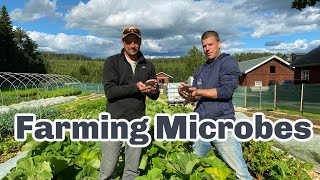
This is a recorded interview (YouTube) in which Richard Perkins interviews Joe Carey (59 Degrees) about soil microbiology, compost-making and practical microbial inoculation techniques. Joe recounts his transition from an arborist to building a company focused on restoring plant health via compost extracts, root injections and foliar compost teas, drawing on Elaine Ingham's microbiology approach. The conversation includes hands-on advice for home gardeners and market-scale growers (compost methods, inoculation frequency, equipment needs) and describes 59 Degrees' compost-hub product and educational focus.
Chapters
All right, welcome back to another episode, folks. Today I'm here with an old friend, Joe Carey from 59 Degrees, and Joe is very excited about soil microbiology and compost making. So we're going to have a chat about that today. So Joe, we met in. When was it?
Summer of soil? 2013.
2013, I think.
2014, maybe.
Joe is from Wales, which is an appendage of England, I'd say.
Indeed.
And you were running a pretty successful tree surgeon business, weren't you? And it was with Joe that we made a Jean Pain compost near Stockholm, which was a pretty full on project.
Yeah, totally.
And made beautiful compost too.
Yeah.
But you turned your attention away from your business and started up a whole new company.
Yeah. Essentially, having met you and being enlightened to the information that you share now on a daily basis, it really opened up another world for me in terms of how as an arborist, I'd been dealing with the symptoms of health rather than the kind of the roots of health, if you will, to use an appropriate pun. And as an arborist, I really wasn't equipped with the tools of remediating plant health. And so that really opened up the avenue to put up a number of tools for me to really build plant health from the soil up.
What was your journey then? I know you did Elaine Ingham's training.
Yeah, she's been kind of the foundation, you could say, of the work that I'm immersed in. Elaine, of course, is a microbiologist. She's not a soil scientist or a plant physiologist or a botanist or an arborist. So I think one could say that I've kind of brought a plethora of topics together to kind of synthesize some really important information that on a cultural level is key to our kind of entrance, if you will, back into the spirals of health.
And what did that look like in the early days for you? You were doing a lot of root injection work and trialing stuff.
Yeah. So as the story goes, I had about €100,000 worth of trees in the ground that were dying planted with very poorly engineered soil that we would as kind of standard working practice. And my hands, as an arborist, putting all of these trees in the ground, my hands were really tied in terms of the potential to establish trees based on the supplier. And kind of going into this world, you realize that these big soil producers or compost makers have about as much integrity as. I don't know, I was going to say the English, but can't say that. Sorry. Just a bit of. A bit of sparring. No, on a serious note, it was.
In the context of like you were putting in a lot of parkland sized trees.
Yeah.
Large mature trees.
So we're talking. So standard working practice looks at pit planting. You buy in large trees.
This is for context. This is for like estate work, where people have an avenue of trees and they don't want to put a sapling in the ground. They want something to immediately.
Yeah. They want immediate gratification. We're talking. So we're putting trees in the region of 1,500 to €2,000 a pop in the ground, using potentially 15 cubic meters of soil. If you're growing in poor, poor soil quality with the, I suppose the hope that the plants will take. And they didn't. So I was really scratching my head in terms of how I could with perennial plants. I mean, clearly you're dealing with a hidden root system. So what tools did I have available to transform the health of the plants? So I did an awful lot of research based on Elaine Ingham's work, made a couple of machines based on a simple brewing system and root injector, which.
You might have seen on the channel. It was a few years ago now, but Joe brought his rig over here when we had an internship running. You might have recognised Joe from some of the arborist work he's done here with working with our interns as well.
So I went away and made some high quality, handmade, high quality compost, made the machine, made some extracts and the transformation over a growing season was incredible. And that was, I guess, the kind of R and D, so to say.
Is that with the root injection?
That's with the root injection.
Maybe explain what that is to someone that doesn't know much about it.
So a root injection essentially is taking the microbes from compost, because compost ultimately is a biological living system. I don't necessarily put too much energy and energy into, or attention into the kind of chemical aspects of compost and those are made redundant, essentially, when you're looking at extracts, when you're making extracts, you're looking at taking the biology from this humic substrate. So to say that then is brewed in a big tank of water, you're extracting the microbes from the compost into the water. That then is just a carrier for getting the microbes in and around the root system of the plant. And that's essential, obviously, when we're looking at working with perennial plants.
So you've got this like meter long needle injector. That's essentially putting your compost tea or an extract down at the root zone.
I don't know how big your meter is, but my meter is about so big, we're talking about eight inches. And we inject that living extract then in and around the root system under the drip zone of the tree that we call it, which is where the density of fibrous roots are found. And that is, you could liken that microbial inoculation to something like a sourdough. That's the, that's the kind of foundation of the microbial communities that we call it a later successional plant would enjoy in its kind of niche environment. And those microbes were missing from the engineered soil that I was buying in. So after doing the research and meeting you and really kind of going to the depths of the subject, I found that that was the missing link. So we would have to go about and make that product and establish those microbes so that the plant eventually could take over and start building fertility.
And so explain then what differences did you observe in that first season's growth after applying the extracts?
Well, it really depends on the health of the plant initially. There are very few plants that actually I have failed to. Or the microbes you could say have failed to remediate. Some plants are really stubborn. I mean, obviously as the foliage of the plant dies back, which is looking at kind of plant senescence, like the foliage dies back, which is symptomatic of the root system also dying back, you need to continually apply, one would need to continually apply these microbes to kind of intervene in some meaningful way so that you can actually encourage the plant to making sugars and then feeding the microbes that are so fundamental to the health of the plant soil system.
So are you looking at growth rates and plant vigor and healthier?
I'm looking at, I'm tuned into density, foliage density and leaf color and thickness. These are indicators. For me, these are prime indicators. I'm not so heavily focused on growth per se. What I want to do is look at a tree that quite literally on a physiological and physical level, cannot fit any more leaf biomass onto its crown. And a tree would only grow when it can fit more leaf biomass, so to say. So I'm really, that's my focus of attention is, is growing plants with literally as much leaf as is possible. And you know, if that's the case and the leaves are quite clearly healthy, in that case the plant will be quite clearly healthy, then the health of the microbes and the health of the soil which is ultimately a sum total of the interaction of animals and plants will also then be in a peak state of health. And then you're in this place of self organization, self optimization, which plants inherently are. And it's only, I would say it's only for our false assumptions on taking soil into like a chemical, the chemical domain that, that we've sort of led us down this avenue of looking to try and cheat the system through applications of synthetic fertilizers.
Sure.
And then you have to support disease through, rather support the plant in disease through the application of pesticides and fungicides and nematicides and all the rest of it. And all I'm doing is basically building the structure of the soil structure so that the plant can make best use of the minerals that are locked inside.
So very much in line with Elaine's thinking of if you've got soil at all, you've got plenty of nutrition and it's the life that needs to be put back in most cases.
Yeah. So it's not only my research but my experience now tells me that the limiting factor in most growing systems is the capacity for soil to hold water. And that is always going to limit photosynthesis since 95% of water is vaporized, the technical term transpired through that process. And so if water is the limiting factor, then your plant isn't going to produce sugars. And yet somehow we've got into our minds that perhaps manganese might be the limiting factor when actually it's soil structure. Soil is a living system, it's a biological system. It's been somehow interpreted as this kind of chemical.
Reductionist.
Compartmentalized totally. There's very much a compartmentalization process going on that is appealing to the kind of machine operator, I would say. And building compost and building fertility is very much a hands on. My own experience tells me this is a hands on approach that needs a dynamic kind of reciprocal engagement that cannot be solved through mechanization.
So what is then the, is there a difference between what you call an extract and a tea?
Yeah, for sure. Extracts are fundamentally just the biology. And teas you would add, you would add foods to the, to the biology and then you would apply that to the, to the foliage of the plant and the extracts are injected into the, into the soil system itself.
Okay. And do you do them in combination?
Yeah, so generally I operate a two tank system. So generally when I'm, when I'm treating plants, I would root inject initially root inject the soil with microbes, the extracts, and then Secondary to that, I would apply the compost teas, which you could say the kind of shield of the leaf and the above ground part of the above ground part of the plant, which are vital, they're fundamental to the health and vigour of plants. There shouldn't be any aspect, according to Elaine, there shouldn't be any aspect of the plant that is not coated in microbial communities of some sport beneficial microbial communities.
Yeah, we talked about a lot how if you could take an electron scanning micrograph, your skin should be covered in microbes and likewise a tree in a wild habitat should also be. You shouldn't even be able to see the surface of a leaf, which is not the case in agricultural site.
Sure. And I don't think that we give enough attention to the toxins that are floating around the atmosphere that by definition of stripping plants of their inherent capacity to resist pathogenic attack. And this is really important work that we need to engage in in order to promote the health of plants that we're immersed in, whether we're eating or otherwise. And my question has always been, how are we people supposed to, we humans supposed to optimize our genetic potential, if you will, if plants aren't doing the same? And the very notion that you can go out and feed plants NP and K and then go out and express yourself optimally like this is. This is really the emergence of a culture that is declining in health rapidly. And I guess I built this company because I didn't want to be part of that destructive culture. I wanted to actually bring some really important information to the fold that Elaine has spent her whole life working with and being in your company and in Elaine's. I just felt like this is information that the whole world needs to know about. This is a solution to agriculture.
We talked a lot about. We just had a training here. And something I've always reiterated but totally continuously now is like, hey, we're microbe farmers. It's like, you're not raising beef, you're raising microbes, you're not raising vegetables, you're growing microbes. And it's really the fundamental basis of our productions. So I'm wondering for viewers at home who don't have fancy setups. Now, obviously you've been talking about fungal orientated compost for perennial work, but this can obviously be applied to annuals too. What would you say is the most easy leverage point for someone at home with a market garden or orchard or whatever that they can do at home scale for themselves?
I would say making a high quality Compost. So I see the majority of growers that I work with are firefight because they don't have the robust communities of microbes that are necessary in order to look after the plant. So everything from weed proliferation right through to pathogenic attack, etc. These are all indicative of a deficient soil food web. So my own personal view is that we need to put far more energy and attention into the composting process. And if you can do that, then you can leave us so much gains from really small amounts of compost.
But it's using teas and extracts.
Using teas and extracts. So if you were looking at a thousand litres a cubic meter of compost, for example, you can easily treat a thousand square meters of growing systems throughout the season based on that, if the microbial communities are there. And then all you need to do, I always encourage people to look at its compost is a sourdough. And if you're applying the microbes, then clearly the microbes need to be fed. So mulching for me is a really under practiced phenomenon, not happening in the growing world. That's the skin of the skin of the soil, so to say. So applying fresh residues in terms of grasses, green materials, etc. These are really important. Yet under practiced ways of operating that are by definition building fertility. And that's the objective of our time, I would say we've been depleting soil fertility for arguably 6,000 years since we invented the plow and we're still using that. So going over to ways of working that actually build life into the soil as opposed to destroying them. But the majority of growing beds, growing systems that I come across are deficient in microbes. So by making the high quality compost and applying them through the extracts, which is simply done, a pair of tights would do a pair of coarse tights, filling the sack up where the tights up with compost. And then all you're doing is immersing the compost in water and rubbing out the microbes. Agitating. And you'll get.
And you can use a watering can, you don't need anything more.
And we've had. So the farm that I live and work on has transformed a pretty redundant piece of land, silty piece of land with very or no soil structure whatsoever, with persistent applications of microbes. Along with getting green growing plants into the beds and covering them with mulch that comes can look like a silage or a grass or hay or whatever you've got available. We've transformed this very poorly structured soil into Something of representing stable soil structure, which is indicative of these relationships, these plant soil microbe relationships that are beginning to enter the stages of health.
So what would be like, what way of making compost do you think is easiest for people to get engaged with on a home scale?
So I think if time isn't a critical factor, I'm a believer in the kind of, I see a big proponent of the kind of lasagne style compost thing of just adding layers with whatever materials that you have available. I see a really big need for finding solutions that don't rely heavily on oil. So building small scale, small scale is absolutely the way to go. I think quality beats quantity any day. So just one cubic meter layer, one cubic meter of compost will really go a long way. But ensuring that water isn't ever limiting because that's the, the necessary component for life to proliferate.
It's coming down on us.
And plenty of diverse foods. If you have a diverse ingredient of foods, then you're going to be supporting a diverse population of microbes.
So that could be like a Berkeley compost, like the rapid 18 day compost like we've shown on the channel, but it could be a slower pile, like at the end of the market garden.
Yeah, sure. So if time isn't a limiting factor, I would recommend the sort of lasagne style. If you really urgently need a product quickly, then the hot composting is the way to go. Not letting the compost go above 55 degrees Celsius, I would say, and ensuring that the pile, the microbes never go without water.
And what about the Johnson sue method? That's something I've not got much experience with, but I know you've played around with it.
I've played around somewhat with it. It makes a very good quality fungal dominant compost. And to my understanding is that it's limiting, it's not so resource intensive in terms of time. So that's, that's a big consideration in any business. You're always balancing and juggling equations and time is inherently one of the biggest limiting factors. I just see, as you rightly said, that compost really is central to any growing operation and really needs that credence of sale.
So really anyone on a pastoral level through to a perennial crop to annual crop could be using this on a simple way that's not taking up too much time.
Yeah, absolutely. I would recommend just doing the research in the off season of looking at the varying methods because there is no one size fits all solution. It really is dependent on the context and the machines you have available, be them hand forks or front loaders and applying different method for a different growing operation. But as I see it, and my experience tells me that the majority of soils I come into contact with are lacking, they're significantly lacking organic matter, they've not been fed and as a result the microbial communities have gone dormant or died. So you need to replace the microbial communities in the form of compost or compost extracts. And then it's very important that these beds are fed consistently throughout the year and the soil is never left bare.
So it's like a renovation project in the sense that like in my mind I'm thinking of it similarly to using a broad fork. In the beginning we've used that in our no dig beds to kick start process of change and now it's totally redundant. You can feel it's not doing anything. And would you relate to putting compost teas and things in that way that you're, you're doing a refurbishment? And at some point if you keep the system fed and plants growing and roots in the ground as long as possible, then you don't need to be applying that anymore?
Yeah, absolutely. I think our culture has normalized bare soil, which is a really dangerous, a dangerous sort of normalizing thing that we've done. So kind of recalibrating our mindset to seeing that or perhaps initially acknowledging that our food system is failing and then looking at what we can do to re engage in a way that is again building into the spirals of health. And this looks like finding and building systems, closed loop systems we might call them, to ensure that all organic matter finds its way back into the soil. I mean that's the critical aspect of it. And we just cut off tons and tons of organic residue to the tip without acknowledging its fundamental importance to the systems that we're a part of.
So where is 59 degrees now? You're based over near Stockholm. Like what's your focus at this point as a company?
The focus as I see it in the long term is based on education. I see that there is a real need for better building upon our foundation of knowledge to understanding how we can operate more harmoniously in the landscape. Like our presence on the landscape currently is really destructive and that needs looking at. That's not something that on a cultural level is answered for us. We need to go out and find the answers. So 59 degrees has really been inspired by that notion of me ultimately just looking at how can I be a force for good in the landscape? And that question in itself has led me to building a company and. And teaching growers and farmers and arborists how to build fertility. I mean, what we're after ultimately is stable soil structure. That's the end product. And that ultimately is achieved through the building of microbial communities and the feeding and weaning ourselves off the idea that we can find feed plants, synthetic fertilizers.
One question that's going to come up, particularly amongst the market garden community, is the lack of availability of good compost in all over Europe. It seems, as I'm interviewing people around Europe this summer, and obviously the way that we've been advocating market gardening with no dig is using large volumes of compost, particularly in the beginning. I would say our compost application now is probably less or no more than any market grower who's putting compost, but just is tilling it in. And we've actually got our production of winter bedding to the point we don't need to buy in. But for those starting up, it can be overwhelming to get enough material. So what would you like? How do you foresee someone that wants to start up a market garden of sizable, you know, for income like 1500, 2000 square meters and wants that big load of compost? In the beginning, I mean, my advice has often been just buy it, because your time's probably worth more than that. But what gear would you need to make in the order of 50 to 100 cubic meters of good compost? Like, how could someone do that for themselves?
What.
What would you see as the minimum requirement to do that?
I mean, 50 to 100 cubic meters is a lot of turning. That kind of rules the pitchfork out of the equation.
So front loader only, really.
Yes, But I see that the limitations to that are the integrity of the system. Like, there are not many compost producers out there making anything of integrity. It is simply organic matter that doesn't have the biological communities that the plant needs in order to. In order to grow to these peak states of health. But it's.
Do you think. Because, I mean, that's been. Our approach is buy cheap, bulk organic material that's balanced nutritionally and inoculate it with our own.
Sure, sure. That's, that's. That's probably the most economic. Yeah, I would say that that's. That's probably one of the better options.
Or even municipal compost, because a lot of people have varying experience with some of it. Some people I know grow only with municipal compost, and it works great for them. And others I know have dreadful time with it. And it obviously varies on the spectrum.
Yeah, it varies on the processes of the producers, of course, and the inputs like, you know, what did they have at that time? And I don't think that there are enough people that really understand the, the craft that goes into making compost, which is the niche that we're filling. But to answer your question, I see that I would say one take biomass assays, so send them off to a local lab. There are a couple of people doing them and doing that in Europe to see what is the biological.
So these are like the sort of Elaine Ingham based soil science. And you can find these on Elaine's website, can't you? I know there's some in the UK and Holland and places like that.
Exactly. So that's, that's one thing. If you can't get hold of any decent compost, I would use preferably on organic cow manure, which is going to have a rotten cow manure that is going to have a significant kind of humic component. I mean there's a, there's a movement against the word humour. So I don't have an issue with it. I like the word in fact, so, so I continue to use it and then inoculate that humus. What you need is basically a substrate. So before you apply the extracts, you need a substrate or a material that the microbes can use as a habitat and food source up until the plant starts to produce the sugars that are feeding the microbial colonies.
I also agree Calman gives the best heart compared to any of the other manures, but other manures will do if that's all you've got access to.
I just looked at a compost for a friend yesterday that he'd taken on a material that was horse manure that was full of wood chip. And this is a really big problem. If the microbes aren't present to break down the sawdust, then you will get this nitrogen robbery that we talk about that is tying up the nitrogen is going to give you a whole heap of problems. So that material is going to need to be composted properly before. Well, I mean that material, that horse manure was 2 years old and there was no composition, there was no decomposition or evidence of decomposition whatsoever because the microbes weren't present. So I just informed him that that material would be make up perhaps 50% of his next compost that would need to be. You'd need the diversity of foods, the diversity of microbes and then the kind of tending to the composting process, ensuring that temperature and moisture were monitored throughout that process.
So people have options. You know, it's probably most economic to buy in bulk organic matter and then treat it.
Right, Absolutely.
And that could involve like, certainly if your compost is still warm, like you need to compost that further before you put it on your beds. And you could be inoculating it in that pile. Right. And then inoculating it again. How often would you say to someone to invest in inoculating that in the first year, say.
I mean that really depends on the, on the food source that is present. Because obviously all of this life that we're applying to the soil system is dependent on a food source of one sort or another. If the foods aren't present, then they will go into dormanc, wake up when food becomes abundant again. So that's a sort of open ended question. But what I would say is in optimal circumstances, if your planting cycles are optimized, then perhaps just a number of times, 2, 3 times in quite short succession, the objective really is to install or integrate the microbes as quickly as you can and then feed them and allow that process to kind of feed itself simply by adding the mulches.
So the notion of living roots, of rapidly photosynthesizing plants.
Absolutely. And the notion that we would continually need to buy in compost each year is then redundant. We can simply use the byproducts from the growing operation to feed the growing beds. And that's basically it. Nitrogen potentially could become a limiting factor when the seeds come into germination, which might need tending to. But other than that I see that the nutrients, the nutrient availability isn't limited by the parent material. It's limited by the microbial diversity, which ties in very heavily with Elaine's, Elaine's work.
So there's hope for you gardeners. Yeah, it just requires different work in different circumstances based on where you end up and what you got.
I would say that the best investment I've made in 59 degrees, apart from the knowledge that I've gained, is the application of, or the capacity to apply the products in liquid form. One litre of compost can be spread out over 10 square meters, which significantly reduces the need for low quality, high volume products and time as well. And the microbes are going exactly where the plant needs it because the water is acting as a carrier down into the. Down into the soil system, which is a really smart resource. Sorry. It's a smart way of working, I would say.
So it doesn't need to be complicated. Can be done with a bucket and a pair of tights and it could be done as technical as you want it to be.
Yeah. I mean, I only developed the machine that I did was because I was dealing with thousands of litres of extract and it made sense to make the investment in a diaphragm pump. But the more sympathetic you are to the life in the compost, the better the results. The plants are taking up the proteins, they're taking up chelated minerals held in the compost that are left intact when you're really massaging the compost, as opposed to the kind of potentially the more aggressive ways of extraction through the mechanical means that I use. So these are all considerations. I see that we need to look at life, sorry, look at soil as a living system, a living biological system, and plant life that we see as a result of that, as a symptom of that. And the healthier and more robust biological communities, the healthier the plant. And we, as you say, we compartmentalize, we separate soil from root from plant and they're all part of the same one system. And really integrating that into our knowledge base is fundamental to the transitions that need to take place. And that comes from you. I saw the big picture through one of your lectures. I just had this kind of eureka moment that I'd just been sort of thinking about this all upside down and in this kind of isolated setting. And that really led me onto the journey that I've been on for these number of years.
So what's the next 59 degrees.
So we've been working on developing a compost hub. A compost hub. So this is a 1.6 cubic meter container that rapidly decomposes organic matter through the. Whilst building the communities inside it. So they're using the kind of starter effect you will the really diverse spectrum of species, microbial species that we're using. We put in the hub along with fresh organic material that decomposes in a really quick period of time. And we're left with a very high quality product that we can then use for the teas and extracts. So we've been developing this piece of equipment with a view to teach growers like yourself how to use this. Because I see that that is a really critical missing link, so to say, in the, in the chain of events that need to happen in order to build fertility into soil. So we're looking at moving away from the notion that we need to buy in big volumes of low grade production and installing the equipment to grow microbial, indigenous or indigenous microbial communities in their setting and then extracting the microbes through the application of extracts and teas.
Trying to close the loop on.
Yeah. So Elaine has spent 20, 25 years in promoting a way of working, but we see that there's very few next steps in order for the grower to take in order to utilize this really important science. So we've kind of stepped into that niche, if you will, and said that this is something that we can do that I've had a lot of success with. So I now teach growers and farmers and arborists how to use this piece of equipment and get the best out of it.
So where is it that people can find out more or get in touch with you?
So we have a website, very basic website that we can find their contact details, 59 degrees SE. And we have a YouTube channel, 59 degrees soil, where Octavia is presenting all of this work, and an Instagram and a Facebook accounts, 59 degrees.
We can stick them in the links below.
Yeah. And. Yeah. And just get in touch.
Awesome. Yeah, great. Thanks so much for joining us on the channel, Joe. It's always a pleasure to have you here.
Thank you.
And I hope you folks found that interesting. You can catch us for another update from the farm very soon. See you in the next episode.
It.
More from Richard


A review of short and intensive season on a mixed farm and restaurant/event space in Sweden






Alskade Kyckling Exploring complexities of poultry production in Sweden and what we stand for


