MOVING BROILERS €13,000 of pasture raised poultry moved and fed in 15 mins
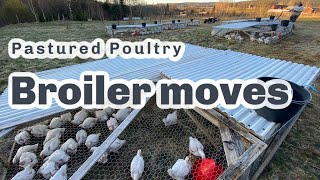
Richard Perkins moves 75 broilers into fresh pasture in 15 minutes using a mobile pen, then manages water, feed, and predators. He drains water lines at night to prevent freezing, mixes broiler starter with local wheat and oats, and leaves about 5% feed uneaten by morning to encourage outdoor activity.
Questions this video answers
Day 33
75 birds
3 by 4 meter celaton pen
Ross 308
About 5% left by morning
Chapters
Sun is rising, now it's time to move boilers. So just going to have a quick look at how that process goes and it's the little details that make that a safe and quick operation. Water lines are potentially freezing on these frosty days, so just tapping in the water, we drain it at nighttime so we get water up for the day. So day 33 and you can see traces of ice on the water. It's quite cold. What we've been doing is just supplementing the water with little trays. But it's basically as soon as the sun's up, it's thawed out and they're sleeping most of the night. So it's not a big issue. Kristen's just knocking the plastic there to shoe the birds away from the end. And the risk is mainly when you're pulling the contraption along that you will trap a bird under there. But you see it, the dolly lifts it quite high off the ground. The key is confidence, quick rapid movements to get the dolly in. But the other big risk is letting the dolly out. So by tapping on the plastic, the birds move away from the edge and you can move quite rapidly as long as you pause and let the birds catch up in between. After a few days of daily moves, they get used to this whole process. And so that's the main points you want to worry about is getting the birds away from the end and really being careful once you release the dolly can just see the sun in the last couple of minutes has peaked up over the horizon. So we're not so concerned about the temperatures, the water, they have water late at the night and then first thing in the morning. So they're fine even though it's slightly cold. It says no frost for the the next week and last week. But up here in the micro climate we're in, we do get a bit. So you see the birds are well away and you can be quick and confident. And what I like to do is catch the pen with my other hand so it's momentarily off the ground and that way you can do this day in, day out without squashing any birds legs. But they're growing well, they're eating all of their food. They tend to go through a growth curve where we've adjusted our feeding regime from industry because our birds tend to go through a phase where they don't eat as much after about three weeks and then they get hungrier because obviously the birds are outside and they're moving a lot more. And we're doing time controlled grazing where we get them Hungry in between. Therefore, you have to adjust your feed. So the feed sheets in our book and in our online training, they're the result of a lot of research that we've done in the field using the feeds we have in this particular method. And they're pretty solid to go by. Ideally, you want to put these wires at comfortable standing position, because you're going to lift that up slightly onto the dolly to get the tips of the dolly feet under. So you want to set those at the height that suits you. Now, we have multiple people working with the boilers over the years that there's no ideal height, but that's something to consider. And what Kristen's doing right now is putting tiny bit of residue of the feed on their next spot. So they're right now in the growth curve where they're leaving maybe 5% of their food by morning, and that changes. It's good to observe on a daily basis. Here's their next feed. So this is broiler start mixed with wheat and oats that we get from local organic farmers. And that's the way we've always raised boilers. We did a lot of feed research because traditionally broilers are raised in three different feeds. They have starter, grower, finisher. It's very expensive feed. Note how the birds are right away from the end of the pen. So Christian can be pretty rapid with his movement. Key is observation, stopping, starting, just letting the birds catch up. These birds have been moving enough on a daily basis that they know that they're going to a fresh spot. And even though the grass has only just started growing, there's fresh ground and bugs and greenery for them to peck at. So see how Christian's moved the birds away from the end now? And he can make one fluid rapid movement. And then you see he's gently lowering it down. Now, he knew the birds were out the way there, but you can literally hold the pen up. They're light enough to hold it off the ground to ensure that you don't trap birds. And you can really use your ears at this point. You can hear if a bird's in distress. So we put the feeders under a covered section of the pen. So in all our pens, we have three of the roof panels covered and two of the sides covered. And that always moves with the prevailing winds, which come up here in mine. So when they come around the tree lane here, they'll turn that way. So the wind protection is still in the same direction. So it just takes a couple of minutes of pen to move 75 birds. These are 3 by 4 meter celaton pen. So 75 birds being the standard based around the nitrogen loading of the land and because they move daily, this is 16 times less intensive than organic boiler production. So for those that think this is intensive, you wouldn't want to eat any other type of chicken, that's for sure. You can see a bit of water comes out because the ground is a bit bumpy, but that's no issue. We've got a hose off the mainline that we can fill up the waters. Something else you might note here is we often carry bits of wood on the sides of the pen and that's just for bumps in the pasture. So you can fill any gaps so that young birds can't escape. Or less attraction to predators. We've never lost a predator in these pens ever. And yeah, they're just solid. I think partly on our farm, there's something about the intensity of livestock and people in such a small space. We don't have predator issues. I know a lot of people have problems with raccoons and foxes, etc. We do have foxes here. We don't have raccoons here in Sweden, but we do have foxes, wolves and lynx. There's even wolverines apparently somewhere around, but very unlikely to see them. But I think because of the amount of intensity in such a small space, there's human smells everywhere. So I think that helps keep predators at bay. We do see foxes quite regularly, but we've never had a single fox take a broiler on this farm. We have other videos on our channel detailing the entire process, including with our other types of pens, the roller pens. Some people have been asking why aren't we using the roller pens at the moment? And it's mainly because these are a small batch for us. It's only 500 birds for me. The roller pens work best with four of the carriages in a 25 and a 50 meter net. When you're doing a thousand birds, then it really comes into its own. We've done it for 500 and it's definitely quicker in the long run. But I think with the temperatures as they are so early in the season, this is a really early batch for us because we sold out of our winter stocks of chicken earlier than anticipated. These pens definitely help with the microclimate. With so much shelter and with the lower roof, they're able to keep heat in there better. So we thought with this time of year we'll go with this type of pen and just know that it's safe and reliable. We also have plenty of videos about slaughter process, how to run an on farm slaughtery, how to deal with clean down regulations, etc. You can find all that in previous videos on our channel. We've put a lot of information out about how to do this enterprise efficiently, profitably, keeping nutrients on the farm. So a lot about confidence and that comes by practice and repetition. And one thing that's worth pointing out is when you're moving these pens along we've got a handle that's just a bit of flexible tubing on the wire. But what you do if you hit a bump and the dolly gets stuck on its wheels rather than pull with excessive force, the best way I've found is to zigzag pull from side to side in a sort of scissoring action because the danger is if you pull really hard you'll go over the bump and you'll move at uncontrolled speed and that's when you'll trapper bird get its feet caught. That's what we want. Birds moved on to fresh ground. Can you see how inquisitive they are? Taking up leaves, insects. That doesn't save you on your food rations, but it does translate to vitamins and minerals. You see that bird in the middle just taking down grass. We're giving them a healthy diet and exercise and that's what keeps these birds healthy. The health of these birds is all based on management and we've shown that repeatedly. You can raise. These are Ross 308, very similar to Cornish cross but they're perfectly functional. Just heavy birds. It's all about management time, controlled grazing, getting them hungry in between letting them forage and express their natural tendencies. Healthy legs, good bone development. Quick video today, just trying to show you snips of daily life on the farm. Don't forget to hit subscribe and notifications bell if you want to see updates regularly from us. And you can find out a whole bunch more in our book Regenerative Agriculture, a defining manual for the movement as well as our online training in the links below. See you next video.
More from Richard


A review of short and intensive season on a mixed farm and restaurant/event space in Sweden






Alskade Kyckling Exploring complexities of poultry production in Sweden and what we stand for


