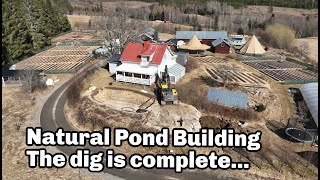
Richard Perkins documents the second day of digging a natural swimming pond, including trenching for sewage, water, and electricity lines to a new house. He shows how to insulate shallow pipes with foam blocks and finishes the pad with topsoil, while dealing with equipment damage and planning the next phase of work.
Chapters
All right, welcome back, folks. Day two of the dig and today we're going to connect up sewage and water and electricity conduits to the house, to the new house, the aterfalsus, and hopefully put topsoil back on the batters of the pond. But it's all frozen in lumps. I'm not sure if we'll be able to get through all of that, but hopefully job done today. And then I've got to get on ordering all the components for building the pond out. All right, Eric's moving some of the topsoil up.
I've come into town to buy insulation.
So typically here, if you were putting in a water pipe, you would go down a meter, 20 meter and a half. We can't do that. And it's a lot of digging. So we're just going to go about 70 or 80 and put these insulation blocks on top, which is pretty standard practice here for short runs. So I'm picking up these and some lagging to go where the pipe comes out the ground. And I need a hole saw to get through the laker blocks under the lean to greenhouse.
Okay. Hectic days, running around, looking after kids, running around after a dig all day. But we've got a solution now for coming up out of the ground with these foam blocks.
So normally you have lagging that you.
Put around the pipe, but we're going.
To use four of these blocks as.
A cube vertically in the ground and just cut a fine hole for the.
Tube because that seems cheaper and more effective than the thin lagging that people typically sell, which they don't have a.
Big enough diameter of. Here, I got it. I got sunburned yesterday. This spring sun is pretty fierce when.
You'Re out in it all day.
Still cold, it's minus degrees. But fun times. I feel really alive doing projects like this. It's super cool to have started this now before the season gets real busy. Having a lot of fun. All right, back to the farm. The dig is on the go. This topsoil's been moved up to the top of the farm. Hopefully he's finding some unfrozen stuff that we can put on, too. Topsoil going on the batter. I'm going to check my hole drill. It's big enough. Looking good. All right, so this is the septic tank. We're going to end up scooting this insect brush pile away. You can always put it back. And we're going to intercept with an existing pipe. So we're going to take an angle just to Go around the bushes to the pad where the Atafel Seuss will stand. And then we're going to dig in this black pipe to one for water, one for electricity down through the side of the lean to. Because I can come out with the electric and water there and that's. It's not going to be so deep. So we're going to put the insulation on top of there. I'm wondering how the dig is going to get out of here. Okay, Nearly forgot to feed the cows. This tractor has just been a beauty for saving my back in the old days because I have a herniated disc from when I was 14 as a youngster and that's been a major problem with working physically at this human scale that we've always done. And buying this machine was not cheap, but it's, you know, I haven't had a bad back since. However, I broke my machine. I broke the bit that keeps you safe. So when I was taking compost into the big tunnel, I was keeping this up when I was lifting heavy pallets and putting it down to go into the tunnel and I forgot one time and I drove into the wooden beam at the top of the doors of the tunnel and it didn't break the greenhouse, but it broke the roll bar. So that makes you wonder. It's actually just broken a weld in this piece. And whilst it might be possible to fix it, I'm factoring on this is the bit that saves your life if you roll over. So I'm gonna buy a new one, I think, and fix that up. It's a bit scary. Like right now, this would buckle if I tipped. And this machine, although it can lift a ton, I've only got 400 kilos on the back. So it's pretty edgy when you're lifting a wet bale or anything particularly heavy, and especially when you're lifting it at height. So it's another job to do. I bet you guys are as eager to see green growth as I am. Arguably your life depends on it. My life depends on you. Okay, getting down to sewage pipe. So this is what we have to intersect with and make it fall on a nice gradient all the way across.
To the Aterfels house path.
No problem.
Got the laser level, we'll be grand.
Alright, so taking the old bit of pipe, they actually had a very dodgy connection made with perforated pipe and concrete seems to have held up though. So we're going to put a little bend in there and off we'll go that way. So we're silicon up these joints to make them go in easy. And I've just got a connection like that to send us off at the right angle. Okay, so got this pipe in. Now we just keep digging and get the levels right. Getting there. Okay, so can we get the next one in and backfill this? But we need at least 6 centimeters across each of these 6 meter pipes. That's the minimum. Got about 10, so that's good. And that should lead us all the way up. Okay, so we've just put two of these in to cover the sewage because sewage pipe is empty most of the time, but it is quite shallow. Eric was just saying he's got water pipe just 20cm under concrete with one of these and it's not freezing. So that sounds good to me. So we're going to dig now to the bottom corner of the wall to la lean to and connect back with where the pipe comes out here. And this is where we're going to put in this black pipe, which is one for electric, one for water. And we'll pop up in the far corner of the pad. That's where the water and sewage will come out from the little house. Once we've got them in, it's time to just cover everything up again and finish up. Neighbour Bjorn is going to have some of the excess topsoil. We've got a little bit of topsoil to finish. You can see the water line there. Need to sort of bring it around here and raise this bit of ground up too. But it's a bit wonky because the pad is lower down than the water line. But the building will step up a bit so it will work out in the end. It'll just look a bit wonky in the meantime. All right, so got the channel here. Found a sewage pipe going around the house. That's a bit bizarre, but that's the way it is. Now I've got my new drill bit and I gotta chip my way through there.
Get a couple of holes through for.
The pipes and we can backfill the whole lot and work on the other end of the pad. Okay, two holes. Okay, so last sort of leg now just getting the ditch to the corner of the pad for the house. Got to lay this curly curly pipe in and I'll jump on it while he puts a bit of soil on top to hold it down. Chuck the insulation boards on top, fill it all up, smooth it over lovely. Okay, made it all the way. Now for the wiggly wiggly pipes. All right, one pipe in It's a bit windy. Just hold it down with some rocks, get the other one in. Then we can start putting a 10 centimeter layer of soil before we get.
These insulation blocks in.
Well, a few flakes of snow can snow till the 5th of June here, so it's not that surprising. It's a bit weird on a sunny day when you're getting sunburned. Kids. Back, back to the dig. Okay. Pork is smelling good. Seems like digging is going good. I'm gonna jump in. Philly. Oh. Dig has gone quiet, which means we're pretty much done. So that's moved out and we've got the batter here of topsoil that will make up the waterline coming around here. Perfect. And we'll have to deal with this bit when we get to it. Neighbor's going to have the rest of his topsail and we'll work out. I'm gonna have to mark out where we put pipes and work out how we do the foundation for the atifar.
Cells because it won't work with the.
Screw pins they were looking at.
All right, that's where we're going to.
Make the platform to hop straight in.
It's a wrap. The build is done and obviously there's a lot more work to do. I'll be doing updates when we get into that. I'm thinking to actually start building the brickwork inside there pretty soon. Soon, because it would be awful to see the soil collapse and have to dig it out by hand. It's been surprisingly dry inside. And one big concern is if you have water coming into that hole, you would kind of need a concrete pad in order to stop water coming in under the liner and ballooning the liner up. But it's remarkably dry in there. So very happy about that. Super fun. Great working with Eric as always. And I really enjoyed these last couple of days. Been hectic and busy trying to manage everything else around the dig. But I think you'll agree, really nice job in two shorter sort of work days. So fantastic progress. Thanks so much for watching. As always, folks, don't forget to hit subscribe. Click the notifications bell. See everything we offer in the links below. See you in a video soon. Bye for now.
More from Richard


A review of short and intensive season on a mixed farm and restaurant/event space in Sweden






Alskade Kyckling Exploring complexities of poultry production in Sweden and what we stand for


