NEW CHICKS, EXTENDED IRRIGATION and new tents...
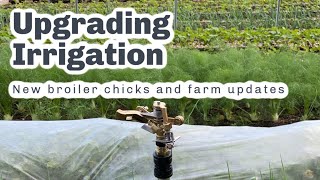
A Richard Perkins YouTube episode covering on-farm updates: arrival of a new batch of broiler chicks and brooder management (watering, temperature control, sawdust handling); experiments reusing oyster mushroom substrate; acquisition of new packing crates for vegetables; an irrigation upgrade using Tricoflex flexible pipe, brass/stainless risers and adjustable impact heads (design, pump/pressure and filter notes); and purchase of three 6 m tent teepees to trial low-input farm stays. The video closes with promotion of Perkins’ interview series and book.
Chapters
Welcome back to another episode, folks. We're just about to smoke. A new batch of chickens and new baby broilers are arriving on the farm today. Taking out the first strawberries now. There's a lot coming on. Hands are nice and relaxed early in the morning. Beautiful time of year now. So up in that field, let's show you this new growth. So right down here. Interesting. It's coming alive in here slowly. Right now. Who is that?
Paddy.
Paddy, your toad. He puffs up when he gets scared, doesn't he? That is a big toad.
He can climb really good.
Yeah, you shouldn't hold him too long. You should put him back in a nice place.
No, he won't live there.
He lives there. That is a big toad.
Right now he's on my arm.
He is cool toad.
He loves me a lot.
I spent. He does. I love you a lot, little smusher.
My pad loves me like this. I hold it.
So, last batch of birds coming in and Kristen will be back with them around lunchtime. So we've had a little bit of water added to each pen. You know that when we flip over the brooder, in previous years we've had birds in on the day birds go out at three weeks of age. We add a watering can per 10 square meter pen just to keep the biological activity in the sawdust because it really lowers mortality to have that biological nappy. And because this is. We actually did that when the last birds went out. But because there's big gaps between each batch, we've added some more water. Just top that off with a bit of fresh sawdust. Had the lights on since yesterday. Getting it warmed up. Now. The building is much warmer at this time of year, so we're going to have to monitor the temperature a lot more carefully to make sure that they quickly start reducing temperature because if anything, at this time of year it's hard to keep them cool enough. Excited to have baby chicks again. While in the brooder, we've got another rehash of some of the different oyster mushrooms. So these were bags that were grown out a year ago, left just lying around all winter getting frozen. We took the whole substrate and split it 50, 50 with new medium and got two, three flushes off them. And now we've taken that material again, split it 50, 50 with new growing medium just to see what sort of yields that will give us. It will obviously be much lower yielding and already I can see it looks slower in the running of the mycelium, but just fun to try because life wants to live so we finally invested in some new packing crates for veg. I think these are originally from the fish industry many market gardeners are using because of the stackability. And the integrated lid means you never lose the lid. And basically we've run out of kanga boxes. We need a lot more storage. So we figured these will do for storage crops in the chiller and can be used to some degree for delivery too. So good to have a new stack of good pots. Again. So, last birds of the year, you know the drill. If you follow our videos, we will be getting these used to the waterers and then letting them settle down. Now, you can see at this time of year when the building's hot, we've got the lamps right up like this, so quite high off the ground to get about 32 under the lamp. And obviously the building and the ambient temperature is a lot warmer. So it's a very different scenario to the start of the year. And we have to really watch the temperature to avoid heat stress and heat exhaustion with the birds. Mother hen Christian. Nicely done. And you can see the temperature difference. If you look back at other videos, the birds would huddle initially to get straight under those lamps. But you can see with the way they're spreading out, they're much more comfy with this temperature. Okay, so we've decided to invest in more piping, more fittings, so we can keep the gardens totally connected all the time. So we have three of our impact heads here, three in the middle, three at the far end. And then you see the irrigation on the caterpillar tunnel. This is where water comes out from the pump. It splits under the yard here and goes to the south, east, west and to the new and old north. Now, it's a bit of a jumbled mess, but we will build a little housing for this. We're using geckofinners and so I actually looked at investing in a wobbler system. But then you need to have a lot of plastic header pipes all around the place. And they are typically used for lower water pressure because we've got a high powered pump driving water up the hill from the pond. We wanted to use impact heads because you need to release a lot of water when you're working with that pressure. Now, I actually like working with brass and metal better. These fittings are industry standard. They last forever. You can replace that rubber seal and this brass will last centuries if well looked after, certainly decades. And that's long enough for me. Out of interest, I was just costing it up and it's the Same cost to expand on the system we already had and have much longer lasting parts. And so it's a bit of a twiddly mess. But what we will do is build a little cabinet here to house these things. And this works with a two way splitter with taps, so we can have two on at any time. And because we also have an end cap attached to each of these, we can also run any one line at a time. Then coming from the other north beds, we have the caterpillar tunnel. Three impact heads on the backside, four down the middle and two on the far side. So four pipes that can be interchanged with these four. And these are just simple twist bits. And so it's very quick then to change it over. Now what that does mean is that we don't have to any longer walk all the way down to the pump to turn it off to start reconnecting pipes and water somewhere else. It means we can basically do everything up here. When the pond is clean, we get a good hour and a half, two hours before we have to clean the filter. Obviously it's a living pond system, so there is life in there. And it clogs up the disc filter, which would typically be used for drip because it's really removing fine particles. But this is a big improvement for us because it's a semi permanent system. We like that we're using flexible pipes rather than headers because it means we can move stuff out the way if we need to for bed preps. And I like the high quality of metal risers, impact heads, etc. Garden's looking beautiful this time of year. We've been getting quite a bit of rain the last days, which is very welcome, very necessary. Lots of crops to go out again this week for Rico. So these impact heads are fully adjustable. You have two metal things here and you can adjust the angle this will spin to and then that mechanism trips, it will spin back until it trips again here. And thus you can do anything from 360 degrees down to 10 degrees. That suits us really well because here alongside the edge of the garden, for example, we have our kitchen washing up station. So it allows us to water into the beds and not spray people coming by. And central ones are going to be doing 360 and the other end are going to be a mirror of this. So we like the versatility of that because it allows you to, you know, set it up in a way that works regardless of the shape, etc. So on this side, on the old north, we've just Got one in each corner here to direct inwards, a central row with four, and then we have three on the backside. And the tunnel works well over four beds. These sprinklers will cover those adequately. So very nice, very simple now to just change the beds over. And whilst it's an obvious upgrade, it's taken us a few years because it was working how it was. It was just a bit more labor intensive to move things around. And that was never a problem in the first years because we had the wettest years on record. But then certainly the drought in 2018 really, you know, made a lot more work to move around using the limited water that we could. And so it's, yeah, that's the way it goes sometimes. Little improvements over time, incrementally, when we got a bit of cash. And that's the way it is. So not enough power in the pump to run three sprinklers and the tunnel, for example. So what we've done, we have two sections of four off, two sections on, with a little end cap there. The main benefit of this now is that we can change over to any part of the garden. We would just open up this pipe and close this one off. And then if I want to put the tunnel on instead, I can connect that, put an end cap here. So it's still a bit of faffing, but it's very different to walking up and down. And as such, tunnel comes on. So it's maybe not as ideal as a sort of integrated circuit board. I think by the time we have this up in a little shed, a little housing cabinet, it'll be quite simple to operate and it's a big improvement on time savings and walking up and down. And likewise you could immediately switch. So if you wanted to start watering these beds, you'd have to go down to the pump, turn it off, reconnect things, go back up, turn the pump on. So right now what I can do is just take the two that are turned off, switch it on to two over there, and just by turning that, we can start watering over here immediately, which is a vast improvement on how it's been. Oh my gosh. How many kilos do you recommend taking out so far? Oh, hard to save. It was four boxes. How much we have there? Okay, parcels just arrived. So these are three six meter tent teepees. It's a company that has the manufacturing in Sune, the little town next to us. Very high quality tents like you see in the picture here in these boxes. This camp stove that goes in the middle of their tents you can see popping out the top there, very nicely designed. And whilst I've made a lot of yurts and things, I think a sort of technical tent is a little bit challenging that I would rather use their products. And they just had a big open day and I got these at 85% discount, so way cheaper than making it myself Anyway, so we've actually just invested in these as a way to have people come and stay, explore the area, go swim the lake, eat amazing farm food and probably I'll build some platforms in the pig pen and call it pig pen camping or something like that. Not sure if that's going to be the best spot for camping, but we're looking to design that enterprise a bit over the winter. It would be very minimal in terms of inputs. I think we would build some little platforms and I like that spot in the pig paddock and we graze through there with sheep, etc. But I love the little glades that have been created and one thing that strikes me is those tents are going to be best put in the shade, otherwise they're going to get very hot. But we get so many emails where people want to visit us and we're generally just not open because we're hard at work, busy doing what we're doing. And obviously our open days and things are an opportunity for people to come, but that's limited to very, you know, once, twice a year, whatever. But if people are self managed and want to buy farm food and look after themselves, borrow a bike and go to the lake, etc. Not interrupt our workflow, then I think it's something I'm willing to explore. And also it'll be great for us to be able to host friends and larger gatherings when we have them. So yeah, I thought with such a big discount on a quality product like that, I wanted to just jump into that because it's something we've always considered like with building a tree house up in the forest. That whole idea came about in terms of renting that out for two nights a year or two weekends a year would be more profitable than cutting down 2 hectares of forest every 80 or 90 years. So you. Yeah, that idea has been alive for a long time, so it's nice to finally act upon that. So this investment is building on what we already had. So we had lots of 10 meter multiple pipes, but I've bought a couple of hundred meters of Tricoflex pipe, eight more of these risers with their impact heads. That's from access irrigation in the uk, who we've always bought irrigation things from. And yeah, I think it's a good investment. It will save a lot of time and it's hard wearing gear that will last a very long time. So I'm really happy with that. I think obviously there's different options for watering, it's going to suit different people's contexts, but there's something robust about working with brass, stainless steel, etc. We found that in the past experimenting with these, we can only actually run about four and get the maximum width. So obviously that depends a lot on the pressure of your pump, etc. Or the source water. But we can get about 12, 13 meters radius with these impact heads. So that gives you about 24, 25 meter diameter spray. This then acts as a way to control it. If we have a look at this head, what this does is allows you to angle the jet. So if you are close, you know, you can restrict how far the radius of the sprinkler goes. But for me it's much better to have less higher quality units that can spray far than having header pipes and plastic pipes all over the place to do something like wobblers, which I know are very effective and very good. But in the shape and context of our garden, with the pump that we have, I think this was the right choice for us. So I'm having a lot of fun interviewing the unsung heroes around Europe for the Farm. Like a hero tour. For those of you that are not sure what I mean. I'm in Ireland virtually at the moment interviewing some amazing people and I've done about 30 of the interviews now and just incredible. And they're being released weekly, two or three long form episodes a week, plus Q&As with me every week. So if you enjoy our content and want to get deeper into the network and hear about dozens and dozens of people doing amazing work around Europe, then come and join us over@farmlikeahero.com it's a very low cost membership site running till the end of this year at least, where you'll have access to hundreds of hours of awesome content. So hope to see more of you over there. That's it for this video though. Don't forget you can find out a whole bunch about what we do in our book Regenerative Agriculture, which is perhaps the most broad and in depth detailed manual in the field today. That's available in the links below. See you in a video soon.
More from Richard


A review of short and intensive season on a mixed farm and restaurant/event space in Sweden






Alskade Kyckling Exploring complexities of poultry production in Sweden and what we stand for


