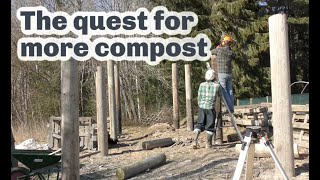
Richard Perkins builds three compost bays from reclaimed telegraph poles and preps the farm for vegetable season, hardening off seedlings and testing the chiller station. He's also removing the layer hen flock and dealing with hail and lightning damage.
Chapters
What's up, YouTube? Welcome back to another episode. It's a little bit crazy at the farm. Lots going on with the team that are here. Still more teams come and I'm busy working behind the scenes with a couple of people that I'm collaborating with to get a load of resources ready for you. But lots is happening at the farm. Lots is changing. We're building stuff and we've just got rid of hen flock. So just a little update from what's going on right now. It's a hail storm. It is really coming in strong. Look at that blow. Lightning as well. Wow. I've never seen a lightning and hail storm at the same time. Okay, Coronavirus daycare aborted. We are using strawberry jam from last year to make cakes. What do you think, Wagner? Looks good, doesn't it? Yeah, tastes good. So I'm on dinner today. Towed in hole with our turkey sausages. Look at that. It's going to be a beauty. Christian's back. Deep clean of the chiller. This has been sitting as a kind of earth cellar all winter with carrots and storage crops that we've been eating. It's time to give it a good clean down. And this is the first year we're going to really be able to test it out with the wash and pack station here. So super excited. But tested it out. It's all working as it should. And we're going to also put an air conditioner unit and a cool bot in the egg packery this year because that gets a bit hot in the summertime. And if you want to know more about building a chiller, we have an old video on how we built this one with the Coolbot system. Okay. More paper parts. It's getting full. This is Selma. Selma is a vegetable expert. I'm a vegetable. She's a vegetable. She feels like a vegetable. But it's the day to get a lot of stuff out of here. We're actually really full up in here, aren't we, Ragnar? You can barely move around. He's trying to catch spiders. But we've been doing a bunch of seeding with parsley in paper chains and a load more kales, etc. So our plan now we've actually scrapped a bed in the tunnel that I've only just seeded. And we're gonna have to use that for hardening off. It's time to harden off. But you can see we've got all the cucumbers seeded right up on the top now. So now's the time to get all these spring onions out of here. We need to make room for these tomatoes which are growing on fast now. We've got to put sticks for each of them and space them out so they grow. So we're going to put half of them up on this bench. And so now we're getting a load of stuff down into the tunnel. Sacrificing one of the beds that I just seeded because it's the only space we have. What happens is typically at this time of year the old hen flock goes and we're able to use the big tunnel as a hardening offspace. But it's just unpredictable with the weather. So what we're doing is sacrificing in bed. We'll go and have a look what it looks like down in there. So. Just had to sacrifice. I bet I've only just sown, but I should have anticipated that. I've just been too busy to think things through. And as I said, we normally get to use the other tunnel but that's been delayed. So we've got all the spring onions. We've still got leeks to get out of here, but that's alright. That gives us a lot of space. So we'll put some hoops over this and put the double layer of fleece. And you'll notice the 64 and 144s are just straight on the ground, whereas the paper pot trays we just got resting up on wood. So they don't root down. They're only going to be here typically a week or so. But we don't want the paper chains getting matted up underneath with their roots. But that's freed up a huge amount of space now for the lean to a greenhouse, which is great. So all the leeks are going out also. So we've actually removed quite a lot of stuff. This gives us a space to put half the tomatoes up here and we'll stake them up just with little sticks. And then we've got quite a few racks empty here now and we can get by on that. I think we'll avoid the crunch. So. Perfect. Okay. Finally found a use for these old telegraph poles. These are the old telegraph poles from across where sadly Mr. P died. And we're gonna make a compost palace. I'm gonna help them. So these are a little bit overkill by my estimation. This will be the strongest, most durable building on the farm. But it's nice to make a use of these. They've been sitting around since they took the lines that ran down here and across through topfield up and across the clearing up in the forest. You can just make out there. They're still up. And it ends here in Topfield. You might just be able to make out that's where Mr. P met his end, and that's staying there for five years as a backup for the system they buried. And they let us keep these posts. So making compost, that's a good use for them. It's always been like that. Nobody has ever sorted out. Whoo. Out of breath. Look at these big Berthas. These are actually very big posts and it's about the edge of our limits to do this for two people. This one is a good 35cm. That's my hand and I got big hands. So we're chamfering the edge with the trusty old Grand Porsche and we got two in, but we've got quite a lot to get in. And then we've got to set a laser level. We're going to build this horizontal to the fence, but also we're on a slope here, so we're going to make the roof horizontal so that it fits and we can collect water and we'll see how it goes. Heavy lifting straight after heavy breakfast of pancakes, cream, strawberry jam from last year. Whoa, this thing is big. I don't know if the camera picks this up, but you can see my shadow against this pole. It's going to need some cutting down. So We've got about 30 square meters of composting bays in three bays. The aim is to replace these crappy stretches we made with pallets last year. And so this is waste from the vegetable garden. Now we use compost in very different ways. This week we're getting a machine to empty out the big polytunnel where the chickens have been all winter, on the deep litter system that gets put in windrows behind the polytunnel in the front field and gets turned later in the year. This is for garden waste coming straight out of the new and old north beds if we don't have pigs to feed it to. And so we use compost in quite different ways here. But we actually filled up about 16, 18 pallets last summer because we didn't have pigs. So we figured it's time to build a proper structure. We had these poles lying around that weren't getting used for anything else. We just had to buy a bit of tin sheet and a bit of structural timber because we've got no free timber left of structural dimensions. And those of you that follow the channel know we get a Lot of our timber for free. We've actually got all the sidings and divisions for the bay using the free timber we picked up last year. And then we're debating whether to put separate side panels in between each bay. That will give us six bays to move compost along. So this is not a rapid Berkeley compost. It's a slow, maturing compost. We're putting garden waste down and then putting carbonaceous material on top in layers periodically and then turning it a few times on its way out of here. And that will be going straight back onto the garden. First job once we build this structure is taking all the old compost from last year and putting it into these bays, turning it as we go. And it looks dry on top, but I suspect we've got some very nice compost forming below that. Okay, so on the left hand side, we have just put these up with the old spirit level and got them roughly in place. Because we're going to have to climb up here, we want the roof that's tilting at an angle, so we're going to actually saw them in place. We decided to do that because by doing it with the ground sloping down here, the danger of cutting it all to the right size up before they're put up is that once you get them up, if they don't fit perfectly in the hole as anticipated, that'll lead to more problems. So whilst it's dangerous sawing up on a step ladder, it's doable, and I think it will give us a better result. So once we've leveled all these up, we'll get the laser level out and start marking up the post. Okay, next step, take the laser level and we will mark equal height above sea level on each post. I predict There's a 50 centimeter fall down here. Now, you can get a sense with your eyes, but our eyes are not designed to judge height differentials. There's Ragnar. He's helping. And so we're going to mark this up. And then the next step is marking up from those marks to mark where we want to cut the poles off with a 20 degree roof for snow. And then we'll start cutting down the poles and notching them. Ready to take the support beams. So, Ragnar. So what we're going to do is set up this laser level. So looking at this lie of the land, it's very hard to tell what's going on, but it's 182 down at this low end. And if we take a measurement up this end, we'll See the height differential? I guessed about 50, but I've learned to never trust my eyes. And that's 102. So it's actually 80cm difference. So that's testimony to how confusing it is for our eyes to measure height differentials. I guessed 50 knowing that I would be, you know, within the region. But that's. You never trust your eyes. I don't believe my eyes and I certainly don't believe your eyes. So we always use levels for building. So now we're pretty much set. You can see there's a good line on these poles. It's pretty good considering they're different diameters. And now we've got equal heights marked on them all. I can measure up to the top and start cutting these down. Ready to receive the ring beam. And then the roof beams and tin sheet it. Okay. Got the chainsawing done. Putting up the first of the ring beams pretty straight considering everything because these are different diameter poles and we're working with pretty hard clay to dig into. So we'll get the beam up. It's only going to be a shallow fall across here, but we figure it's going to be strong enough for the snow load and it will help prevent rain coming in from the sides. We'll probably put a little bit of a lip to stop rain coming in so we can really control the compost. So bracket's going up, marking the roof beams and we'll use the roof beams to square it off. How's it going, Echo? It's been weird with the measurements. It's going all right, I guess. Should have a roof on tomorrow. All right, bring it on. Well, things are looking different in here. Flock is gone. Look at that. So we've got one set of nest boxes to go into one of the eggmobiles. The other is a spare we use for winter. But we have got rid of the hens. We've got a new flock coming. But we've just heard the guy that we buy hens from, we buy lomans, the brown version. Brown eggs are much more sought after even though most of the industry sells white eggs. He had a break in. There's been some break ins down further south in Sweden, we use one of the only family run small growers. He does quarter of a million birds a year. But that's considered very small considering his next biggest competitors do millions. But we, yeah, he had a break in. So we don't know if we'll get all the hens that we need to fill our eggmobiles. But we're a very small producer compared to his next smallest customer. So I hope he will fulfill our order because it makes proportionally much more difference to us. Hard to imagine that not very long from now this will be full of tomatoes and cucumbers as it always is. Right now there's probably 30cm of bedding to get out of here. We'll be putting that in windrows around the back of the tunnel here. We'll be using a machine articulated kind of digger to pull this out of here. But it's very quiet on the farm without the layer flock and we will be. We've got enough eggs just to see us through personally until the new flocks start laying. And I'll make videos of the new flock arriving and how they're adjusting. But big job now to turn this whole space over into vegetable production. The basic process will be take everything out down to the subso, subfloor board, fork eight beds and then bring back some compost in. Then we'll put in salad crops on rotation and on succession. There's a better way to say that. And then we've already got all the tomatoes and cukes seeded that will come in here later on. We're way ahead of our normal schedule. It's only early April and we're already seeding outside and already have stuff ready to go transplanted in here. But you never know with the weather here. We have these iron nights till the first week of June, so you just, you don't know. It can seem like if you look back at videos from a year ago, you know, we got caught out by the weather and you can go ahead and plant vulnerable seedlings and get a cold spell and just get hammered. So gardeners here know that. And it's very easy to get tempted. Glorious sunshine in the evening, but you never know. So that's the way it goes. All right, that's it for today, folks. Just a bit of a mishmash as we get into things. We're just organizing routines and structures here at the farm and I'm looking forward to giving you updates as we really start productions very early for us this year. Normally the team are just arriving about now, so good to get some projects underway and looking forward to the warmer weather because it's been so long that it's just been gray and horrible and now it's starting to warm up and looking forward to new releases coming soon. I'll keep you updated as we go. Thanks so much for watching, folks. You can find out a whole bunch in our book. Regenerative agriculture that's shipped out to over 90 countries around the world so far. And I'm super happy to get all the comments and feedback we're receiving for that. You can find out about that in links below, as well as our online training. And a lot more details to come soon as we launch the Farm Like a Hero Tour. See you very soon. It.
More from Richard


A review of short and intensive season on a mixed farm and restaurant/event space in Sweden






Alskade Kyckling Exploring complexities of poultry production in Sweden and what we stand for


