No-Dig Market Garden ABUNDANCE in the drought!
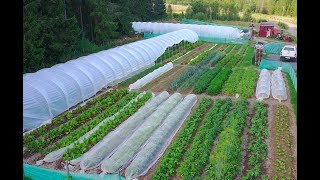
A YouTube video (Richard Perkins, Aug 1, 2018) giving a farm update from a no-dig market garden. Perkins shows vegetable packing and delivery for RICO (harvested and packed same day, chilled in crates), discusses compost choices (nutrient-poor wood-based compost used for carbon during drought vs. usual cow/chicken manure compost), animal management (removing pigs, using sheep and cows, turkeys and ducks), and infrastructure projects (creating a ~26 m diameter turning circle, moving fences, clearing forest for agroforestry and timber revenue). He also mentions an upcoming online training (~80 hours of video, subscription tiers) and promotes his book Making Small Farms Work.
Chapters
Just taking my turkeys for a walk. Yeah. We've been packing vegetables for RICO today and it's a Wednesday delivery to Karlstadt. That's the further drop off point for us, about an hour away. And so there's chickens, smoked chickens, eggs and vegetables going out. This is a little view of our packing set up. We have all the veg stored in the chiller and everything's harvested the day we send it out. Which is a nice thing about the scale and way we operate. We're always harvesting fresh and delivering straight out the ground. So everything goes into the chiller once it's washed. It's been bunched in the field, washed on the packing station, goes into the chiller in crates. And we don't use any totes with lids because we're basically picking and packing and sending out on the same day. And so we just get all the veg back out the chiller and use the packing list. All our veg boxes are obviously the same varieties, but then we have custom orders for rico. If you're not sure what I mean by rico, I've made videos. What is rico? It's probably my favorite way of connecting farmers to customers directly and self organizing pre sold markets. You could say it's like a farmers market where everything is pre sold and I really enjoy it. I think for those of us in Scandinavia, it's really taking off. But it's such a good model. If you can get a critical mass of other producers together. It's a great way to do things. So veggies are all packed and put into kangas. Off it goes in the van with eggs and everything goes straight to town. So great job from the garden team under difficult conditions and great job all around. We've got a lot of nice produce coming off the farm. It's the middle of the season, everyone's a bit tired now. It's, you know, it's been a long, hard dry spell that's taken its toll on. These gears. You can move the rubber band here very easily to change the spacing between the seeds in the row. Then you have your hoppers where you place the seed. And these have little finely tuned brushes which allow seed to fall into the drilled out plate. Now you see at the bottom you have an accurately drilled out bar. And you can move that bar along by undoing nut with an allen key here and sliding it across for different sized seeds. And then you have rollers on the front to compact the bed and little shoes that cut the soil to put the seed at the depth you would like and then another roller to close that all down. And it's this back roller that drives the seed belt that you see there. Now the beds behind me are covered with a wood based compost. Now we've been using this this year. It's not favorable in the sense that it doesn't have much nutrition, but it does offer us a very cheap source of carbon which has paid dividends this year in the drought conditions we've had. Now we've used the six row cedar consistently in beds covered straight with compost. The normal compost we use, which is cow and chicken manure with its bedding composted down and with this wood based compost. Well, it's been a dry year and hard for most things, but it looks like a great year for acorns. We have these two beautiful old oaks outside our house. And so what I might do actually is rig up some tarps to help collect these really easily. And when they all fall down, I might go and actually distribute them in the old pig paddocks just to speed up nature. Now I'm convinced that there are acorns all over our pastures and forest patches because they're coming up naturally. But I would like to see a higher density of them quicker so. So I think I'll do some seeding. We're taking the pigs out the forest as I've talked about many times, and there will be no pigs at the farm for a number of years. So I want to see a lot more oaks. That's the sort of long term canopy tree I'd like to see here on the farm. We're making a turning circle and it's extending into our land here in the old pig paddocks, also onto the neighbor's land here. This is to enable turning of big lorries and things and we're aiming to cut the big forestry that I've talked about in other videos. What it does mean is we need to move this fence, particularly this corner, which was quite hard work. Matt and I put this in last spring and there's a lot of rocks here. This is a drainage ditch down here that marks the edge of our property. So I'm just here with our neighbour and we're basically marking out where the extent of it is. Cut some trees. I'm going to start moving the fence this week and should be going quickly now. That enables us to have big lorries coming and machinery to cut this big forest that you see behind us. And we're going to start turning that back into mixed Agroforestry, like we see in here. So the turning circle is about 30 meters radius into here and I'm clearing 17 meters from this central point. And so what I'm going to do is basically make a temporary fence across and up here somewhere. And we've got three rams in here right now, and then chop the fence, take the poles away and cut down all the trees that are just sticking up in the way. Just clear it out and work can start soon. So I'm actually going to start working on this plan. I'm going to drive a post in here to mark the center point and take some measurements. And it's still approximated that this point point, but I'm going to start to work on taking the fence down. After I've marked out the turning circle, I'm just locking in the actual wires so that I can cut them and not have to rebuild the entire fence. I'm just pinning them sideways against the post. By locking the wires tight here. The fence isn't super tight. It doesn't need to be. It's only a very small run and mainly to keep sheep and cows in, so it's no problem. Now we're not going to have pigs in here for at least five years or so. Now we're going to have pigs off the farm. So what I'll do just to save rebuilding the whole fence is cut the wires, wrap them up. I'm leaving about 5 meters around the turning circle just so it's easy for the excavator to work. And it's Eric, our neighbour, who's been digging ponds for us in the past. And then I'll just start cutting the fence and clearing. I need to get some temporary sheep net to block up the fence so that the sheep can stay in here while the work goes on. Now, we sometimes use trees as anchor points for fences. Just when it's easier and they're in the flow. They're not valuable trees to us. They're sitting in the riparian, but here you can see in a couple of years they've really grown out. So what you need to do if you do use trees for fence posts is come along and get the wires out and twist these back out. Just as the bark is growing and more rings are being added. You need to bring this out, otherwise it will just grow into the tree. I'm just pinning these in with nails again so I can cut the fence here and leave most of this fence up. So I've got a sheep fence up through here. It's not exactly the easiest terrain, but I just want to know the sheep are secure so I can cut these wires now. Now with high tensile we use fencing pliers to cut that. But you've got to be very careful because spring. Now I'm going to stand to this side of the post I've nailed it in. So this is a very short stretch that's got no tension in it. This one I'll expect to coil back that way but as you can see it's very loose so it's not so dangerous. If it was really stretched I'd be wearing thick leather gloves and eye goggles. But right now I'm happy just chopping that where it is and I know I'm not going to get hit. Now I'm only cutting it in one place because what I anticipate happening is being able to use the entire fence wire again because my new fence will be a little shorter. So I'm cutting it in a way that this fence will move in in line with the new road because whilst it's going to have a circle here, it'll smooth out towards the edge of the circle to make a turning circle. So I'm going to recycle all the posts and the wire re stretch it and don't have to put any money into redoing the fence. Now because I'm in such weird terrain, it's not very easy to coil up the fence in an efficient way. So I'm just wrapping it and hoping I can reuse a bunch of it later. Okay, so got it. All clear. It's very sweaty today, but yeah, doesn't take long with a chainsaw to cut down many years of growth. I guess that's obvious but I've cleared out the area up to the fence and basically that allows us to. This is the actual radius of the circle and I've left quite a few meters on the outside to allow for the digger to do its job. They're actually going to remove some of the road surface and then level out this pad on both sides of the road, including the neighbours and then put hardcore down again and reconstruct the road and put a load of the waste material into the ditch that is the edge of our property and that's fine as long as the drainage is working. That doesn't make any difference to us. But this will give us a 26 meter diameter turning circle which is great for a few reasons. One, we have a lot of big lorries coming to the farm and they often turn in our driveway. And we often have stuff in our driveway, trailers and quads and all this stuff. So it can be quite impractical to have so many big lorries turning up, you know, at times when we're all busy and there's stuff in the driveway. And then also we have the forest to cut. So in order to cut forests here, you have to have somewhere to store the timber and you have to have access for these big articulated lorries, which we don't currently have either. So it's really important for us to be able to get the revenue out that forest. Now I've talked about it a bunch in other videos, why we're cutting it Now. It's about €25,30,000 of revenue. And if we don't cut it now, we'll lose some of that value. It's the perfect time to cut it right now. So the great thing about this is that this is a public road and that means we, you know, we actually chose that as one of our design criteria. This road goes all the way up to the neighbors right at the top. And that means that the snow must get cleared in the winter. It's not our responsibility. In a country where you have six months of winter and so much snow, that's quite an important design consideration. If you have a hundred meter driveway, obviously you're going to spend a lot of your time clearing snow. We can have a meter of snow. You spend all day clearing it and then it snows again another half meter. So it's like this. So I think the sheep will be fine in here. They've got their sheep fence. This is the high quality sheep fence with a rigid upright poles, just plastic beading over the top of the net. So the verticals are not conducting electricity. But it's much more stable on undulating terrain. It's a much better quality net than cheap old sheep fences. It's not that expensive, it's just way better. And you can go up and down slopes without losing the top of the net and stays straight. So that's great. So this road development is taking some of our land, but we don't have to pay for it. And it's going to facilitate both our operations and the neighbours operations up here. So I think it's a really good deal. We're just sacrificing a little bit of our regrowth. This is the original pig paddocks that now sheep and cows come through to deposit their pastoral floor, gut floor to start growing forbs and things. So this has been dug over to totally bare Ground several times now, but it's a lot of pastoral species that come back in here, which is nice. It was just monocultural forest floor, pine needles when we got here. So good day's work. I'm gonna go and cool off now and just get refreshed again. So the pond is pretty much full again. It's not quite full. You can see the overflow pipe there. Still an inch and a half bit of air coming in through the pipe that comes up from the top of the forest there. But great to have this reserve now. It's been just one day with rain, but we got a decent amount that hopefully will bring up the pastures again. Still looking pretty bare and we're really having to be slow with the movement of the animals. Duck's happy though. So that's it for today folks. Just a little update. What's going on at the farm? Busy with computer work, still working on the online training which I'm hoping to release on two subscription levels. One with just all of the videos. There'll be probably 80 hours of video that will be coming out sometime in the coming weeks, hopefully. And then another tier where you get all the spreadsheets and downloads and resources and where to buy stuff. And then also some kind of regular question and answer with me. It might be every fortnight, might be every month. We'll see how that goes and that'll get recorded and put into the program. So really excited for the online training to come out accessible to all. It's going to be at a price point where anyone on the planet can afford it and people can engage at whatever level they want to and get the immediate training up front. So that's something to clarify. I've seen from a few comments that people didn't really get that, that it's going to be on a subscription basis, but you can take the entire training straight away. It's all the material available. So I'm doing that just to make this totally available to anyone, regardless of their circumstance. If you know anyone anywhere on the planet will be able to afford a one month subscription and a lot of people will be able to afford to spend their time going through it really carefully. So really excited for that. Thanks so much for watching, folks. And you can find out a whole bunch more in our book, Making Small Farms Work. If you haven't read it, it's available as a PDF or as a hardcover book sent out from the farm. And that's a really detailed manual. A lot of people really enjoying that from all over the world. And I think it's got a lot of deep information in it, so check that out if you haven't already. You can find links to other information on our website, etc. Below. Don't forget, you can follow us on Instagram as well as here on YouTube by clicking subscribe. Please share the videos if you enjoy them, and help spread regenerative agriculture. If you put it through your social media channels and we get more people engaged and looking at intelligent, tangible, practical solutions. Yes. All right, thanks for watching folks. See you next time.
More from Richard


A review of short and intensive season on a mixed farm and restaurant/event space in Sweden






Alskade Kyckling Exploring complexities of poultry production in Sweden and what we stand for


