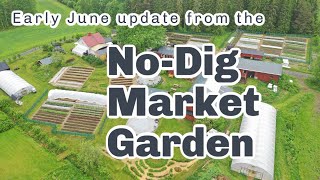
Richard Perkins shows the June state of his no-dig market gardens at Ridgedale, including new compost bays, strong brassicas, and variable carrot germination. He's upgrading irrigation with more takeoff points and testing a jiang seeder for deeper sowing. A live Q&A and Farm Like a Hero Experience membership are coming.
Chapters
Okay folks, welcome back to another episode. I thought it's about time we did a market garden update showing you around the no dig market gardens here at Ridgedale and seeing what's going on in early June this year. You'll remember at the start of the year we actually built these new compost bays to make more use of old veg scraps, etc since we don't have pigs at the farm anymore. One big change you'll see this year is the caterpillar tunnels are generally not up. We've got the 20 meter in the south beds up. But the reason we haven't got these up this year is because we made a plan last minute when I was in Thailand with my family and we didn't actually plant any crops that would specifically benefit from the caterpillar tunnel. So we just quickly made a seed order last minute because we were in a kind of relaxed mode and therefore there's nothing in here that specifically needs the caterpillar tunnel. Obviously these are exceptionally good for extending the shoulder seasons in spring and autumn. But because we weren't going to be here, we decided that we would actually just leave the covers off this year. And that's partly because during the middle of the summer they're just excessively hot. You need to keep them open most of the time. So it's mainly the benefit that comes from the shoulder season. It's nice to have them up because we have the irrigation set up that deals with those four beds. But apart from that, things have remained the same. We've adjusted our crop plan a little bit this year. We are growing less of some things more and other things. So I'll tell you a bit about that. Three types. Four. Four typ. Okay, New delivery trailer, lots of veg and eggs going out. This is the difference fleece makes. This bed didn't have fleece because we ran out and for a few weeks this had fleece. You see the difference in the growth there. It. We stopped using the paper pot last year for reasons of management and some problems that were not being addressed in an adequate way. But this year we're doing the paper pot again for beans, for peas, for hakari and other turnips. And I think that's the main ones we're doing with paper pot just because they really facilitate rapid planting leeks as well. You'll remember older videos in spring where we've got some great early crops in and something we've done is a lot less peas this year and we're trying different varieties of peas. You see Some in the tunnel over here and that's just trying out lower growing varieties to see. Because we had an excess of peas last year, we didn't want to have so many. We're starting to get a lot of hacker eyes and kales are doing fantastic this year. There seems to have been less pressure from insects this year so far, although it's the time the caterpillars come. In the past we've always grown for veg boxes specifically, but as we transition over more and more to rico, obviously we can sell earlier because when you're doing a veg box, you don't want to start releasing the boxes until you're sure you can fill it up with an adequate variety of vegetables. As we move to rico, we can start selling earlier and earlier. Now we don't have restaurant sales at any large degree this year because of the COVID situation, but we are seeing increased demand on the ricohs and that's been working well. So we're on target for a really good sales year. And got the first fennels here, lots of spring onions and so let's have a look at them and close up. These are the beds you'll remember when we were testing the paper transplant it and they're really coming up nicely now. Multi sown to make harvesting really simple and straightforward. Beautiful Pak choy is coming up. A bit of slug and snail damage, but virtually no flea beetle damage, which is a big change for us. We had crops decimated last year. Don't know why. Some people have asked why that might be. I think it's just environmental. You see a lot of the Brassicas doing fantastic this year. We got the first of the outside squash, paddy pans and zucchinis out. So things starting to look abundant here in the Old north beds. And over here in the New north beds you see the first of the young mesclins. Lots more lettuce, still spinach going, although that will be gone soon. Something we're going to do this year is test out the jiang ced. Now, we've always used the six row seeder for putting in things like mespin mix, rocket carrots, etc. And that's always been adequate for us. But what we're thinking is to see if we can get deeper seedings into our compost to allow better germination. If you look here at the carrots for example, we've had a very hot dry spell and there are some beds with quite patchy germination. It's not optimal, not too bad, but it's not optimal. So what we want to do is just test out if the jiang will give us deeper seeds that will stop them drying up so quickly in the heat wave that we've been having. Lots of beautiful lettuces going on. We've got the speckled troutback, plashy troutback, this is an old favorite. And lots of salanovas coming in as well. We've had some issues this year with cut worms that will come and eat the root under the plant and take them out. And the best way to deal with that is with the tilther and just make sure you till the compost over to cut those up a bit. Really nice kales all over the garden and they're insect free this year. But the issue we have on some of the beds in the south is that they're growing too big. So keep the insect nets on. In the past we've just taken the nets off, but then we get issues with caterpillars. It starts about now. So something we're going to have to consider is taking out the metal frames and doubling up the nets to allow the plants to get a lot bigger. So pretty hot in here. Things are growing on now. We start to see the yellowing off of the lower leaves of the tomatoes. So we'll probably come through and take the lowest leaves off. Lots of basil, lots and lots of lettuces taken out of here. So we've got new plantings coming up underneath again and we've probably got a month or so until we'll actually be able to. Until we'll actually have to stop growing underneath because it'll get too bushy. Beds. Pretty hot in here already at this time. Some of that yellowing is possibly down to the compost. This is old bedding that's in variable degrees of decomposition, has varying amounts of manure in it and probably we would be better off to just put well balanced compost equally everywhere. We using what we got a bit and it tends to work out fine. You can see all the new growth on the plants is healthy and good. So looks nice. Things will soon be up at shoulder height in here and a lot of work each week just to keep them wrapped around and suckers going. But for now everything's in order and as it should be in here. So here in south, lots more onions taking the spinach out of here. There's leeks in here and lots more peas starting to flower now. So it won't be long till we start putting the first peas in radishes and spinach out of here that we need to start turning beds over again. And we've got a lot of squash in this tunnel. Just to make use of the caterpillar tunnel being up now, we're going to invest in more sprinklers and connection points. So we have two takeoff points from the pump down at the pond over there. One comes out just here and supplies east, west, south and the small tunnel. And then over in the north beds we have a takeoff point there. What we've actually found with these gekka fittings, gecko fittings being the industry standard, brass fittings with a black seal last a lifetime. You can also replace that seal if you need to. We found two way splitters, so what we might invest in is a few two way splitters onto which we can mount two way tap splitters. So from each takeoff point from the pump we can have four tap valves. And that will actually radically change operations here at the farm. Because currently, right now, if you want to water different sections, we have risers and sprinklers set up, but you have to come down to this takeoff point on the pump outlet and connect up one of four quadrants. So having these taps and splitters will allow us to have those change points here and over in the north beds. So basically the process now is you turn the pump on. Down at the pump, you come up, you check it's all operating and you water a quadrant, but then you need to turn it off, come back up, change it around, move some sprinklers some of the time, turn the pump back on. So this way we would have all quadrants fully covered all the time and then just be able to turn taps while the pump is still running to water different quadrants. So that will be a quite a big efficiency and time saver. Yeah, it's taken some years to get to that point because it works how it is. It's just more work than is necessary and it's a bit of expense to invest in more of these risers. So we buy these from Access Irrigation in the uk. It's just a standard impact head and it's got a stand or you get them with spikes as well. And we like those because we're dealing with a high pressure pump from the pond. And so we need to have outlets that release enough water. It's 4 cubic meters an hour from that pump. And so that's, you know, maybe €1500 investment to totally overhaul our water system to make it, you know, the time savings will be incredible. So that feels really good. And we'll give you an update on that when we get there. Lots of beautiful habitat in the garden now. See newts in here. This is the pond we sort of rent engineered last year to make it a lot bigger. And Ragnar and I have been watching insects in here. In terms of the wash pack station, it's been absolutely game changing to have the walk in chiller over on this side. It's so much more spacious. It's pretty empty now because we've done all the deliveries. But you can see the space in here allows us to stack things according to different deliveries, different restaurants and really have room to move around. It's working really well. You see here. Rico Arvico, Rico Karstad Things that are just harvested that need sorting working really well with the coolbot sitting at three and a half to 3.8 degrees. And that's a really big game changer to have that right here at the end of the wash pack stand station. Things a little bit unordered. We're just packing up in this space to be able to clean all these boxes out, which go through a regular cleaning depending on whether they're holding chicken or vegetables, etc. Still some things going on in here. It's fairly empty compared to how it has been. We're just doing micros for ourselves to eat this year. We're not doing micros for the market. Not so great in summer anyway when there's so much fresh vegetables, more beans in paper pots here, which we've been enjoying. But really good decision I think to use our standard plugs at the start of the year, the 144s and 64s. We just get much better transplants putting out like a much bigger lettuce straight in the ground. It's definitely way better for us than using the paper pot transplanter when they're so early in the season and plants are very susceptible to the extreme weather we get early in the spring. So loving the paper pot still, but very glad we made that decision to really do our first and last transplants with the old system and save the paper pot for more the mid season as the weather stabilizes and equalizes. And that saves a lot of time in that respect. So that's it for the update from the garden. Just wanted to let you know that on Thursday, Thursday, 5 o', clock, Swedish time, I'm doing a live Q and a on YouTube. It's actually going to be the last live Q and A I do every week now for the rest of the year until November. We'll be doing live Q&As weekly over on farmlikeahero.com and you're welcome to join us on our low cost subscription site where we're releasing two to three episodes of the Farm Like a Hero Experience weekly, as well as our private Facebook group and weekly Q and A. So join us over there. But you can also join us this Thursday for for a 90 minute Q&A with myself about any farm topic you like. So put that in your diary and we'll see you soon.
I'm super excited to announce the Farm Like a Hero Experience is Now Live. Our 2020 special features more than 70 interviews with Europe's best regenerative farmers in long form conversation, weekly Q and A sessions with myself, as well as the private Facebook community. Our Epic Hero membership is now only open until June 11th, so join now@farmlikeahero.com and we'll see you in there.
More from Richard


A review of short and intensive season on a mixed farm and restaurant/event space in Sweden






Alskade Kyckling Exploring complexities of poultry production in Sweden and what we stand for


