No Dig Market Garden update from 59 North
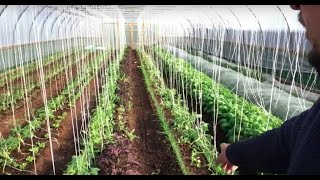
Richard Perkins walks through his Swedish no-dig market garden at 59 North, where cold snaps have slowed the season. He's growing tomato varieties like Black Opal and Idli, testing a paper-pot transplanter, and dealing with flea beetles on young brassicas. Shiitake mushrooms are fruiting on alder logs.
Chapters
So I promised a little update for the market gardens. We had a bit of a slow start this year and some cold snap that's really put some of the crops back. But I'll give you a little tour of what's going on and what we think of the paper pot transplanter and other little things going on in the garden. So things are coming on in the tunnel now. And we've got a bunch of tomato. This year we're growing idli and black opal and chirola and basically a mix of red, yellow and orange and also black cherry tomatoes as well as a couple of standard red tomatoes. This year it's a little different in that we're growing a lot more salad crops on either side. So you see we've got some. Some beautiful red Russian spicy mustard leaves here and some other beautiful salads. Got mizuna and spring onions in here. There's also cucumbers going in here. So we're doing tomatoes on 22cm and cucumbers are on 35cm. We're a little bit late, but that's the way it rolls in Sweden when you can't put out things until end of May, early June if you are not using a heated tunnel. And we don't want to heat a tunnel at this scale of production. It's just not economic to compete with big industrial glass houses. So things are in and being watered in well. But a bit of stringing up to do and the guys have been working on that while we've been busy in class today. But we've had pretty good results in here considering this is really poor quality subsoil pad that we put the tunnel up on. And we cropped in it last year, if you remember videos from there, we had pretty good results, all things considered. And this year I made up beds with the old animal bedding and that seems to have gone okay. But we've got some great salads out of here and salads that we're selling already. So that's nice to have these extra productions. We've just got to figure out how to get the drip installed in here and maybe add some extra drip tape to take care of the side salads this year. These are the west beds, east beds which we put down to perennials. Everyone's having dinner in the yurt. I'm skipping dinner to make you a video because I haven't been around the gardens properly for a while. But we've put this down. The bottom seven beds are into asparagus. You might just see some of the spears we've put in asparagus crowns. So this year we're not harvesting anything, we're just letting them grow. Typically when you put in older crowns, you get transplant shock. And so we just let them get settled in this year and we'll trim them back late in the year and just hopefully start harvesting asparagus next year. But we've decided to put all of the yeast beds into perennials or annual flowers just because they're odd lengths. And I want to start moving towards bouquets. Doing bouquets for the Rico I think will be really beautiful, but it's a bit too remote to do many flower sales. But I'm really interested in it and I think this is just a bit of an experiment this year to see how that goes. So this will become an incredibly beautiful part of the garden this year and we'll do a few bouquets just to see how that works for us. We're getting ready to put up all the peanuts. We've got a lot of pea beds this year. We're putting in bigger heavy duty fence posts with thin timber in between just to hold up the nets. But things have been just settling back because it's been so cold. You remember a few weeks ago we were having 20 degree days and we're all sunburned. But then we've had quite a few frosts and then a spell of cold, really wet weather. It's been great to have more rain and we've got lots of crops coming up direct seeded mescaline under here. But it feels like we're two or three weeks behind due to the weather that we've had. Pretty much all the beds are seeded now, but growth is a little bit slow. We typically always started our veg boxes mid June and I think this year we wouldn't be in a position to really get the first boxes out. You remember a lot of the spring onions that were some of the first things we put in. They, they didn't die at all in the frost, but they definitely got put back a little bit and they seem to be picking up again as the weather increases. We've had a few days at like nice temperatures again, sort of 10 to 15. But that cold step definitely affected things. So in the south beds here we've got lots of beans in the tunnel and we're doing beans in the paper pot and on the 5 centimeter chain. So we're a lot closer spacing than we have typically done. Beans and beans is way one of the crops that I felt will will be Good to intensify. We've also got broccoli and kale in here and got the first squash in. These are patty pan squash. So everything seems a little bit further behind where I would imagine it would have been. But we knew that we were starting a bit late this year because we were making all the beds again. And it's been great to do all that resurfacing work. Lots of strawberries and their root trainers and lots of grapes from cutting here. So we're just going to let these grow on and pop these on a lot bigger. Here you can see these are the suckers that we've been taking out from strawberries. So they've only just gone in these pots. But you can see this is the benefit of a root trainer as you get this lovely root growth concentrated down and it air prunes. So these are basically in here until they're established enough that we can go and pop those into the tree limbs. Have about a thousand strawberries and we've just been potting up this morning about a thousand nut trees of pecan, walnuts and chestnuts. So so far, paper pot is the main thing to update about. We're loving the air pruning and a lot of crops are doing really well. Some more young beans, but some issues getting used to it in the beginning, which we'll go and look in the north beds and I'll talk about. Someone asked in the previous video what these structures are here. This is a root cellar. It's very common in most of the old farms and we don't use it for food storage so much. Now we will use it for. Since it's got this lovely arch stone roof and it's covered with soil and we've built racking in here. Let's turn around. Give you sense of the size. It comes back about 7, 8, well, 6, 7 meters, 4 meters across. We actually have a little pipe here. So it's quite mouldy when we bought the farm. And so we put in a pipe that comes out of here and falls at about 1 in 100 around the tunnel to the ditch. And the reason we've done that is so that we get more airflow with the chimney at the back. And basically it sucks air in and any air, any excess moisture is condensed on the pipe and it runs out back to the ditch. You can see EggMobile 1, the original EggMobile is on hold. We only have the two Eggmobiles this season and really greening up. Beautiful. Just taking a walk around in the evening sun. We've been having so much rain that it's been nice to just get out and about and look around while the weather's still nice and just take a quiet moment while everyone's enjoying epic food. We've been eating incredible meals and had a really nice barbecue last night and it ended up pouring with rain despite the weather forecast. But just nice to get out and about and have a little break. Halfway through the training, caught some fish and ate an epic barbecue which was really nice. So here in North Beds we've exhausted the wood chip supply. Not quite finished but mostly done. So lots of radish and turnips, there's carrots coming up and beets and there's more turnips here and bit of pathway still to go. But we've been having trouble with certain paper pot crops now. But essentially when you're putting out young plants that basically very young, they're just sprouted seedlings and so you've got to be really careful to keep them moist. This bed is a direct seeded bed that we've covered up to keep it moist in the hot sun. On the days we've been having hot sun here you can see rows of mustard greens from the six row seeder. So we always cover young direct seeded beds up with row cover and I think that's a helpful strategy with the paper pot. Something we found is you've got to be really careful that the seedlings are buried properly like here where you see the paper exposed. It's not ideal. These need pushing down and really making sure they've got a good solid soil contact to make sure that they are protected. This bed needs a row cover on it. Most stuff is under row cover at the moment, but pretty much the way things are here until June when we start taking more of the covers off. So it's not very long in the year. You can really take all the covers off in the garden. So here in the 40 meter tunnel. There's a lot of mitsuna here direct seeded along with mescaline paper pot beans and there's kales and spring onions and beets and things are picking up now due to the heat collected in here. This is east to west orientation so it picks up a lot of heat during the day. But we found the paper pot to be pretty good for the taller crops. Peas and beans and things are a little bit more established but trickier for some of the really young crops, especially young brassicas. So with the young crops, as I was just saying, it's really important to make sure they are, you know, really well put into the ground and kept really closely watered in the beginning. And that's. Some young beets have just been going in. So it's really getting used to the fact that you're putting in sprouted seed and it's, you know, it's very different to putting in larger hard ear transplants. But we have had a major problem with brassicas. So flea beetle is a major problem in Sweden and we always suffer with the earliest brassicas that go out. We don't even bother sowing rocket in the beginning anymore because it's just so unreliable. But what we found with the paper pot is that you're putting out such young brassicas, they get decimated by flea beetle to the point that it kills them off. So a lot of packed choi got lost this year and so we've been filling up beds with other stuff. But that's something that I've sort of clocked in my mind is first thing is that next year we would do brassicas in the old 64 cells, growing them out much bigger because they're much more resilient to flea beetle when you do that. And you're also putting in bigger plants at that pinch time early in the season when it's much more advantageous to have much bigger, bigger transplant. So I'm thinking something like using the paper pot for the majority of the transplanting. It's definitely way faster and the seeding is way faster. But the first vulnerable crops, I think it's worth doing by hand still. So that's something I'm making a note of as we watch what's going on this year. So we use pelleted carrots this year and they are a lot slower. They're coming up here, six rows, but they're much slower than we're used to, and two to three weeks, which might be typical for some, but I've got a feeling that the raw seed does much faster germination. But again, the cold weather affecting the plan this year. This is the new north beds where we have wash station now. And it's quite hard to show you everything because everything's under cover, but we got lots of direct seeded crops on the insect net, lots more beans. We've just been putting in, showing people how the paper pot works and all the later paper pot transplantings have been much better. So I think over time, you know, obviously people learning the ins and outs of it and some really nice direct zone crops coming up. So things are, things are all there and Starting to pick up. But we're hoping for some nice warm weather now because it's definitely been slowed down a bit by the weather. All kinds of different crops in here now. Got some beautiful spinach ready to go in here. This is red kitten with the red veins on it. There's some really nice flowers. This will start to bolt if we get some hot weather, so we're going to stay on top of it. Got some good turnips coming up in here and then all our peas are concentrated on the back of the beds. More squash beans in the 30 meter tunnel with the irrigation hup. So we've been managing to keep the watering going pretty good in these and not having so many issues with the pump this year. We've got lots of water and the stream is keeping the pond full regularly. So tough to give you a big update. I really wanted to just have a look around the garden, but it's so covered up with row covers. I think this update will have to go on over a few chapters and I think, you know, we'll see it play out over the season. I'll be obviously making a detailed analysis of whether I like the paper system and ins and outs as we go. And you know, it may be hard to tell at this point, but hopefully you can see a little bit of what's going on. So what started out looking like another drought here has become a really wet year where you really appreciate having the wood chip pass because that's really sucking up a lot of the excess moisture and allows you to work in shoes and not be traipsing around in thick mud which you would be in a sort of, sort of standard till setup. It's also holding a lot of the moisture and will release it later on. So we've been super fortunate to have so much rain and it's really evident in the pastures. We've got beautiful growth up there and chickens are laying their first eggs. So things are starting to pick up. The birds are doing great in the brooder. I'm just going to give you a quick look in there because the birds are growing so quickly. So day seven in the brooder and things are going great. If someone was thinking the birds are too cold, I would say they're absolutely bang on the target temperatures. So we monitor that several times a day and it's going really well in here. The birds are growing really well, feeding really well. So they have five days on free access to food and then they're on restricted feed program. So each pen is measured out and at the moment we're on five feeds a day, that will go down to four feeds a day and we'll start to introduce grain mixed with the start of food. And we talk about those ratios in our online course or in our book and how we've worked out how to do optimal feeding programs. And at three weeks they've got to be down at ambient temperature and they'll be on three feeds a day for the rest of the time. Out in the pasture, we've worked out in a grazing plan to get the cows through front field where we'll be raising this batch and just really clear the ground the week ahead of them so that the ground is in a good condition for them. They can't come out onto tall, lumpy pastures. But really happy in here. The birds are very content and today was the first day they'd finished, finished all the feed in the feeder. So they're obviously going through a little growth spurt now and starting to get a little hungry in between feeds, which is what I want them to do. And I've talked about this in other videos, but I want the birds to be fed in a time restricted way so that they get hungry in between and they go out and forage and that's much better results in both layers. And pastured turkeys and pastured broilers. So this is where we're starting boilers. That's the current plan at least. So they won't be out for another two weeks and obviously this pasture will be up and away. And so we want to come through with the cows. Talking a lot in class about different ways of managing grass, managing everything, as you might expect. But looking forward to coming couple of weeks when we get the birds out. It's going to be great to have all the animals out and moving on pasture. So to give you a sense of the rain we've been getting this time last year, I think we were starting to get low on water already and certainly as the following weeks progressed we were pumping this down super low. But we've got a lot of water coming in and we've had, you know, I think five or six hours on the pump without the filter clogging up. So very different this year to last year. And after the dry start, this has been a very welcome break and rejuvenation for departure. Very nice to see. I've been really grateful for the rain. Well, we've been always having autumn shiitake, but it seems like we're getting some spring flushes with all this wet weather now this is a job that deserves two hands. Well, just goes to show you've got to keep your eyes peeled. Wasn't expecting that as I walked out today. Beautiful shiitake mushrooms of alder logs. This is what much of the pasture is looking like despite the drought. And we're going to be grazing tall again this year. So we're already up at knee height and good age distribution of plants and really happy to be grazing tall, doing things a bit differently and letting plants get a lot more mature. We're going to be going around the farm pretty fast. However, the grass is going to be going much faster than these cows can keep up with, even when the ball comes. So very happy with looking at this. After the drought last year, those of you that follow our channel, it was rough and so seeing the recovery and little flurries of succession on the bear patches that the chickens did make, I'm happy enough to see this. And we did all right to reduce animal numbers. Part of reducing chicken numbers this year was to really ensure that the ground got to recover. I think the start we had to the spring, if we had had the amount of pastured poultry, both layers and boilers that we had last year and we'd had another drought, we would have been in deep trouble and we'd have basically been farming dust and really damaging the land. But seeing how this is all recovered up, we're not even in June yet. I'm super happy and I really want the grass to express its physiology and get tall and ripe and start changing the way we graze and not focus so much on keeping grass vegetative and letting it express itself aerially. Got some nice black walnut coming up here in the bottom of the field, but yeah, it's been beautiful having this rain and I'm sure many of you are getting a bunch more rain this year and valuing it as much as we are. Well, that's it today, folks. We're having evening time together again, hearing more about different people's projects and farms. And so I'm going to leave it there and I'll give you some other updates with the pasture poultry later in the week. But thanks so much for watching, folks. Really appreciate your comments and shares and likes and you can find out a whole bunch more in the links below. We'll see you in the next video. Thanks for watching.
More from Richard


A review of short and intensive season on a mixed farm and restaurant/event space in Sweden






Alskade Kyckling Exploring complexities of poultry production in Sweden and what we stand for


