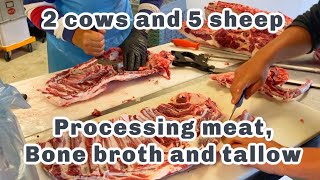
Richard Perkins and Louisa demonstrate rendering tallow and making bone broth from large animals. Bone broth simmers 24 to 50+ hours in cold water with vinegar to draw minerals; tallow gets chopped, rendered wet or dry, then double-clarified with salt and water to remove odor. Pressure canning at 120°C or boiling 120 minutes at 100°C kills spores, and one cow yields broth for months.
Questions this video answers
At least 24 hours (rule-of-thumb; 24–48 hours recommended).
Examples given: 30 hours, ~28–50+ hours (one pot described as cooked at least ~50 hours after combining batches).
About 150 milliliters per large pot (Louisa: "Maybe like 150 milliliter").
If no pressure canner, Louisa suggests at least 120 minutes at 100°C (though she notes pressure canning is preferred).
Transcript states spores die over ~116°C; Louisa references safety at 120°C under pressure.
Chapters
Hey Toad.
Hi.
Maybe Toad wants some broccoli.
Yes he does. Toad wants some beetles and bugs and ladies and worms.
Look at all peaches. Do you celebrate? Can't appear in summer.
Okay, packing cows. We're adding extra fat to everything except for this high fat mince lady said. Okay. Food security. This is mint from one of the cows. And we've put all the fat back in because that's the way I like it. And some prime cuts as well. So we're going to start packing now. Using that to get half kilo bags packing pack lots to do.
You have a child so begins to break deep in the great. Look at towards peaches. How do you celebrate? Count appearance hard nowhere. Look at all the chains. It's already dead. I know you have some I'm not getting. Well looks like D.
All right. We've got these crates and we're coming back tomorrow to do these. We've also got bones we're going to chop down to make stocks. Very nice. We got beaten by time today. But that is a huge amount of meat for the next couple of years. Really nice little labeling system. Don't have all the words brisket now entrical. Look at this grass fed baby. Check out the spider web. It's a net suspended focused and concentrated on the gaps between the boards where the breeze comes in. It's very cool. These vertical structures holding each net. Clever little design. All right. Bones for soup, bones for stock, bones for stew. Last of the meat that we're packing here today. In this freezer we got a lot of stock boiled down to concentrated jellies. This freezer got a lot of liver cut up into nice size pieces. And that's great for sneaking into the kids food. Just mince that up and add it to mince to put in lasagna, burgers, stews, whatever organs is where it's at. Cordials, srirachas, jams, chutneys, lots of chicken.
Hearts, chicken liver, smoked chicken bone broth. Can't smoked chicken. This is chicken broth. All canned shelf stable.
How long can that last? Like the cellar or something.
It's good when it's cool because then the fat gets hard and it seals it even more. Of course it's always nice to have it at a cool temperature. But it doesn't need to be. It will last like half a year. A year it will last even longer but I think the quality goes down.
This is sheep tallow. And is that canned as well?
This is canned as well.
So if you don't can it you just store it in the fridge.
Yeah, but actually if you get all the.
It's pure fat. So it's.
Yeah, if you evaporize all the water while the rendering process should be shelf stable because it's the bacteria that needs the water to grow.
This is Louisa, who's been here from Germany all summer and is super good at making all kinds of delicious. Tell us a bit what you got here.
Here we have also bone broth, 30 hour cooked bone broth from beef, pork feet and mutton bones cooked for 30 hours.
Is that specific?
Yeah, it's like at least 24 hours. Like between 24, 48 hours. That's good to get all the nutrients out. Like first all the fat and all the gelatin comes out and the taste. And then the longer you cook it, the more minerals will come out of the bones.
So you're saying rule of thumb is absolutely minimum 24 hours?
I would say so, yeah.
And 48 hours for some of the minerals to come out.
Minerals. And then you should never add salt in the water. That will stop the minerals from coming out. But also we add vinegar to get the vinegar.
Add acidity.
Yeah, acidity to just get more minerals out.
So you're doing. And it's quite important to either cut or crush the bones to expose the marrow.
Yeah. Because you want the marrow. That's where all the nutrients and all the taste, of course, is in. Yeah.
Cool. So a little bit of vinegar, like a tablespoon or two, I would use more.
It's like I've read a paper about, it was an Asian paper where they said the higher acid is in. In the water, the more minerals come out. So actually you could add a lot. A lot of vinegar just wouldn't taste, but then it doesn't taste anymore. So it's about finding a balance of putting.
So you're talking like a big pot like that, that you're making all of these jars in one go sort of thing. How much vinegar would you add for that?
Maybe like 150 milliliter.
Yeah, yeah. So that doesn't need to be precise. But more acidic means more nutrients.
Yeah.
And using like apple cider vinegar, is it better to use etiquette, like stronger?
Then you probably wouldn't use so much Attica, like the vinegar essence. But you could use apple cider vinegar. I prefer white wine vinegar, like a table vinegar to have, as we add, not so much different taste in it, just get the acid.
What's this? We got satis or tamale sauce.
Yeah. Pasta sauce with onion Garlic and basil from the garden, also canned.
So that's safe against botulism or anything like that. Once it's canned.
Yeah, like the botulism is with the tomato sauce. There's enough acid in it, then you don't have any petuleum growing. But with these things like, because we don't pressure can them like on 120 degrees, it's not safe for not 100. It's like really, really rare to get the petuleum bacteria. So it's really rare. But if you have it, it could grow in here because it's just canned with 100 degrees because we don't have a pressure canner. So before using I would always like boil it up.
So you cook rice in it or added stews. But it's getting boiled anyway.
If you boil it again, I wouldn't eat it cold for the slow wrist. For this really small risk of petuleum, if you would have a pressure can 120 degrees, then this is no risk at all.
And so we've packed all the bones for making bone broth. We're going to make bone broth. But you're making tallow now, right? Yes. And so this is all fat from the cow?
Yeah, this is nice grass fed grass finished fat. And this is all the organ fat, the liver fat. And from the inside I think this is the best quality for tallow because it has, it's the most nutrient, the organ fat. And it's nice and soft. It has the best taste.
And what's the basic process?
I'm gonna chop it down in small pieces. Now you could also mince it maybe, or when it's frozen, you could put it in a food processor if you have a really strong one to get it into small pieces.
And then we kind of smaller the pieces the better, right?
Yeah, and it's just faster and yeah, it's not so. And then we put it in a pot and then there's two different methods. You can use a wet method where you add water and salt and this will get all the impurities out. And yeah, it's just a bit easier with the water because it won't burn, the fat won't get too hot. But I think we start with a little amount of fat, render it really slowly onto low heat and then just add more fat and don't add any water. It's just then we don't have to evaporize all the water again to make it shelf stable because we want just 100% fat, no water in it. And then it's super stable fat and you can keep it for really long. It will last for years in the jars.
And talking about doing like double clarified tallows. Tell us a bit about that.
Yeah. So this is. This tallow that I think we're gonna make today is for eating, for, like frying things in and putting it into stews or whatever. It's just a super healthy fat to eat. You could also use tallow for making skincare products, soap, these kind of things, because it's super healthy. It has lots of vitamin E, vitamin A, D and K. Like basically E and K is the most, and the skin will absorb it as well. So it's super healthy to put it on your skin as well. But then you don't want to have beef smell. So to get it odourless, we have to purify it and get all the imperaches out. We would make the tallow and then we put the tallow, the finished tallow again in water. You could also do it in one step, actually. Then we add quite a lot of salt and water, boil it up again for one or two hours and the salt will suck out all the impurities and all the. Yeah, all the smell and everything.
This one, for example, a sheep one is. That's pretty clean, but it's still got a sheep taste.
Yeah.
So you would get rid of that taste by clarifying it again.
Yeah. And then you let it cool down with all the water and then you have like a kind of a tallow bar under in the top and you take it out and then you can just scrape the surface of the tallow that was on the water side. It's not salty at all. Even that. You add a lot of salt. The salt stays in the water. The fat is just completely white, pure fat, order or less, and you can use it for whatever. And it's also actually the better quality for cooking the purified one, because you don't have all these little impurities from the meat pieces that you maybe still have on it. So it has even a higher smoke point when you purify it. Then it's like super high smoke point. It won't have any burned thingies in it.
What do you think about vegetable oils for cooking? Not good at all. So we've got a couple of crates of loose backbones to get processed into stocks and then we've bagged up a lot. Hard to vacuum pack bones. Obviously you've got sharp edges, so actually pierces the bags, but they're going into the freezer tomorrow. And a lot of crates of meat. This is a lot of mince. And then we've made stewing packs of really fatty meat. All of the cuts are labeled very nicely so you know what you're getting when you take it out the freezer. Lots of beautiful grass fed fat. And that's my favorite bit. I eat a very fatty animal based diet. That's enough food for two years at least. And bone broth every day. Cooking rice in bone broth, cooking stews, everything. Replacing water with bone broth basically. And kids love it too. Okay, some hours later that is rendering beautifully. And you can see that's a big old pot. That's a lot. Oh no. Bongo looking great. Lucky peeps. Out with the old. Okay, got the cow. Next morning. Another flat. Coming up on that now. Well, that's it for larger animals at the farm, all animals dispatched five sheep today. We're taking off to go process for sausage and things. Look at this beautiful grass. This is a shame we couldn't graze it all through actually. Then we'll mulch cut this to fertilize. No problem when we have them in one leg.
But I still don't want one.
So how long has that been boiling, Luis?
So that was 15 hours. I turned it off in the night because fat can get really, really hot. So you should always check every hour or something like this. And also stir because the little chunks of fat on the bottom now. And now we can put it through a sip and then in the jars.
So what temperature? Like what's the important things about.
It's important that it doesn't get too hot or else it would. Yeah get a burned taste because we didn't use water on it to have it easy. Now the good thing about the fat is like water just boils until like or gets up to 100 degrees. The fat, like I checked it a couple of times in between. To have like 100, 120 degrees, it shouldn't go higher. And with the 120 degrees there's no risk for any petuleum bacterias. Like the bacteria die at 100 degrees, but the spores they just die over 116 degrees. So it's actually super safe. But even if you have it in the jars, I'm gonna can the jars because we want to have it shelf stable for like a long time, for one or two years.
And how about the bone broth that's been going on. Yeah, the bone same amount of time.
Was actually even longer. That wears longer.
That's got like A half inch of fat on top.
A lot of fat. That's really nice. It's nice on the jars on the top. When it has a layer of fat.
It seals it a bit. Turned.
Yeah. That's really nice.
So how long is that one going?
The bone broth was Yeah. A good 24 hours now bit more like 28 hours. Because the bone broth I leave on overnight. Nothing bad can happen. Yeah.
So we start with this.
The pot is too heavy to pour so I need this tool. A bit greasy but too thick amount.
There's more bone broth going on over here. Oh yo, yo. Look at all that fat. So we buy jars from like a honey supply or any old jar supplier. They come sterile. But then to can them, how are you canning them? You're boiling them for 15 minutes or so.
Yeah, I would do like with meaty things. Usually you should can it with the pressure. Yeah. Under pressure. And if you don't have a pressure cooker you should do at least 120 minutes at 100 degrees. But we just do this like 30 minutes at 100 degrees and it's basically fat. So because it's just fat there shouldn't be any. Like all the water evaporized. So actually there is no chance for any bacteria to grow in there because they need water. So it's actually safe. The canning is just to get the little air that stays inside also sterile and yeah, to have a change there. Because we can it. We can't fill it all up the way up till the top because it will boil inside when we have it in boiling water and then it might go through the lid. So we always leave at least 1cm.
When you buy a jar of tallow like this once grass fed tallow cards, €10, something like that probably.
I never bought grass fed tallow. I made it myself.
Same with bone broth. No, like bone broth is really expensive. If you buy grass fed jar like this, 750 mil.
Yeah.
It's like euros. Yeah. Enough one cow. What are we going to take off that from one cow? You could get what bone broth wise, you can basically have bone broth every day for a year. Yeah.
Liquid gold looks super yummy. I turned it off a while ago that the fat is not too hot when you put it in glass jars they might break. When it's super hot.
What do you do with the chunks that are left at the end?
Eat them, Put salt on them and eat them. Or just feed it to the hands or something like this. It's basically Left over.
All right. Making sausage with sheep with heart, liver fat, kidneys. Very nice. So if we make it like that or what do you think?
Yeah, I, I always took this and this part.
Yeah, there and there.
Yeah.
It's the roast beef Francisca in a load with little more. So it's been okay?
Yeah.
It. Okay. Quite some mints from sheep, some slogan bits. Gonna saw up cutlets. Okay. Bratwurst recipe. Grams per kilo. It's quite low. Salt. Next one is garlic then. Oh no, sorry. White pepper and black pepper, they're interchangeable. Muscot is nutmeg garlic, cumin is caraway seed. You don't need any nitrates or anything if you don't want it. Okay. Five sheep, we've got 100 kilos of mince, four crates. We're going to do four different batches of sausages. Got some nice pieces from the legs for slow cooking. Now we're cutting all the cutlets out as well as some fillets, etc. We're just going to use the saw to be quick because we've got to get home to pick up the kids. It's going really good. Really like this rail system. It's very common in a slaughtery like this. But that's definitely something I want to have in the future. And I really like this detail that we saw where you can lift this end bar so you can really pick up a heavy animal off the trailer. It's really good as you get older and have bad backs. Okay. Plenty bone broth. Constant pans on the boil, not losing any water there. All this beautiful grass fed tallow. Look at that. All these beta carotene is making it yellow. And we've got more pots of bone moth on the go. All the bones that we've brought back are now in and then we also have a huge amount of bones, sawed up marrow bones for roasting as well as more bones to work on. Two weekly batches. So we've got got a constant supply of this throughout the next whole year. At least a lot of food off a cow. And we've had two cows, nine sheep, 25 turkeys and 150 odd broilers. So ample food supply. Last step in the process. This is bone broth.
This is bone broth.
And you cooked this a long time?
Yeah, 24 hours. But it was balanced brown that we already cooked 24 hours and new bones. So there's some bones in that. Cooked at least like 50 hours now.
So that gets full maximum mineral component. And this is not Salted. Right. So you salt it when you want to use it.
It's a few important things. When you set up the bone broth, you should use really cold water with the bones. Because when you use hot water, the. How do you say, corn pores, the proteins, they all stay in the. In the bone. So if you want to get all the good stuff out, you should use.
Cold water and bring it up to the boil from cold.
Yeah.
And no salt.
Yeah. Slowly heat it up and add vinegar. Vinegar is super important. Like, now, we didn't have white wine vinegar. We used the Attica. This is like really strong vinegar. Snow salt that all the minerals come out. And I put bay leaves, black pepper, unicorn, and these. Pepper. I don't know the English word for it.
Neither do I.
But this is optional. This is just for taste.
And.
Yeah, then we put it through a.
Sip.
Because there's all the bones. Like, the bones changed a lot. Like, you can see they've been cooking for a long time, or not cooking. Actually, it's just like a simmer. Put this through here. And then I spread out the fat in the beginning, because the fat is always on the top.
You want that layer on the top to sort of seal it in. Look at that.
If you would pour everything in the first jar, you would end up with a jar full of fat. And then the liquid broth is coming. Then after this.
Okay. Jar's been canned. Boiling water. So it's going to last a long time. Tallow, bone broth. Oh, yeah.
More from Richard


A review of short and intensive season on a mixed farm and restaurant/event space in Sweden






Alskade Kyckling Exploring complexities of poultry production in Sweden and what we stand for


