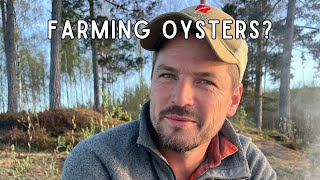
Richard Perkins updates on three Swedish farms: moving cows to winter paddocks, converting felled areas to agroforestry, and pausing egg production to pay down debt. At Kletta he's trialing oyster farming with floating baskets. Siligorden installed 1.5 km of wolf fence and will host a regenerative agriculture festival.
Questions this video answers
November 9, 2025
Three farms (Ridgedale, Kletta, Siligorden)
About 1.5 kilometres
About 8 hectares
Approximately 59° north
Chapters
Welcome back to another video, folks. It's been a pretty eventful, intense year and so I thought I'd do a little video update of what's happened and things to come.
It's crazy to think 13 years ago I arrived in Sweden with a few thousand euros and a lot of ambition and excitement and passion. And now today we have three farms here and it's kind of a lot when I think about it, and obviously at different states of development and different things going on now. And my directions changed a bunch in my time here, but I thought today I'll do a little tour of all the farms and what I'm thinking and how it's been going and just give you an overall update of all things going on in my world.
So here at Ridgedale, I'm putting the cows now in their winter paddock, which is where we rear the pigs. It's the first of the pig paddocks that go up through the forest. They've grazed around the farm. Now I've left a bit of the last of the grass. Grass has gone into dormancy pretty much, but we've got grass in front field for when the sheep come back from Silly Gordon. But I'm going to get them in their winter paddock today and they will be in there until they can go out grazing again in the spring. Well, it's definitely a late winter this year compared to other years, but more typical from the historical data maybe, but soon it'll probably get iced up. They don't like walking around this tight corner. Well, you got it. Well done. The last muddy one. So this is the felled region that we're turning back into mixed species agroforestry. You can see mainly birch and poplar there, but there's also a lot of oak and other species coming back. I'm actually standing by some oaks here and can't see very well perhaps, but this is a 10 year old tree. It's probably about 8 meters tall and these trees are similar 8 to 10 meters. Beautiful. And how they prune the side branches lets all the light in and that allows a lot more grasses to grow. So it's more like a pastoral floor than a forest floor. Very different to the neighboring land that's had no animal impact. So I've shown this many times before. Just across the the road, the trees are far smaller. They're also very much denser and only two or three species compared to nine in ours. Forest floor species. You see there's blueberry and there's still a lot of Brushwood lying in here. And we've raised a lot of value of forest rose pork as well as the cows and sheep grazing through multiple times a year. And there's nothing pruning the under branches here, so no light real down to the ground and no grass growth except on the very edge. Very different pigs being the climatic trigger in the forest systems here. So we're just working with natural systems, mimicking natural systems to drive the ecosystem in the direction that we want it. Eggmobiles sitting empty for the wintertime. We've got no hens this year for the winter because we want to refocus, get ourselves ready for the new season with the restaurants after this year. It's been a lot this year and so having a bit of time to regroup. And I'm also working on a book writing project as well as a bunch of other stuff, so giving us a bit of time out over the winter. Yes. So our production levels are much lower than they used to be in the early days of the farm. And that's partly because we paid off the debt in the five years that we planned to. And so our financial needs are not as great on the farm. We also have multiple plates spinning with the restaurant and with a place on the west coast as well as the other activities I'm involved with. And so it's finding a balancing game really. But we're still raising all the same things that we always have. We had pastured eggs in the eggmobile that we've been selling on the Rico rings and a lot of pastured boilers in the way that our farm got quite famous for. And we also raise forest raised pork and we've got beef and mutton and lamb. And so everything that we've always done in the market garden. Of course, one thing that I've come to accept is the sort of rotation of staff over years and that's a high cost to myself energetically, mentally. It takes people a long time to get familiar with the systems and how to work effectively. And so I have no intention of scaling this back up to the sort of levels of production we used to have unless I had a permanent team living here. And those options are more open in in the past because we've got more accommodations, swap the silly garden, etc. But we're taking a tangent to a new direction there. And there's other things in the pipeline too. So that's where we're at with the farm. We'll keep running that. We've got an exciting internship lined up for next year. Actually only running a single internship and it's also going to be working on the farm over at Siligorden. We might do some natural plastering as well and it'll be looking at all aspects of farm design, market, garden, pasture, poultry, grazing, management, keyline design, all the things we've always done butchering and processing on the farm. But it'll also be working over at the restaurants, getting some experience with events as well as getting to see world class concerts. And we're also planning a regenerative agriculture festival, a co created event where we can all come together and we want to create presentations from within the network. We're not paying speaker fees or travel costs for anyone. Everyone buys a ticket and that's a low cost ticket that just covers all your food. So basically you've got the whole two days paid for. Everyone's camping together on the lakeshore on the beautiful freakin where the restaurant sits and we'll just pack the day with a busy schedule with two days. Make sure you have a little look at that in the links below because you can save yourself a spot and mark it out in the calendar but we'd love to invite your input for sessions on anything to do with this field of regenerative agriculture. There's some information on the website but if you want to come and get involved then send me a the information via the form on the webpage and we'd love to host you there and have a really nice time networking, learning, sharing, feasting, celebrating together.
Well it's safe to say this has been a pretty stressful year and financially and people wise has been the core reasons for that and the start of the year was extremely stressful. I took on a lot of debt to start up the restaurant and to buy the restaurant and we had to cancel events that would be the main money makers due to not having licenses in place. Took a very long time with the authorities and also losing the chef we had planned with for the whole time and so it just felt way too risky so we decided to scale it back to just opening once a week and putting on events and that turned out beautiful. And Jonty the chef who stepped in last minute was incredible and just picked up everything and made a beautiful new menu. Farm to fork and was just Sterling. He was cooking for up to 300 people, sometimes on his own and with a teenager crew for serving led up by my daughter Grace and some of her friends. They did exceptionally well as well as Marlon and Melody who ran up the bars and they did a fantastic job so I'm really happy with the team there. Had difficulty with some of the crew at the farm and I always have high expectations. But what I do feel like is there's a lack of people who are tooled and skilled up to hire in this field. Especially as I'm tending to hire people from abroad. There's a wider pool there in Europe of people interested in these things. And because of our short season we have a transient crew. It's only possible to have someone year round if they actually move here. Which we had Victor this year, but unfortunately I can't afford to keep him on when he's not working in the winter months. There's just not enough cash. It basically took all my management capacity to not go bankrupt this year. I have four RB companies, like limited companies and have the ability to move money around between them. But with the level of production at the farm currently and the level of money going out with the restaurant and hosting people for trainings, etc. And not the level of income we needed, it was tough and we scraped through, but it was really, really testing and I was losing a lot of sleep in the early spring. Just it was very high risk and a lot of weight to carry. As the only person sort of holding financial responsibility in that way. So not being victim, I mean, I took it all on myself. But yeah, people saying is tough. It's really hard to find the right people. I'm sure many of you can relate to that. And we do. We are blessed to have amazing people come through here, but they don't always fit well. And that happened a bit this year. And that's stressful when you're already pushed economically and underperforming, etc. And so there's been trouble. But we did produce a lot of amazing eggs. People were very happy to see us back on RICO rings with those, as well as our chickens, which are somewhat famous here as the first organic chickens. And just nice to be back in touch with some customers and people happy to have our incredible produce. And I think what really makes a difference, I mean a lot of the people on the RICO rings are people we've trained. And I find that we just take it an extra level. Like a lot of people copying our pasture poultry models only move their birds once a week or every four days. And there's a real difference between a bird moved every second day or every day and a bird moved once a week. They ingest a totally different amount of greens and forbs and insects and it's a totally different product. Same with the broilers. There are no other comparable birds in Sweden other than students doing the models that we've been showing. The only other organic chicken in Sweden is mass produced outdoors in an indoor enclosure. So it's just mass production outdoors. There's nothing beneficial about that, really. So we're really proud to be able to keep offering all the products we do and branching out into new ventures as well. It's really fun.
One thing I'm excited for is to get a little farm sawmill and utilize some of this timber here. I want to keep this forest here after the travesty of what happened when we cut the forest up on the hillside. But I'd love to cut timber and get more into timber framing. We've got permission to build a big barn structure back up on the west coast and it'd be really nice to be able to take timber from here. Cut a traditional timber frame building and just over time put it up over there. Could be used for accommodations. We could easily run B and B over there and there's lots of cool west coast activities, fishing, kayaking, climbing, etc. That, that could be an arm of things we open up in the future and we've got exciting plans over there. I'm going to take you over there. So over here at Kletta, that's my second farm on the Swedish west coast, we are. Well, we haven't been doing anything here this year. We had sheep here previously and I was excited always to maybe put an intern here who could run a market garden enterprise to Greberstad, which is a very affluent summer town. It's a holiday town. A lot of scope for running a good seasonal business from here, but that hasn't happened so far. But something I've started to explore here is the possibility of oyster production and to do some aquaculture. I've always been fascinated by aquatic systems and have been interested in aquaculture from sweetwater perspective. But actually, as I start to think about this place, it's. Grabestad is the heart of Swedish seafood. It's where all the lobsters and oysters come and it's world famous. The European oyster is in decline, being taken over by the Pacific oyster, which is just dominant in these waters. And I've been thinking about. Well, it'd be kind of cool to employ the services of the local oyster and do experiments and see what production looks like. For sale to direct to consumer and also to restaurants, etc. And to our own restaurant. Indeed. It'd be amazing to have a connection between our place here as well as our third farm, Siligorden. Agriculture is very small scale still in Sweden. It's not been overexploited in any way. And it's actually here in this area that you have culture grown spats, which are the baby fry oyster, once they settle. And actually there's a company here producing oyster, the native oyster that actually seeds them themselves and collects the larvae onto shells in the sea, which is quite an interesting process. But we'll be looking at more buying spats, a 2 millimeter baby shells, and then growing those out in floating basket systems which avoid the bottom mud and keep them up in the surface waters where the microplankton that they feed on is. And it's an interesting idea. I don't know anything about oyster farming. I've been doing a lot of research and looking at different models around the place and just finding out a whole bunch more about it. But I've made an application now to trial it and just see if that's going to be something worth pursuing. So here on the Swedish west coast, we're in Skagerrak, which is some of the saltier seas out towards Costa Islands. And this is where the oyster beds that are collected by divers and by hand as well as the farms are. It's still very small scale in Sweden, but there's room for more. And I think it's an interesting idea. And we all know about the ecological benefits of oyster production and water cleaning capacities. So it's something to pursue and it's a way that could produce something useful and meaningful at this farm. So there are tens of thousands of small islands around here with fishing for mackerel and sea trout. And in the past they were cod, but they've been overfished so heavily. But lobster, edible crab, langoustines further off. And there's a lot of shellfish, obviously, both farmed and wild, but mostly wild. And there's just an abundance of opportunity, I feel, and it's something that I would like to have more connection to the sea and have more reason to come here. This property is 8 hectares, but it's mostly these gigantic rock walls that you see that could be better utilized for climbing or things like that. But I would love to see one day someone actually taking care of this place, farming, maybe for the summer market. And hopefully we'll one day find a student who is looking for access to land that could do that and we could run something on the seafront. So on the third farm up here at Silagoon, we made Some really good progress. This year we got funding for wolf protection fence because we have sheep. And so we put up about one and a half kilometers. But with the funding we actually planned not just the fencing here around the two primary fields, but also the fencing down the bottom where the houses are. So we got the materials for a lot more fence than the prescribed meterage that we got funded. I've been posting more on Instagram on a day to day basis where you can see things like this taking place. But asides from grazing with the sheep, we hosted the village triathlon here as well as our concert nights which were fantastic. And we've bedded in a lot of flowers here. But this farm, we want to probably bring poultry up and keep grazing livestock so we can have people develop a connection to their food. But here we grew some vegetables. But we mainly bedded in flowers now that we will be separating and planting out. Now it's a real honor to be able to be custodians of this historic place. And one thing we did is applied for planning permission for the yellow house to turn it into a permanent house with a view of one day maybe making our operations much smaller and moving up here to be up at this incredible st. This is a very long and deep lake that has burbet and trout and salmon. But this place has mainly gone to sleep now. We've put the bar truck undercover and the only thing going on here now is sheep are grazing as the grass has stopped growing. Now we're just grazing free flow until they come back to Ridgedale. Our stage held up really nicely. We take the roof off because we get heavy snow loads in the winter and we'll see if we can find the sheep in the back here. Now this land is a bit reminiscent of how Ridgestar was when we first came to it. You see all the sedges and signs of waterlogging or compaction or acidification or combination of those. There's the sheep parbots. We can really impact that by grazing management and also like bringing poultry. Especially for small scale farms. There's no quick at all. But we'll be getting a ram this winter so we can have lambs next year and we'll actually reduce our cow numbers. We've been very lucky to graze the neighbor's land this year, but that's not a given. So we need to reduce the the beef numbers again and work a bit on the agroforestry up on the hill at Ridgedale. But we've got some hectares of grazing here and we also hire the neighbours couple of fields over there that we've taken our winter feed off this year, so we're now able to close the loop a little bit more there. And soon the sheep will come back and graze on the last bit of front field before rejoining the cow as a flood. But they're happy in here, so we're not doing any grazing management as such yet because the grass has stopped growing. Now we're just letting them graze through until they're done and then bring them back to the farm. Now, this place has obviously got a lot of historical value. I've talked about it in other videos, but we're not going to do too much. We want to keep this aesthetically very nice. We're not allowed to touch this avenue of trees. We wouldn't want to anyway, but it's not a place we'll plant many trees or anything like that. I think we're going to work primarily on ornamental gardening, as well as supplying the kitchen here with meats, veg, flowers and eggs, etc. It'd be nice to get an egg mobile up here next season, and we're looking to host the Regenerative Agriculture festival that I mentioned here. So make sure you check that in the links in my bio in the description below and see if you want to come and get involved. It'd be really nice to gather a lot of people here and roast whole animals on the fire and talk about farming for two days straight and make connections with people from all over Europe and all over Scandinavia. That is something I'm very excited about, so make sure you check that. Well, that's a little update from life here in Sweden at 59 degrees north, with the three farms that we're managing now and a bit about what we're up to, and I hope that's interesting for you. And we're looking forward to running our online training now over the winter months, as well as working on a book project. And let me know in the comments below if you've got content you'd like me to talk about over the winter months on videos. And you can also find out a lot more in our books, which are in the links below. There's also free trainings and we've got a whole catalogue of videos showing all aspects of the farm over the past years. So don't forget to subscribe, like the video and see you in another video soon.
More from Richard


A review of short and intensive season on a mixed farm and restaurant/event space in Sweden






Alskade Kyckling Exploring complexities of poultry production in Sweden and what we stand for


