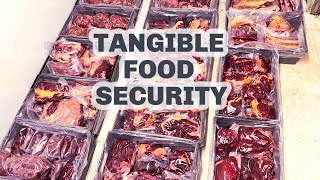
This YouTube video (uploaded by Richard Perkins on November 19, 2020) documents packing and vacuum-sealing beef for long-term family storage after breaking down a whole bull. The on-camera speakers (Richard Perkins, Sam, and Johanna) demonstrate tools and workflow (bone scraper, bandsaw, mincer, vacuum packer), describe packing techniques (bag-folding, sealing, labeling), discuss rendering bones to stock, and comment on the economics of livestock ownership (explicit cost/value claims). A brief family exchange with child Ragnar and an outro promo for a Regenerative Agriculture Masterclass appear at the end.
Questions this video answers
330 kilos
November 19, 2020
€1500
About €4,000–€5,000
One horsepower
Chapters
Welcome back to another video, folks. Yesterday's video, we broke down 330 kilos of grass fed beef for the family freezer today. We need to pack that in vacuum sealed packs. We need to mince and cut up meat for stewing.
And so I'll take you through that now. Well, good morning. It's been the wettest, warmest November on record. Still like 9 degrees at night, but just heaving it. So Johanna's got the stock pot on. We are gonna need dozens of these to render all the bones. Beautiful stock. Well, it just started snowing. Time to get packing.
Someone asked about this tool that you saw in yesterday's video. This is just a simple bone scraper. They're usually stainless steel or plastic. It's really effective at taking away bone dust or fragments from the bandsaw.
Okay, mission on.
Sa.
Sam. Okay, so cubed up. This is for mints. These two boxes got some cubed up stuff for stews. Johanna's vacuum packing steaks and ribs. Another stews. She's got cold fingers. So we just got a simple vacuum packing machine. We've got quite a nice grinder, so we'll start getting stuff into that pretty soon. So to make it efficient, we're just packing everything first and then we'll seal it in one big go. Still got a few boxes to go here. More bones for stock.
So important thing about mincing, obviously you've got to take all the bones out and they're taking some of the hardest sinew out. But we want all that collagen, all that good stuff in there. It's really good for you to eat. Bit of a long job with a small mincer like this, but it's got.
A one horsepower motor in it. It's quite powerful.
Certainly good enough for our needs for just taking an animal or two.
So machine made extremely light work of that crate. It's got one more crate to go here, but I think it helps cutting it up into these sizes. Really happy to have all this fat and collagen, all the good bits that are really important for nurturing the body. Turns out our bags are a little bit small for some of the bigger cuts, so these folks are going into town to get some bigger bags. Ragnar, you've been so patient while mummy and daddy have been doing this, haven't you?
But really, this is the basis of what I think of as food security. Thinking about the economics of a cow. That bull cost us €1500. He served the cows, we had some calves and hopefully they're pregnant, will have More calves. And each of those cows will have many calves, and they will yield not so much meat as he did, but several thousand euros. For context, this is about €4 or €5,000 of grass fed beef. In Sweden, it's not cheap to buy grass fed, premium organic animals. And so I think you'll agree, remarkably good investment.
Livestock, not dead stock.
So from this one bull, essentially we can eat as a family one kilo of beef every for the next year. Pretty amazing what you get from a big animal like this.
Tell us you had an idea, Ragnar.
What was your idea?
Building a shop.
Building a shop out of wood tomorrow. And what are we going to sell in that shop?
We're going to get stuff and put it in the shop. And we don't need to have things in our house.
Aha. And you said it was going to be all organic. What happens if things aren't organic or people don't want organic?
They do not come here.
They don't come here. If you're not organic, don't come here.
Do you know what we would call this off Coke.
So would you look at that? A little bit of snow landed. Now the sun's out.
Okay, we've been out for some hours.
Just attending to other business. But now it's time to get the vacuum packer on, seal this stuff up, and finish the job.
So mints on the go, separating things into different cuts. Important thing with these vacuum packers. This isn't the best machine. It's just what we have. You've got to make sure you keep the ends of the bag from getting grease on them. So we always fold the bags down, put the meat in, roll them up again so there's no grease on there. Make sure it goes into this duct fully and press it down equally over the whole length. And you can see on the pressure gauge starts to rise as it takes all the air out. And as it reaches the top, put the electric on to seal that. That's good to go. This one's annoying. You have to turn it off and on again. But then that's sealed up good. Perfect. Okay, folks, look at that. Job done. Still got a little labeling to do. We've got mince, mince, two things of stock, bones. We've got roasts and stewing stuff. Most of the leg stuff is for roasts and stews. And we've got ribs, ribs, all the fine steaks for me for breakfast and lunch and dinner and some more stewing and stuff like that. So this is going off to the freezer space tomorrow. That's a big job done.
I guess I can actually say it's a wrap. It's definitely wrapped. And that's it for the video. Don't forget, this is the last chance if you want to join us in January and February for the Regenerative Agriculture Masterclass, the broadest and most in depth regenerative agriculture training online today day. You've got a little bit of time left to sign up. You can find out in the link, the first link below. And you can find out about our book and all kinds of other things down there too. See you in another video soon, folks.