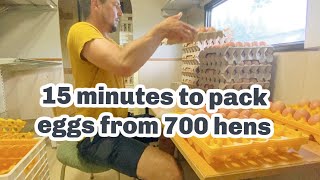
Richard Perkins walks through his farm's morning routine, managing 700 hens across two eggmobiles. He collects and packs eggs in about 15 minutes, spending roughly 1 hour 20 minutes daily on total egg work, and talks about staffing, publishing, and how his priorities have shifted.
Questions this video answers
700 hens
Two eggmobiles
About 1 hour 20 minutes per day (total) with two eggmobiles
About 14–15 minutes (he reports 15 minutes)
Chapters
Welcome back to another video, folks. It's sweltering today, and we've had big thunderstorms. I haven't been making videos very much. I'm taking a lot of time out, and today I thought I'll show you some of the metrics around packing eggs, because Malta and Johanna are off on delivery. So we've just been taking the afternoon shift, and it's time to pack eggs. And egg enterprise is something I've talked a lot about on videos here on YouTube, and I want to show you how. 700 hens, two eggmobiles. That's an hour and 20 of work every day, seven days a week. But it's a very efficient, profitable enterprise. So there's only four of us at the farm now. It's a very small team, smallest team we've had here, in fact. And we're just keeping on top of the gardens, the pigs, the cows, and the layers, of course, and just taking it quite slow. I'm doing a lot of work with the other properties that I'm renovating. I'm also running the online masterclass. Now, before we jump into the video, I'll roll on a few clips of the morning moves and things going on around the farm. Enjoy. Oh, yeah, we have a lot of here. Finding chanterelles. We're a bit early here. We have one further south in Sweden. There's probably a lot more already, but here, give it another week.
No, this slug on this one. It was a slug on it.
This one?
Yes. Good one. Daddy gets this many.
No, lots of chanterelles.
I got my back here.
Ragnar, you've got your backpack. It's a little bit behind here compared to some places. Another week.
This is the. Malta is gonna get none for this now.
You find mushrooms everywhere, but mushrooms evolve with animals. Along the sides of these little pathways is where you often find big clumps, spores being moved by the traffic of animals or humans. So actually, today, most of the ones I found have been on the size of these animal tracks. Be careful drinking from wild streams. You got to know that your water's clean. We have hundreds of hectares up here draining into these river systems. Only possible risk is dead animal further up. But we think it's pretty clean. We're close to the source, but just go steady. Sweden is one of the few places in the world where you can drink out of many of the lakes and rivers. And we're very lucky here. Most places on Earth, that's not advisable.
All right, I'm on a trip. Multiple trips. To the village to pick the rest of the books I have in storage there. This is regenerative agriculture, because I've got a whole bunch of pallets stored at the farm now from the floor that I built in the barn over the winter. And I'm paying money to store a few pallets up there that the guy that's renting the main space needs his space back a little bit. Slow tractor's not the best for moving these pallets. About 7 to 800 kilos each, and it only just fit in the trailer. So I'm going to see if I can pick up another trailer. I've got three more trips to do, and then I've consolidated all the books in our farm, and hopefully very soon we're going to be getting the copies of Bridgedale Farm builds from Poland. They'll be delivered straight to the farm, and I'll store them here. Hopefully it'll be a smaller truck this time. They sent much too big a truck last time, and it damaged the road in the wet time of year. But quite nice being out on the.
Tractor.
In a nice summer day, so.
So about 1400 kilos of books on that pallet, on that trailer, and I've got one and a half left. Then all my books are out of here. Nice.
I'm a little bit in the pickle.
Because I don't have enough space. Getting eaten by horse flies. Finding Jeppe's drone. We find it. Yep. He managed to have a stunt. Yeah, we actually found it exactly on the line. Perfect. No, it was actually. What was it, like 2 meters off? Yeah, you were just. This is where the drone lost contact. Yep. And this was the direction it was heading. So we've been walking through the bush getting prickled, getting eaten by horse flies to no use, and we went through the easy part, and it looks like there's no damage other than that one propeller. Yeah, I have many propellers, so that. That doesn't matter. Perfect. I mean, just. Just to see it, like, turn up, turn on. That was great. Yeah, yeah, yeah. Okay. New roof finished. Guttering's replaced. Sweet job. These boys, Local boys, I'll use again. They're really nice guys and they've done a really nice job that Santa ever. Cleta. I don't know if you heard the sheep down there. Interesting to see their tracks from up here. We've come to take the ram lamb. Otherwise he's going to start impregnating the ewes. Just taking it easy. Beautiful.
It.
Hey, flower.
You know what on shin Rose does?
Let's go. Don't you have to move this one also or. No. Okay, it's feeding time. I'm sorry, Jake. Here we've done two egg collections. So we've got EggMobile one, EggMobile two. And we'll have a similar amount of eggs in each. And underneath me I have a bucket, I have simple sandpaper pad, soft foam ones are what I find best. And we've got fresh, clean egg trays. And what we do, as you've seen in videos if you follow this channel, is we're collecting eggs pointy side up and we're already pre sorting in the field. So that I just have to look for any dirt, any cracks, flip them over and stamp them. I've got my egg stamp up here. So really the hen enterprise is an hour and 20 minutes per day with two eggmobiles, the Ridgedale style eggmobiles. That's 20 minutes to go up and feed and move one of the eggmobiles. We're moving every alternate day. 20 minutes to collect eggs in the morning after breakfast, 20 minutes to close nests and collect eggs in the afternoon. And it should take about 10 minutes in the summer to clean and sort and stamp the eggs from 350 hens. The eggs are superbly clean with the rollaway nest boxes that you're familiar with from our channel. So I thought I'd just leave the camera rolling and you can just see how long it takes to sort and pack the eggs from 700 beds. Okay, so off we go. I'm putting a spare tray that I can use to fill up any that I discard on the side. And because these are all pre sorted, I'm just looking at the top surface. So time starts now and I can use this to take off any partial dirt. And I'm also looking for micro cracks. But remember, when I'm collecting the eggs, I feel the micro cracks because you hear the egg doesn't sound pingy and resonant. I'm picking six or eight up at the same time. So then my job in the egg pack week is simply flipping, checking for any more little dirt marks that I want to take off and then stamping, handling a tray of eggs for a few seconds at a time. Now, in the beginning, you might need to use a lamp to look through the eggs and see if there's any cracked eggs. Now for me that's too dirty, I'm discarding that egg and I'll use one of my refills to fill that hole and we'll eat that egg. It doesn't go to waste. But in the beginning you might want to use a lamp. You don't have to use a lamp. You just have to guarantee that the eggs are not cracked, that one's too dirty. Because I've handled millions of eggs, I can just feel and I can also see micro cracks very easily. And if you're in doubt, you can just tap a couple of eggs together and you'll soon see if one has got a crack because the shell will disintegrate. Also when you're collecting, it's very clear which eggs are likely to be soft shelled. They're usually lighter in color. Here's an example with like white powder from the laying process. But that's something I'm happy taking off with the sandpaper, you see that comes up perfectly good. Making sure there's no feathers. There's a little bit of down sometimes, but we're trying to take that off. In the eggmobile, the overall aim is just not handling eggs multiple times if not necessary. And really doing the pre selection work in the actual egg packery, sorry, in the eggmobile, eggs that are lighter coloured like this often are weaker. So I tap them together and I can hear if they've got integrity. Another one there. So we just need to know that every egg is clean, free of any dirt and doesn't have any cracks. As long as that's the case fitted down here. Then I can stamp them up with our producer number which makes them safe for sale to restaurants, shops or to our customers. You see, I'm really not spending a lot of time and an hour and 20 minutes is ample time to run the entire egg. And the prize when we've got 700 hens. This is a really big egg double yolker. I'm putting that aside because it doesn't stack very well. There's another one here and that's actually got some micro cracks. Now you can only just make them out with your eye perhaps, but I'm very, very familiar looking at the eggs so I see them very easily. That's something that might take a while. But like all things this makes perfect. There's a bigger egg and I always put them in the corner of the tray if I'm putting them in because they're less likely to get broken there. And that's a good strategy. So simple procedures that happen every day. Just got to make sure that you keep your nest boxes clean. So once a week we'll wash out the nest mats. In the summer, obviously in the winter when the birds are inside Everything's a little bit more challenging in the summer months. The eggs should come out perfectly clean. The hens have got a really good diet from the pasture and their chicken feed. They've got access, free access to oyster shell. So the shells of our eggs are actually surprisingly tough compared to eggs you buy in the store. And you can see we're going through these at a decent pace. And I can guarantee the cleanliness and integrity of all the shells. I know for sure there are no cracked eggs in here. And that comes with time. Just picking up eggs, some picking up six or eight at a time. And just by feel, I know I have no micro cracks. I've said many times in videos what I like to do. If there are cracked eggs, I typically just throw them through the floor of the egg mobile. I'm not concerned about chickens eating their own eggs. If I find them in the egg packery, we'll either eat them ourselves or give them to the pigs and that's fine too. So I'm really just looking at the top and sides, knowing that when I flip them, I can see the full other side. And that's what you've got to do if you're running this enterprise day in, day out. You've got to find the most simple hand motions to make this job as effective as possible. And it's a very scalable enterprise. When we had three eggmobiles, we've had up to 1200 hens here. It didn't really take any longer. 20 minutes more in the packing and that's it. So it's a very scalable enterprise and one that you've got to go in. Here's some egg yolk. I could take that off if I really wanted. I'm just not gonna bother. We'll eat that one for breakfast. But yeah, very scalable. And it's the sort of enterprise you don't want to do. Just saw a micro crack last minute. Now I've got a head torch here, see if we can see that one. Maybe it's run out of batteries. I haven't got an egg lamp because it just got broken, but there is a micro crack there that you can see quite clearly with naked eye. So we'll swap that one out. I like to get in the egg packer even if I'm not on egg duty. I like to get in here every now and again just to keep my senses sharp, really looking closely even though I'm moving fast. It's the same with every job around the farm, whether I'm moving eggmobiles or cows. I'm not. Whoa. Bumped myself out there. So I dropped the magnets minus 10 points for Richie. But there's a big one that I'll swap out because it's gonna get crushed in the packing crates. But yeah, even when we're just doing jobs like moving animals, putting up fence. I'm not just putting up the fence and inspecting the entire fence for any places that need wires fixing or any little problems like that. So it's all observation based. As I've said a thousand times, this is observation based farming. And so you really got to look closely at everything you're doing on a daily basis. So that's Eggmobile 1 done. And now we're on to Eggmobile 2. So if I have any reject eggs, I'll put them on the other side of the tray here so that I can then count them up easily. We've got a few spare eggs. They will go on the top so I can count the two eggmobiles separately and then I will join them together to make full trays in the packing area. These eggs are all beautiful. So that's Eggmobile one done. And that didn't take so long. Now we're on Eggmobile 2. I've got a partial tray that will stick over here and go straight to my full trays. So it's going to be a slow ramp down now till the end of the season with just a small crew here and we're just keeping on top of the main things. I'm really prioritizing, taking a lot of rest, being with my kids. Something really exciting for me is my daughter Grace is going to start school at Christmas time and do the last two years of primary school here in Sweden to catch up on her Swedish language, but also to spend time with me at the farm. And who knows, she might even come here for high school. And her mother's quite open to that. And so that's a big shift for me. I'm really starting to think to slow down my work, keep my outreach work going, probably change YouTube over time to include more of my other interests. Sailing, fishing, hunting. I got a hunting license last year and stuff about parenting, cooking, you know, all the other parts of my life that this channel has been very much just about high speed farming and getting a lot done. But now life is changing and I really want to make up some of the lost time with my kids and especially with the COVID situation. It's been a while since I've had Grace here on the regular basis that she used to come. So that's it. Life is moving to a new chapter. It feels like Ridgedale has completed a lot of the work that it set out to do. And now my students are going off teaching and replicating fantastic business. And that's great to see. And it's something that we do as part of our online training, which we are focused on more and more, especially with COVID now. And we've got 10 of our past students who are running excellent businesses as mentors and coaches in that program, which is really nice to see. So we're getting through and pretty sharp. So it's the sort of job where you want to be looking. It's like slaughtering or anything. And a big part of my job here at the farm has been cracked egg, has been teaching people to think about time and motion studies. You know, these jobs that you do over and over again. That egg's too big. Finding the best way to lay things out, to set up a workflow so that you can perform these repetitive jobs that you do on a daily basis just as efficiently as possible. I think you'll agree that this is really not very laborious to sort the eggs from 700 hens. Anyone can learn to do it. Some people are always going to be faster than others, but that's, you know, it's not a race. The important thing is you can fit in what you need to in your day and that's all that matters. But it's been a really important element of the education here is getting people a direct hands on experience of what can you manage, what are you comfortable with so that you can scale this business to your time, place and circumstance and know that you'll be able to handle it and it will make you the money you need to pay your overhead, to pay your salary, etc. So really important time and motion studies. I always encourage everyone to take notes, you know, set themselves benchmarks, try and beat their own benchmarks, because it's a lot of fun to work like that, to work efficiently and know that there's no faster way to do this stuff and to do an excellent job at speed. We're not cutting corners, we're not compromising micro crack. I can guarantee every egg here is perfect. And I've just got rapid at it by doing it over and over and over again over the years, Down to the last two trays. Now, this is an interesting egg. It looks like it. Yeah, it was a little micro crack. See? Too soft. So we'll eat that one. That's fine. That looked Like a sort of crack that comes from handling, not from in the nest box. And you can start to see these little micro differences when you handle eggs a lot, as I said in the beginning, use a light, you know, and what I always do for the people here is I say do the eggs the first times, don't use the light, and then go back and look through them all with the light to learn. Because if you sit and just use a light with every egg, it will take you three hours to do what I'm doing now. And so I encourage people to learn to do things by feeling themselves and then check their own work. And then I'll come and check it as well and make sure they've done the job to the standard required. And I think that is a good way to learn. Here's a cracked egg. And so good eggs, you can squeeze as hard as you like and you can't break it. Same this way. Can really put a lot of force in. And an egg with a good shell maintains its integrity. So last try, got a micro crack on that one, a micro crack on this one from handling, perhaps. Good to go. So a few less in this eggmobile. Got this last bit of the tray. But it could be we just evened out the birds while ago. It could be that the odd escapees ended up in the wrong egg mobile. You see, we've got about 30 eggs different in these two. So we'll look into that. And let's have a look. 14 minutes to do all the eggs from these eggmobiles today. And these are the bee eggs. So they will go to the kitchen and that's what we will eat. And then sea eggs are any that are laid under the egg mobile that we can't reach or were cracked in the nest box that we threw through the floor. And you expect two or three of them. But this is great for us to have some bee eggs. I always keep numbers on the bee eggs because I want to know how people are handling the eggs. But to have 10, 12, no problem. We'll eat those. And we eat more than that anyway, so nice job. So there you have it. 15 minutes to do the eggs from 700 hens. That's not bad at all. And that keeps everything at a very simple, even level. Keel, add on an hour to sort out the nest box once a week, just to clean all the mats, change them over. It's a really simple enterprise. One of my favourite enterprises that we run at the farm. Don't forget, you can find out a whole bunch more in the links below about our book. We have some free online trainings, introductory trainings from we have obviously, a masterclass that we're running currently that you can sign up for the winter edition. And we've got the ebook of the Ridgedale Builds book. If you want to know how to build yurts, how to build your own eggmobiles, wash pack stations, you've got detailed CAD plans of 22 different structures that we've built around the farm. That's already available on the links below as a PDF. And we're expecting the hard copy books, nice hardcover printed books, to turn up anytime now. So I'll let you know when that happens. And I'll make some videos to update what's going on around the farm in general shortly. And I'll look forward to seeing you in a video soon. Bye for now.
More from Richard


A review of short and intensive season on a mixed farm and restaurant/event space in Sweden






Alskade Kyckling Exploring complexities of poultry production in Sweden and what we stand for


