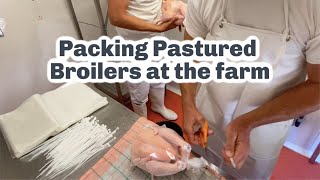
Richard Perkins walks through packing pastured broilers after slaughter: sorting by weight, labeling fresh or frozen, bagging, and chilling. He targets 20 to 30 seconds per bird with a small team, shows defect rates from a 250-bird batch, and breaks down labor costs at €20 per hour to show where money goes.
Questions this video answers
About 1.5 to 2 hours to pack 250 birds.
<1 minute per bird in the brooder; <3 minutes per bird in the field; ~8 minutes in slaughter; a couple minutes in packing — roughly 12–14 minutes total per bird.
About 20 seconds per bird with a team of three (30 seconds acceptable); he can process a bird every 25–30 seconds in slaughter.
Feed ≈45 crowns per bird; labour (if paid €20/hr) ≈40 crowns per bird; total ≈85 crowns production cost; average sale ≈260 crowns at 2.2 kg, net ≈165 crowns per bird.
Out of 250: 13 B-grade birds, 1 D-grade bird; the rest were A-grade (Cs only used for temperature-test birds).
Chapters
Okay, welcome back to another episode. Today is about packing the birds. So put out a video just showing you a bit of what the slaughter process looks like. We're having breakfast in a minute and then we'll be straight into packing these birds should take an hour and a half, two hours to pack 250 birds, label them in weight order and we're going to put the, we're going to clean the chiller, put them back in the chiller and they will go off with the RICO delivery to be put in the freezer. Good morning Seku. You chilling out in the sun? Someone commented recently about the cost of small scale boiler production being so high they didn't know if it was worth it. And it's a complicated topic because it requires a lot of thinking about. But I could share some thoughts around that. One thing is economies of scale. Now obviously if we're doing thousands of birds a year, we dial in our processes and they're much more efficient. I calculated that the target benchmarks that I work to you would spend less than a minute per bird in the brooder, less than three minutes per bird in the field and about eight minutes in the slaughter process because there's lots of people involved in that and then a couple of minutes in the packing process per bird. So all in all it's maybe 12 to 14 minutes per bird. So if you wanted to factor that into labour costs, etc. That's the target benchmark. Now obviously we're often working with people that are being trained and they're not working to that benchmark. It takes time to get up to speed. I'm talking about servicing a salatin pen in 2 minutes flat with 75 birds and an additional 3 minutes per pen throughout the rest of the day for water and extra feeding, etc. And I can also process a bird every 25, 30 seconds, which is something you have to build up to. And it's the same with packing, etc. So about 12 to 14 minutes per bird comes in when you're doing thousands of birds and you've got an efficient setup like we demonstrated here on this channel. So the feed cost for a bird to get them up to 2.2 average is around 45 crowns. If you paid yourself €20 an hour, you could say the labor cost is 40 crowns. So about 85 crowns to produce that bird, which on average at 2.2 going to be worth about 260 crowns here. So that would net about 16 and a half euros. 165 crowns per bird. So if you're doing thousands of birds a year, you can see that makes up a good business. Now, there's some losses involved when you're raising thousands of birds, but they should be kept to 2 or 3%. And someone asked about the ratio of A, B and C birds in the slaughtery, so we'll have a look at how that went this week. First level, someone asked about the ratio of A, B's and C's this week. We had really nice plucking and scolding and we had virtually all A beds, right? Yeah, we had 13B, 13B out of 250, and the rest were A beds. And the only Cs were the ones we were testing the temperature on, so we made them Cs. So you have to test the temperature at the start, the middle and the end of the batch to. To ensure that you're chilling down. And Alex was doing that yesterday, recording the temperature drop. As well as with the organ meats, they're put into small bags in the bottom of the chiller, and so they're in water in a container and they cool down a lot quicker, which they need to by regulation. So 13 out of 250 were bees, and we can still sell at full price with those birds, but they typically will have a broken wing from the plucking machine or a little nick in the skin. And we can still sell them to customers that don't mind those sorts of things. So a seabird to us is one that's edible, that we will eat. A bee bird is one that's just slightly blemished, we wouldn't give to a restaurant or to a prime new customer, for example. And D birds are ones that ill in some way and they don't make it through. We actually had 1D bird yesterday. So 1D bird, 13 bee birds, which are still saleable at full price out of a batch of 250. We're doing the 1.9 to 2.09 first, and that is those two and this rack. So these are all weights. They're put in weight category when we're actually slaughtering big chickens here, for example. And that means that as we pack, we have them stacked in grey food crates in their weight order. Some of these are going out fresh, some are going out to the freezers and they will be stored in their weight categories. And so we're doing. Are we doing fresh first? Fresh one first, Fresh birds first. So we're doing all the fresh ones. And the reason we're doing that is they have different labels. So fresh birds have a fresh label and frozen birds have frozen labels, obviously, and that's important. So we have to be a little bit organized. The weights are recorded. So once I pack the birds, I put them up on here, they can read that on the scales, put it onto the label, and also put it into a spreadsheet that we can record the slaughter data. Once we've gone through the different weight categories, we'll do the organs down below. So that's livers, hearts, and we've kept a few gizzards for our own eating. So, like everything, this is about workflow and organizing the most efficient minimal hand movements to get the job done. And all farm enterprises can only be run in an efficient, profitable way if you find the quickest ways to do repeat tasks over and over again. And that's something we love to do here. So my job is the bit that causes the bottleneck because there's more pieces to the pie. But one big change I've made this year is only dipping the bags a single time. Once I put the cable tie, these are heatering bags. So we've got this clean scalder at 80 degrees. And so I'm able to use the tie of the cable tie to dunk the bird and the outside of the bag. And then I snip it and pass it off to the weighing team. Previously, I would dip and then cut the top of the bag and dip it the other way. But that adds a whole other step that's unnecessary. If you use the bit of the cable tie as a handle and dunk the whole thing in one, this job can be done about 20 seconds per bird with a team of three. Today we've got a team of four, two of them on the outside to get that organized and working well. But it can be done with three, and 20 is good. 30 is acceptable. So that's the target for packing each bird. You guys ready. It? It's it. So saying about the Konamisa scales earlier and like everything, it's like if you have 50 laying hens, it's actually no more real work to keep 3 or 400. And it's the same with this kind of process. If you have a simple outdoor slaughter set up, then you're going to have a much slower process because it's just not set up in an optimal way. And likewise, once you get in here, set the space up for packing, it doesn't take much longer to pack a few hundred birds than it would to pack 50, because a big part of the Other thing is setting up, cleaning down, etc. So like everything, you've got to plan the business to be at the scale where it's, where it makes numbers work and that's the way it is. Looks so big on the picture. I guess there's foam all around it as well. So moving on to different weight categories. So these are being stacked in boxes in their different weight categories, whether they're freezing or frozen. And so everything's nice and organized when we come to collect and we're selling on Rico in the different weight categories. So it's really easy to take them out of the freezer space in that way. But nice birds, they're looking pretty good. We've got a lot of heavy birds because we're slaughtering in two batches, not three, but looking good. It's quite important how Alex is handing me the birds. He's tugging over the net skin as the birds come out the chiller, but then squeezing the body bit to get them in the bag. These are kind of mid sized birds around 2.2 and they fit comfortably. But as birds get bigger in the weight categories now it gets harder to get them in the bag without me touching the chicken. And the whole aim is to have no grease or chicken on the outside of the bag. It. Alright, beds are all done. We're packing the next two to three kilo bags and then we'll be doing the livers and hearts in smaller shrimp wrap bags. These are actually the older bags that we used to have for chicken, but bigger size and I like these much better. They don't actually make them anymore. So we have the clear, some more clear plastics for the chicken. But I prefer these, they're a lot more malleable and they sculpt themselves to the chicken better. The organ meats. So what we do with them is typically put them into the chiller in small bags. That's approximately 700 grams. We're going to weigh them out into 500 gram bags which is what we sell both hearts and livers in. But we split them into smaller bags because they cool much quicker. And you can see Alex has color coded some of the bags for temperature testing. So we fill these with water and ice packs and they go in the bottom of the chiller and every 50 birds or so we put the organs through in these plastic bags. And the smaller the units, the quicker they cool. They have to cool down in about half the time of the actual chickens to meet reg. Okay, chillers clean birds are to go back in and because they're not out very long, they don't lose any of their temperature, so they can go straight back in. Everything groovy. 2.46. Lovely bird. We've got all the different weight calories ready to go in. Okay, birds, all in weight orders. Good, that's a wrap.