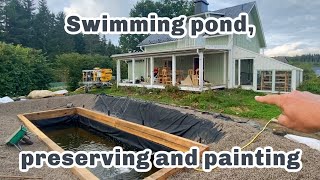
Richard Perkins documents a day of heavy, practical work on his farm: creating a gravel-lined pond with biological filtration (liner, gravel, four bubbler tubes fed from a central perforated pipe and air-stone distributors), moving large quantities of gravel (about 20 tons moved by hand in places), and using a compact digger/skylift (cost ~€160/day) to access tight roof and tree work. He also shows interior plans for the small Hatfeld house (shower, kitchenette, sleeping loft), describes extensive food/freezer stores (eggs, beef, pork, sausages, frozen tomatoes, broths, berries), and outlines landscaping plans (decking to join buildings, possible sauna). He finishes by painting trims and doors on barns and securing rocks/wood to anchor the pond liner; pumps (one installed, option for a second) and air-stone hoses are set so bubblers aerate the pond (~1 m depth).
Questions this video answers
About 20 tons.
Four (evenly spaced vertical tubes fed from a central perforated pipe).
About €160 per day.
Approximately 1 metre underwater.
September 16, 2022.
Chapters
Gracie and me up a tree. Whoa. All right, now we're going to spin around. Okay. Yeah. This kind of feels really. Wait, did you paint the underside of here as well? Okay, so big day gravel comes tomorrow and the digger has only got a small place to get through the lime trees here. So we're going to have a lorry with washed gravel show up and dig into a pile. I'm going to have to move 20 tons by hand. That's going to be fun. I put in some wooden baffles that will join the, the weakest part of the joins here, but also act as something I can put rocks and gravel on to hold this structure down. There's also little nubbins at the end that I can wedge rocks against and that should do the job. Then I've got perforated pipe that goes to four evenly spaced vertical tubes. These tubes are going to have little air stones and the tubes will be out of sight and they're going to bubble all the time. And that's going to draw water through the gravel, through this drainage system and create aeration as well as natural biological filtration. Hello, piggies. One of you got big, huh? Oh, no. The hob gun. The herb garden's getting a bit trashed. Well, it smells like thyme. Smells like thyme. Sometimes you gotta do what you gotta do. Okay, now it's about getting big machines in tight spaces. Just about might have enough room to get through. Get the last bit on to the other side. This is tight. It's a heavy old machine. A couple of tons. A little bit scary. That's crazy. I think we're just gonna be able to do this. That's also going to allow me to top the trees up here. I want to cut all the trees at the same height. That's going to be nice with the aid of this tool. Very nice. So the important thing with this kind of machine is that you get the machine level in this plane and that plane and you do that with the hydraulic feet. Just putting some pads underneath. And we level up the machine. It's incredible how you get a two ton machine in a tight space like this. Really practical. It's about €160 a day here. Now we've made contact. Got to get the wheels off the ground of stability. And we've got a level here. So going to raise up 1 and 4. Pretty good. Pretty good. We can raise that up a little. That's about our limit. Pretty good. Spot on. Okay, so day is coming to an end. I've just Got to leave it here to finish this side and the balcony and the eave on this side. And then everything else on the house is. Can be done by ladder. Super nice. That's really cool. And now I might just top the trees to get a nice hedgerow effect. I'm going to show you around the Hatfeld's house. So a lot of work's been going on in here. And it's going to be a rather luxurious place. So it might be hard to make out. This is the shower room. It's going to have a mirror with a light here, sink here, shower in the corner, toilet here, light up here. So all the electrics and ventilation are in fuse box coming up here. This will be the entrance way with some kind of place to hang clothes. Sleeping loft up here looks quite small, but I think that'll be a double bed or certainly suitable for kids. And then this will be a sort of kitchenette. But probably just a sink here and a table to work at. Nice double doors onto the pool. And then it's going to be a double bed here looking out onto the pool. So it begins. Eric's driving blind behind the trees to be able to bring this gravel over. It's going to be a lot of work moving this. It's. Okay. Moving some by hand. Gonna be able to fill this side. We're gonna have to move by hand to do the background as well. It. So bubble stone goes in the tube like so. Now I'm going to feed these back to a central point to pump up here. I've got the option to put two pumps on if it's not enough. But they're not very deep underwater. Only about a meter underwater. So it should be fine. Ah, we're back on the west coast, baby. One of my favorite spots. Looking for the last of the mackerel. Hey, Ragnar. We have been at the west coast and Gracie caught a pipefish and a few other different fish. They're like cod family. There's a whole load of them. That one coming up to the top. Not ones you've seen before. I think they have spots. Pretty cool. Look at this beautiful sunset, baby. So aside from having plenty eggs and two cows and turkeys and chickens in my freezer down in Karlska. I've also got a freezer full of McGay sausage the girls make full of cutlets, pork legs for stewing and smoking. This is full of beef and bratwurst. We've got liver to add to mince. Kids. There's other cuts there. This is all full of prime beef, bratwurst, chorizo and sheep. In this freezer we've actually frozen tomatoes because I've got so many tomatoes that we can put into stews. There's about 100 chickens under here. This is boiled down beef broth to save room as well as pork broths. And here I've got more tomatoes, berries from the field. Got black currants, gooseberries, red currants, white currants. Then we got a fridge full of sriracha, chutneys, cordials. Got a freezer full of organ meats. I don't think we're going to starve. Okay, market garden pump is on. Just going to start filling it up. Got to tuck away the liner under the wood. And I started filling this up before I put air stones in. Not a good idea. So I've got the air stones labeled here, 1, 2, 3, 4. And that's because I want to have the same length on the hose to get equal pressure through the distributor. So have a look up here. These pumps, I have two. So if there's too much hard work for the pump, I can always put a second one in. You get these cones, distributors. So I want to be able to have equal pressure on each. So I want to be able to measure them. So if I know which one's which, I can just cut the cables to the same length to ensure I get similar wavelengths throughout them all. So it's going to take a long time to fill up. And so that gives me time to. It's much easier to get the bubble stones in these ones. You can see I've just drilled a hole, put the pipe through and then I can hide that under the gravel. The decking is going to come out over the water here. And so I'm just holding the liner down with a bit of gravel just to keep it there. There's a lot of gravel here in the middle where it was dumped. We've moved tons and tons of it and obviously there won't be any on the back here where it's too steep. But it's going to be hidden by the decking anyway. So I'm planning on having a deck. I'll just make it wider angle. I might even deck all the way up to the greenhouse and across here. Have an outdoor kitchen here, maybe even have a sauna here. So we built a pad with some of the topsoil removed from the digging process. So I've got room for a little two by two or three by two sauna here. That would be lovely. So I'm thinking a bit of decking here joining into decking in front of the house, a platform out resting on that wall for diving in the pool and that decking joining the two houses together. So I'm going to get the laser level out soon and measure points to work out how that decking is going to go. But it should be fairly straightforward. So that's the process so far. And as soon as I got these in and fill this up with gravel, we can start bubbling the water, getting some oxygen into it and maybe we'll even get to planting some plants this year. We'll go to the lakes around here, take some lilies, hopefully in a respectful way and we can plot them into the gravel. Homemade sorbet from our new ice cream maker. Mango, apple, passion fruit. Grace is making ragnar a T shirt. All right. Nothing crazy going on here. Just moving a few tons of rocks. So put in rocks. The wood as I started filling up the pond slightly moved and that scared me. I do not want this wood floating off because there's no way to get that back if gravel is going underneath. So with inadequate machinery, I'm just hoiking out rocks, rolling them around. A bit of a job. Linus seems very hardcore. It's stood up to some pretty big abuse. Just managed to get this beast up. Coming up the bank here seems to work. Haven't made holes in the liner yet. That's good. It's a pretty tough old thing. It's a millimeter thick, so pretty resilient, but better safe than sorry, I would say. So just a few rocks around, I think it's going to look nice as well as be holding down what's essentially a big raft. Well, when you're on your own and you've got half ton rocks to move. So I've got a winch on, made some rails. I don't know if this can work, but I'm going to see if I can pull the rock along. It. What have you found, Magna? Show us your mushrooms. Mushrooms. A little bit crazy. Okay. This will give you a sense of what I just came through. Right, Last bit of the roof. They're coming to pick up this sky lift. It's been an incredible tool to paint all the barns. I've had to come through the treetops to reach this bit, but I've basically achieved my goal nearly of painting the entire farm. I've still got all the black doors to do on the barns and I've got about 10% of the house left to do. But it's been an incredible long summer project that's basically been mostly happening in the last couple of weeks. Super happy about that. All right, the other thing I'm doing is painting trims up under the roof. Got Ragnar in the tree down there. Hey, Ragnar. He's collecting apples. Okay, now what to do. All right, last corner. If you've ever done this kind of job, you know it's a massive amount of work. Most people spread it over some years. But I wanted to just get this done because I'm not sure of the future possibly moving away from the farm. I'm not painting this roof because that was fairly new when we built this lean to barn. €800 barn using seconds. But there's nothing really wrong with him. They're grey rather than black, so they'll look different from above, but you don't really see them from the field. I just mainly wanted to get everything protected, rust proofed. Just looking well cared for. After years of working on the land, we just didn't really ever take care of the buildings. And it's a lot of responsibility having this many buildings. Mission accomplished. Well, still a lot of black doors to paint. They take a while. A bit of white trim on the ground under the silos. But finishing with this machine is a big deal. Very hard to get to this roof even with a climbing rig. Not a good. All right, last pesky bit of the house is this corner. Couldn't reach it with the skylift thing. See the pond filling up below. Tied ladder on here should be fine. Well, sometimes you just gotta do it, haven't you? Barefooted. Better grip. Okay, little updates. So we've put rocks around some of the wood and to make the pond look a bit more natural, but also weigh down the wooden structure. You can see the four bubblers are on and we've got a few sub marginal plants in. The water is quite dirty because the gravel was not washed, but we've got it mostly filled. We're in the process of building the overspill and this part of the line, obviously too steep for gravel, is going to have decking out over the top of it. But for now just getting the water in and once we've got the overflow, we can fill it right up. The water level will be near the top of the gravel here, so once that's done, we can tuck down the edges of the liner and start a bit of landscaping, put some soil back on and get some other plants and things planted. Pretty cool. Ragnar, what have you made for us? Tell us foods. Tomatoes from the greenhouse. Chilies, sweet peppers. Tomato with creme fraiche. Cucumber and watermelon. Nice, Nice.