PERMACULTURE FARM WHERE SWALES ARE BANNED S4 ● E33
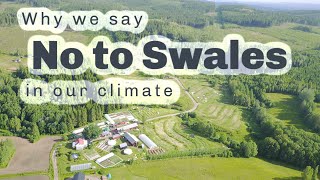
Richard Perkins (creator) explains why his farm favors P.A. Yeomans' keyline design over swales, describing how keyline ploughing evens water distribution by fracturing compacted subsoil (improving infiltration and rooting depth) without creating permanent on-contour water features. He recounts on-farm observations after repeated keyline plough passes (reduced compaction, deeper roots to ~40–50 cm, temporary wet patches on ridges), links keyline to the scale-of-permanence and whole-systems placement of roads/trees/fences, and contrasts costs/risks of swales. The video also covers practical farm activities (eggmobile/chicken management, silos, garden transplants) and the integration of keyline, permaculture and holistic management in his design work.
Chapters
A lot of people get confused when they discover permaculture and hear about things like swales and contour lines and then keyline design. We were very influenced by keyline design for the last decade in our design work. So I wanted to talk to you about what's going on behind me and some of the observations I've been making with the wet weather recently. Many people hear about things like swales. These are uncompacted ditches dug on contour to catch and infiltrate water, the runoff that's, you know, misappropriated all over the world. I feel like in the permaculture movement by people that probably have a lack of understanding of hydrology and of geology. And when you change the shape of the earth, it will influence water, because water travels at 90 degrees to contour lines perpendicular to contour lines. But when you change the shape of the ground, you're creating a very permanent change that could lead to problems that are unforeseen in the future. And what we're trying to do at our farm is evenly distribute water across the landscape, which is why we favour PA Yeoman's keyline design framework. It's both an exquisite design framework for putting priority onto the things that are most permanent in landscapes, starting at those places in our design work and going down to the areas that are least permanent. Things like soil. Very easy to build soil. Very easy to destroy. Soil too. But the tree lanes you see here are not on contour. Some people have mistaken them for swales or contour plantings, but they're all falling off contour. The basis of keyline cultivation patterning is that you create lines that fall from valley centers towards ridge centers. Now, it's a bit more complicated than that, but, you know, we do a week long intensive training in keyline design, and I've really laid it out in my book and broken it down. What we've done here, because you can't just pick it up in a short video like this. It's been really misunderstood all over the world, I think. And besides myself, there's one or two other professionals working with keyline design in Europe. And I think there's been some mis publications and a lot of misinformation spread around the Internet. That doesn't really help with understanding this exquisite design framework. It's a whole design framework in itself, you know, and we integrate it with permaculture design as well as holistic management, because they give us all the tools we need to design future proof farms. In my mind, all these tree lanes are put in this cultivation pattern that falls towards the center of a ridge. And what's interesting then is you're changing the hydrology. You're, you're pulling a keyline plough along the same patterning between these rows, but we're also planting trees on these rows too. Now there's a misconception that we're moving water towards a valley, from a valley towards a ridge shape. And that's not strictly true. What's happening when you pull this non inversion rigid tine plow through the ground? You're exploding the subsoil. And when you explode the subsoil, air and water can infiltrate into compacted soil. So before we used this tool, we came around a farm and we took samples in every one of the fields with a penetrometer. And that's a tool you push into the ground and it measures the compaction power as well as the depth that you're pushing it in the ground. So you can visually read the state of compaction underground because plant roots can't penetrate below 300 psi. And so we found a layer of compaction about 22 centimeters where they used to plough each year to grow wheat here with a horse. And so grassroots couldn't really penetrate through that. So we knew we wanted to pull a keyline plow through as a strategy to mechanically kick start the process of pasture regeneration and then use our animals in a holistic plan grazing setup to really start making the grass work and express its physiology. We've now got root going down to like 40, 50 centimeters. And this year we might pull the plow through for the third time, reaching a depth of 40, 45 cm which is pretty deep. But I wanted to show you this observation because we're now in the middle of a ridge that runs down top field. If you're familiar with the map of the farm, this is the center of this ridge shape. Now we've got water sitting on the ground here with which is never done before in history. Now I predicted this would happen when we first pulled a keyline plow through because water that's sitting on the ridge shape, water raining or precipitating on the ridge shape is sitting there much longer. It still flows off the land in the same S shaped curve that water always flows in. But it takes a lot longer to do that. So it's not so much we're moving water out of a valley shape towards a ridge shape. It's more that the water landing there sticks around a lot longer. And I predicted we would get Wet spots here. My concern was that it would. It could lead to destabilizing the gravel roads here. However, I've already considered a way to deal with that and so my plan would have been to watch it and then to put little pocket ponds if it was a problem. It's not really a problem. You get a bit of standing water here in the early spring, but as soon as growth kicks in, it's, you know, it's covered up again really fast. So it's not a big problem for us. But it's an interesting observation. I anticipated what I thought would happen and it turned out to be the case. Besides Yeoman's geometrical topographic planning of farm landscapes, he also gave us the scale of permanence, relating to how to prioritize layers of your design, as it were, according to the permanence of those features, starting with the climate which controls the. The species that you'll be using and the limitations on that front, and then designing water first, because water's a very permanent feature in the landscape and you can't really change the way water flows through a landscape unless you change the shape of the land. That's why we favor keyline ploughing as a strategy for evening out water distribution across the landscape. It's not that we're moving water from one place to another, it's more that we're evening out water, allowing it to sink where it lands. It's why we don't promote things like swales. We've never used them ourselves. I've never actually seen them implemented in a way that I thought I couldn't get the same result. Cheaper and lower risk. There's a lot of problems associated with digging swales or permanent water features, and they will be concentrating water into a very small part of the landscape for a long time, and they've often led to landslides and other problems that aren't talked about so much. Personally, I always favor keyline where it's appropriate because it's a much more gentle intervention. I pulled the keyline plow through these fields twice and a couple of years later you would never know, other than my grass is a lot better than the neighbours now. But something that Yeomans gave us was, he wrote in his book the City Forest. He wrote about how to apply that whole systems design to urban developments, where all the infrastructure was correctly placed in the landscape and roads are in the correct place in the landscape to passively collect and move water from one place to another. And this kind of whole systems thinking is something that's influenced my design work more than any other design approach. We have some wonderful examples of bad planning here, like these roads. These roads go for hundreds of thousands of kilometers all over Sweden. And they come and they bad basically rototill the road and pack it again at least two times, sometimes three times a year. But this road is built in the incorrect place in the landscape from a yeoman's sort of perspective. And it's amazing after like the day it was two years ago now, the day they actually packed the road, There was a 50 millimeter rainfall, which is a very large rainfall here, and it dug 6 to 8 inch trenches all the way down this road. The road was basically a stream. And roads can either be very expensive to maintain, or they can be features that catch and move water passively from one place to another. So there's a very correct place to put things in a landscape, whether it's tree systems, road systems, electric utility lines, etc. Another element that's really great about keyline design is when you create these cultivation patterns on the landscape. Everything's parallel. There's fixed width, which works with machineries for pulling things like a keyline plow or if you were sowing crops. But it also works well with animal infrastructure, like putting in the fencing, the electric fence that surrounds the chickens, but also pulling along things like boiler pans, where you can fit everything into a certain dimension. The boiler pans are 3 meters wide, 4 meters long. And so in this field we have 9 meter rows between the silver pasture lanes and the. The black plastic chestnuts here. And so we can pull three boiler pans along with these. It's the same in other fields. We have three can run in a line in nutfield and four can run through front field. So it works really well with, you know, with basic farm procedures, daily procedures. That's something that you wouldn't find with swales, for example, because swales are not equidistant at all usually, unless you have a very uniform piece of land, which is not the case in most places. You see, the hens are starting to really explore now, and they've had a nice day. It's been a bit wet, but there's no snow now. So they're really utilizing their full paddock space now, which is great to see. We're going to be moving this eggmobile now tomorrow, and they sort of jump ahead two patches and the other one keeps catching up. Here you can see where an eggmobile sat overnight and it's a high concentration of manure. Now it's calculated that, you know, if we're moving them every day, then it doesn't build up too much that it's causing any problem. But that will be really synthesized by the grass. And given the warm weather coming, it's going to go up to 15, 16 degrees this week. I think a wet day tomorrow and then nice weather for the rest of the week. And that really will turn into a lush little patch of grass. And our aim is to try and park the eggmobiles in slightly different locations every time to really spread that manure. Obviously they're putting manure in the rest of the field too, but it's a little knack to move in the eggmobiles because they're quite heavy and the fields can get quite wet. Here we get a lot of rain. You want to park them on the crest of a little hill or facing slightly downhill to make it easier to move in the morning. Because the rhino that we pull them with is a very powerful machine, but it doesn't have much weight, so it doesn't have the best traction in the world. Had a nice day. Just finishing up some jobs and calculating the needs of the silos that were getting delivered soon to be able to take bulk feeds. And team have finished up in the loft. They've done a wonderful job up there. And this weekend we decided we're moving out the house. We're going to get the spaces set up so that everyone's got their own room space and feels really comfy here. And the weather should be getting warmer for that. The garden crew have been doing a fantastic job transplanting out some beautiful pak choys today and in pretty wet weather, but the garden's looking great. Tomato seedlings coming on. Cucumbers went in today. So really excited to be getting more veg coming out of the garden now. Really craving like fresh, nutrient dense vegetables after a long winter. Buds are coming on the trees, leafing out what's happening with all the berry fruits. So spring is coming slowly and I think by the end of the week we'll be having some beautiful weather and it'll be some of the first barbecues down by the lake, hopefully. Well, that's it for today, folks. This big topic and you know, as I said, this keyline design has been a massive influence to us. We designed over 100 properties on several continents now and it's always a driving force in the way we approach design work. And along with holistic management and permaculture design, these three things really integrate so fluidly together as is you know, I think it comes out in our book Making Small Farms Work, the approach that we take to design and the laying out of this farm. But it's big topics and you know, it's often misunderstood, so I encourage people to read up about it. There's some good books out there and you can also find out a lot more in our book. So thanks for taking the time to watch the videos and don't forget to share them with your friends if you think they will benefit from them. And click subscribe if you haven't already, to stay up to date with the farm. Thanks for watching and we'll see you next time.
More from Richard


A review of short and intensive season on a mixed farm and restaurant/event space in Sweden






Alskade Kyckling Exploring complexities of poultry production in Sweden and what we stand for


