Planning our grazing: filling out a holistic planned grazing worksheet
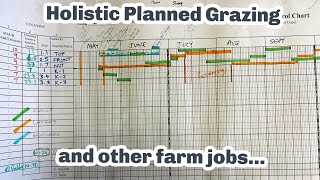
Richard Perkins (with a second speaker) presents a walkthrough of a holistic planned-grazing worksheet for his farm. He explains how to list fields, estimate relative paddock quality (1–10), compute average paddock quality, set recovery periods (documented here as 20–45 days), and calculate minimum/maximum days to stay in each paddock so as to avoid overgrazing while integrating cows, sheep and two types of poultry (broilers and layers). The video includes field-specific area estimates (e.g., Top field total 1.7 ha but 1.1 ha usable), eggmobile logistics (two 50 m nets per eggmobile), and a provisional seasonal rotation plan tied to haylage timing and a temporary poultry outdoor ban.
Chapters
Welcome back to another video, folks. First delivery day of the year and grass is just starting to grow. It's kind of normal year. Even though it's a cold, long, slow start to the year, this is actually normal April, May weather we've been having. We've just got used to a bit earlier springs. I thought I'd walk you through the grazing plan today and a bit of the thinking behind how we graze the animals here at the farm.
Paper pot and leaks. We're putting down oyster shell from the laying hands. Every four years or so, we add a couple of kilos to the bed just to make sure we have calcium.
When you've got high amounts of organic.
Matter, it can lead to some nutrient binding.
Paper pot leaks. Welcome to Operation Vole Irritation. Any point in the storm?
Yeah, there's a vole.
So if you follow the channel for the last years, you all know that we use holistic plant grazing on the farm. And the objective of our grazing is to integrate the herbivores with the laying hens and the broiler chickens. And so it's a little bit of a dance. And like a financial plan, you work both forwards and backwards and juggle the bits of the jigsaw together until it all fits.
So currently batch one still in here, they're averaging around two kilos. It's getting pretty full in here in water and time. Not something we've ever done before. If you're not sure why we've made this decision, obviously we are not particularly interested in raising birds indoors. We are faced with major economic decision. There's about €30,000 of income here and we figured that we couldn't afford the amount of employees we have if we cut out this. And in the early process of forming a team. It's not nice to send people away. The birds have done fine. I mean, it's been very cold spring, so they've enjoyed being indoors, I would.
Say, but not something that we particularly.
Advocate, but tough decisions for all poultry producers this year. But the gang have done a great job with keeping the bedding good, keeping it clean and hygienic in here.
And it's.
It's worked out better than I expected so far, although still got quite a while to go and the birds are going to double in size at this point. It's day 11 in the Buddha for this gang. So hopefully with the current state, these will be out on the pasture. So not so many birds out on pasture either way this year. But that's all part of the planning that we have to consider for the grazing plan. So eggmobiles are still locked in, Birds are doing okay. They're a bit bored in there. They've got a bit of structures to keep them occupied and we can put branches with leaves and things for them to get busy with here and there. Now hopefully just be a couple of weeks until the ban lifts.
There haven't been new cases.
The grass is getting green and the ecosystem is starting. Don't know how long they could stay in this tunnel.
As the heat progresses, it's going to get inhospitable.
But we just got to wait and.
See over the next few weeks what we'll do there. These are the new energizers we've got from Voss Farming. So these are the only energizers that can power two poultry nets satisfactorily. The original boxes we used when we moved onto the farm are no longer available. And these are the units that can power two electric 50 meter nets in long grass and still produce a decent amount of welly. I've explained how you do this in the past, but I'll do it quickly again. We write down the name of all our fields. Top field, front field and up field. And then our neighbours land K1, K2, K3. We write their size in hectares that you can find out on Google Earth really easy. And then we estimate the quality of those against each other on a scale of 1 to 10. Where your best field you mark as 10. And if you're just starting out for the first time, you make that up and just guesstimate based on what you think you can see. And you'll soon get information after the first year that you can improve that and watch it change over time. For example, front field used to be our best field, now top field is our best field. If you have animal days per acre or animal days per hectare recorded, you can use the actual numbers in here, but you got to start somewhere and estimates are good enough. Then in this column you take the size 1.1 hectares here times 10 to get the estimated relative paddock quality and you do that for each subsequent row. Then we add up all of our estimated relative paddock qualities and divide them by the number of paddocks to give us an average. In this case it would be 14.12. But we're working with two numbers here because our neighbour's land is not in the grazing plan most of the year because we cut it for haylage and then we graze it at the end of the year typically. So we've Also done the same and calculated the average of the estimated relative paddock qualities just for our fields. You'll see why in a minute. Then we come down here and we write our recovery periods. Now, recovery days is when grass, if you imagine grass, has got three tree leaves growing and you come and graze it, how heavily you graze it isn't important. That's just light or heavy grazing. It will recover exponentially faster the less you take off. But that's nothing to do with overgrazing. Overgrazing is simply a matter of time. Time. You stay in one place and time until you return to that place. So if you want to be truly safe, you need to let that plant grow back more aerial material than it had before on the last grazing so that, you know, it's put back energy into its root system and you're not living off a credit card, as it were. I've explained this in more detail in older videos, so I'm just going through it very quickly. Once we have our recovery periods, which we've documented here as 20 to 45 days, we then take that number 20, and divide it by the number of paddocks, minus one, because we're already in a paddock, and that will give us a range of 4, and then 45 divided by 5, 9. 4 to 9. The red numbers here are the numbers we would use if we're working just with our fields, which is what we're going to be doing here today. So that's what those numbers are and what we're trying to do with this grazing plan. The goal and objective is to never overgraze our grass and to integrate the cows intelligently with the chickens. So the broiler chickens, they're best grazed onto short grass so they can find their way around and forage new growth, and also to get their manure straight down onto the soil surface, where it can be assimilated and turned into a fertilizer resource. With the laying hens, we typically want to cut the grass a little bit before them, but then we want the grass to grow back, that there's enough of an armoring on the surface that the hens are not destructive to the soil because they will scratch a lot. And so we like to have a bit of grass. We also like to graze tall. We like to trample a large amount of our grass. We like it to express itself high and get, you know, up to my chest height. We like to put 40, 50% of that back down on the ground as a carbonaceous mulch. And Graze some and then leave some standing too. So that's the objectives overall. On the vertical columns, we note things that affect all grazing, like a cow is going to slaughter here. So then our amount of feed per day is less, obviously. And it's a particularly big cow who's never had calves. Here are days when animals go out, or when our silage runs out, when birds are on the field, when they're slaughtered, etc. So vertical lines mark things that affect everything. What we're trying to get to is these numbers over here, which seems like all these arbitrary numbers, but actually works out beautifully mathematically. And it gives us maximum and minimum times that we can stay in any field to know that we're never going to overgraze our plants. We've also got some information down the bottom. Now, top field is 1.7 hectares, but actually only 1.1 hectares are flat field space where we can take an eggmobile. Front field is five points, 0.57 hectares, but only 5,000 square meters of flat space. We can move an eggmobile and nut fields Whilst it's over 2 hectares, only 1.7 hectares we can take the eggmobile. And because the eggmobiles have two 50 meter electric nets, and because we have tree rows in all of our fields, 9 meters in top field, 12 meter tree rows in front field, 10 meter rows in nut field, that means our fences will be 9 by 41 meters or 370 meters squared, 38 by 12 meters, 456 meters squared, or 10 by 40, 400 meters squared. And so by understanding that, we know every time that eggmobiles come into top field, two egg mobiles moving every second day can stay there 29 days. In front field, that would be 10 days. And in nut field, that would be 42 days. And so that's important because they're on a fixed rotation. Whereas the cows and sheep would have ever changing sizes of paddocks based on the amount of forage they need during the day. So when we start out with the plan, we're looking at a few things. We made the plan yesterday. That's here on this orange line. And then this vertical line tells us when we estimate our haylage will run out. And we like to spend a few days transitioning between fresh grass and haylage, because in the spring, when the grass is all growing new, it's full of energy and it's got no fiber. So you get serious problems if you stand at the back end of a cow first thing in spring. So we like to give them at least 4, 5, 6 days of transition period. So estimating when that's leaving, we've got to consider how early we can get the animals out to not impact the grass too heavily first thing in spring, which will put it back the whole year. And so we're actually going to go to our neighbours land and do a very quick run around all of their land, leaving enough time for it to recover. For cutting hay lich, which typically we end up doing mid July grass is biologically programmed to go to seed by mid summer, which is here. But most of the people that have hay weeks that we could contract out to cut tend to have their own fields to cut first. And so we get pushed back into July time. So we wanted to know, can we get around our neighbor's land quickly enough to not impact it too heavily, but leave enough time for our grass to get away before we come back to our land? And in this case we can. So these numbers, the minimum and maximum amount of time we can stay in any field, are calculated by taking the estimated relative paddock quality divided by the average of all multiplied by the average grazing periods. And so we're actually using these red numbers because we're only working with our fields in this case. But when we include our neighbor's land in the plan, we're using the blue numbers. So you can see, to go through the neighbor's land we've got to go between two and five days. In K1, K2 we've got to be between seven and 15 days and in K3 between seven and 15 days. So we've taken this sort of mid period, we've taken three, nine and nine days to go quickly in very big paddocks, a few thousand square meters a day in cases that would leave us till about the same 7th of June to come back to our land. And that's fine. By that time we'll have knee high grass that will be thick and thriving. So that works. And we plotted these first green lines. Now we've got our first batch of boilers are basically not going to leave the tunnel because they are due to be slaughtered in about two weeks. And even if the ban did lift before that, there's not really a lot of point going through the logistical effort to move a thousand birds out onto pasture for a couple of days. And it's quite likely the ban will not lift until then. So we're saying that batch one, remain indoors. If the ban lifted around 17 May, when the cows go out onto the pasture, they would have this many days. And we would be putting them in top field because we rotate the batches of broilers through each field to spread the manure over the years and it's their turn to go into top field. So at this point we plotted the maximum amount of time they would be in top field. And that's important because we've got to coordinate that with the cows. So the cows will be coming back from the neighbors. They would naturally go to top field. And so then we've got to look at these red numbers and look at the maximum and minimum time to stay in the fields. Just for our fields now, because we're not including our neighbour's land. And the rule of grazing, as a rule of thumb, is when the grass grows fast, you move fast. When the grass grows slow, you move slow. And if you don't know what to do, you slow down. Now, at this time of year, the grass starts growing exponentially and come July, it will start tailoring off like this and then it will slow down. So we're going for quite a fast move. You can see on the red numbers, the minimum time is 10 days. So that's a fast move through top field. And that's also factoring in that broilers will have impacted a large part of the field already. So we're going quickly through. But we also anticipate a lot of grass being there because it's already been left till the first week, second week of June. Then we go jumping into Nutfield, the bigger field, and you see if the layers are allowed out. The layers will be going into Nutfield, so they will have already flattened down a lot of grass and they'll have eaten a bit. But when the grass is new and quite soft stemmed, the hens will tend to just lay it down and it will pick back up behind them. So we don't anticipate them having grazed potential much that we can do a nice graze through there. You see, our shortest is 15 days. So we're going on a really fast journey around our farm to make sure we keep up with the grass growth, because we're already in July at that point. When we get to front field, we're avoiding front field because it's characteristically very wet and it's going to hopefully be drier at this time of year that they won't get mashed up. So at this point we've put in the next grazings and we've put in where the eggmobile will go if it's allowed out, if it's not allowed Out. We'll have to make a decision about the hens, but it won't affect the grazing plan here. Now, this is when we anticipate cutting the neighbour's land and we need to let it recover at least this long. But actually we want to let it recover all year so that we can graze it after dormancy, which you typically mark as the end of October. And then we'll do a really slow, heavy graze back to the farm centre when they go indoors on silage. So we naturally are going from front field back to top field and we're doing a sort of mid length grazing now to keep the grass down and to leave some armoring on the soil for the layers to come in based on this fixed rotation here. And that's the pattern that follows. We'll go back to Nutfield on quite a long graze, leaving enough forage that the hens will come in later. And it's a really nice progression and you see it gets us all the way to mid October. Then we can worry about grazing our neighbour's land. We always have a little bit of contingency because we have the forest pallets and so we can always add a few days here and there to bring some of the gut flora and fauna up into the forest pallets. And this is a provisional plan. What we will do when we hear that the poultry ban is lifting, we will sit down and replan this all again and just double check our assumptions and thinking. But right now, I really like this progression. It's going to let our grass really get going in the spring. And there's a really nice progression with the layers following the herbivores, knowing that we'll leave enough armouring on the soil. So a nice plan that's come together and we will see how that goes. But I'll update you on that as we go throughout the season. So, talking of recovery periods, you see that we first come into top field on the 7th of June, we come back into the field on 7th of July. So we have a month's recovery time at the time of year when the grass is growing fastest, where we would expect recovery in 20 days or so. We have got the layers coming in after, but because we always graze from the top of the field down to the bottom because we're pulling our egg mobiles with no tv. So it's just using gravity to help us. The recovery time is actually that first day until that next first day will be in the same spot on those two days. So you can see it's a long recovery time. There's 5, 10, 15, 20, 25, 30 days a month. And so that's ample. And if you do that calculation from front to back, you'll see that we're really working conservatively, which means it's going to be good. We're going to have tall grass and we're going to be putting down thick mulch, paying into our carbon bank for next year. Okay, that's it for this one, folks. I just wanted to give you a little update on the thoughts behind that. We're really excited to get the animals out on pasture after this long, long, cold start to the season. Now, if you didn't understand some of the parts of that with grazing planning, it can look overwhelming and complex. It's actually really simple. And I've made previous videos. You can look back on where I explain those steps and the calculations in more detail and make sure you understand what they mean. Have a go with it. If you're grazing livestock, you will learn a huge amount by doing this. And there's something amazing about having a plan, whether it's a financial plan, a grazing plan, it means you're confident that you've thought through everything throughout the year. And when something happens unexpected, like the weather or whatever it is with farming, or you get more animals or you sell animals you weren't expecting to, then it doesn't stump you in any way. You just sit down and replan. And that leaves you with this confidence of knowing where your animals will be every day throughout the year. And yeah, it's an incredible tool to help us guarantee that we don't overgraze a single grass plant on our farm. And it's been a major part of how we've built topsoil so radically heavy input of fertilizer from poultry manure that we raise intensively here and just allowing proper recovery periods, never overgrazing a plant. Don't forget to click like and subscribe to the channel that helps with the funny algorithm things. We'll see you in the next one. Bye for now.
More from Richard


A review of short and intensive season on a mixed farm and restaurant/event space in Sweden






Alskade Kyckling Exploring complexities of poultry production in Sweden and what we stand for


