A first-person interview-style video about a permaculture community practicing low-input, collaborative food production and material reuse. The speaker explains a ‘no-nonsense’ permaculture approach emphasizing abundance, generosity and inclusiveness, describes a forest-garden conversion with multiple annual harvests, salvaging wholesale organic produce and other goods for free, extensive food preserving (canning/freezing), and very low running costs (only "a few tens of euros" for electricity and gas). The speaker also makes numeric claims (e.g., garden not tilled or fertilized for 25 years; olive oil remains good for 2,500 years; strawberry variety fruits May–end-November).
Questions this video answers
25 years ("It hasn't been turned since 25 years. It hasn't been fertilized for 25 years.")
2,500 years (speaker's claim: "olive oil stays good for 2,500 years.")
May to end of November, continuously (speaker: "gives from May to end of November, non stop.")
"A few tens of euros" for electricity and a few tens of euros for gas (speaker's estimate).
Chapters
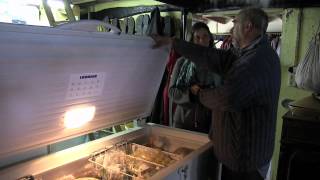
This is why I call it new, no nonsense permaculture. Because in my opinion, it's much more about bringing people back to common sense, teaching them also day rhythm, graphs, order and all these things. We try to produce as much food as possible. You will see that not much space is left. You will see also there's lots of materials. We are going through place. People bring stuff and we give it to people. And we are convinced that abundance and generosity will guide us over the difficult moments that the banks are creating for us now. Inclusiveness is really the basic drive of this community. We want to include people in our lives and we like people to include them, us in their lives. Give away a shot, people can come in and just take what they want. And that's. Yeah, there's nothing more to it. Here is the stuff where we. These are our treasury, where we find stuff that we can use. Boxes and bicycles and. And wheels and electricity and plumbing and. And iron to build things with and wood to build things with and insulation and stuff to make preserves with. We are very heavily into preserving things also. All of this gotten for free. Bruce Lipton has a theory about nature being ordered, ordered around on the principle of mutual exchange. And he says that in a cell, when a cell exchanges something with another cell, it usually goes 150 times around other transactions and then only comes back but multiplied by 150 to the original cell. So this is the basic, the philosophical base, the scientific, basic, basic for abundance, for generosity, against all this madness about competition and rat packing or rat fighting or whatever the name is. This is a really lazy garden. It hasn't been turned since 25 years. It hasn't been fertilized for 25 years. I've cut the place now because it was really infested with too much celery. And so we started again, but we didn't do anything. It just came back. We multiplied the onions a little bit and we multiplied some of the chard, but that's it. And now the rest comes back spontaneously. Or we do things like we seed five, six salads together, maybe that's one. You have to get closer. We seed spinach and salads together with onion. And then, yeah, eventually comes out. And what we eat, we eat and what doesn't, what we don't eat goes to seed. And so the seeds fall. And then after a few years, the only thing that comes up when you let it germinate are edible things. The caravan is for people to live. I always include a few alleys of 3, 4 meters wide where they have the fruit trees and the berries and everything. And then this kind of COVID for the chickens and then chase the chickens underneath the fruit trees. And so this way you harvest the fruit and the chickens clean you up for you and no more work for it. This is our version of the forest garden. It's a conversion of a wild. Because when we always away for a few years, all these trees grew and nettles and everything, through the nylon, through everything. And so we fought what we didn't want and we kept the ones that we liked, the white ones, the birches, and we added nut trees and fruit trees. And we also added the strawberry plants now in the berries. But it gives three to five harvests a year of all kinds of vegetables. Now it's onions and spinach and we're planting salad and chard, two kinds of chard. And then after the onions will come the late beans, and then after the late beans will come the, what do you call that one? Corn salad in English. So it will keep on growing and at the same time the strawberries will keep on giving. Because the strawberries are a special variety that we have made that gives from May to end of November, non stop. It's very nice, very big strawberries. So. If I go to my ex colleague, my ex colleagues in the wholesale business, organic. Well, I get lots of stuff for free that they normally have problems getting rid of because they have to pay for it. And so yeah, we get it and we give it to other people and we use it. And you see, as you see, the shelves are full. And then lots of stuff from the garden also has to be canned and preserved. And this is what we have the freezers for. It's again, it's like the other things, it's all in a chain, all going around, all networking. We get lots of alternative, how do you call that one? Cosmetics. And we give them to women and to women with babies and everything. It's an unending chain. In a sense, of course, it cannot go on forever because the wastefulness of this society, this economy, is absurd, totally absurd. It cannot go on. But on the other hand, it would be stupid to let it go to places where they crush it and destroy it, or make gas out of it, as you say. I would think that's a waste. And here we can recycle it. One of the things that is also very special is that people have to put dates on everything now, like olive oil. We got a few hundred liters of olive oil here, and olive oil stays good for 2,500 years. And it's good. It's good to think olive oil good till 30th November of 2010. But we fish boats out of the Mediterranean that have been sunken for 2,500 years now. And we take the olive oil out, we unstop the Amphora and we. Oh, yeah, what a nice smell it has. Still amazing. But it said that it's not passed through the European commercial. Okay. You go to as big the place, as big as possible. The producer is better than the wholesalers. The whole sale is better than the shop. Yeah, but all levels are good. Yeah. So wherever you go, you say, look, I see that you are. That your olive oil is out of date. What are you going to do with it? Can I help you? And they'll say, oh, yeah, we think we can still sell it. Okay, keep it. It's okay, no problem. You come back half a year later, you say, did you eventually sell the olive oil? So now it's still on our hands. I'll take it off your hands. Deal done.
How much do you reckon it costs to run this place? And like on that, on the scheme of growing things and like having all this food you can get free and skipping.
Ridiculous. Totally ridiculous. It's a few tens of euros for electricity and a few tens of euros for gas. And then if we buy cat foods because the cats are not allowed to eat or vanish. That's my wife's decision. I don't agree with it, as you feel. Toilet paper, that's we have to buy also. What else do we buy? Rice, lentils, cereals up till now, but as you will see on the other field, we are now growing our own cereals also. So eventually that will phase out also. And that's about it.
I think what I'm amazed about is how much food that they've got today. I've just picked up a skip load. 40 kilos of asparagus. This is all organic. It's not from skips and chocolate muffins that are processed. This is organic produce that's still totally good to eat. There's some cauliflower here, perfectly fine. There's nothing wrong with that at all. Then they've got about 60 kilos of tomatoes, some of which are squashed, but still fine. There's about 20 or 30 sacks of red onions that are totally fine. There's about 60 kilos of broccoli that's, you know, totally fine. There's nothing wrong with that at all. There's 30 crates of potatoes. There's bananas that are just ready to eat. And this is just from one day at a wholesale market. And it's free food and more than they can eat. And this goes on every single week.