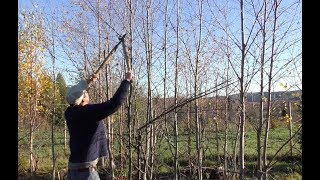
Richard Perkins shows how to pollard trees on his Swedish farm to create a savanna-like grazing system. The practice yields nutritious hay for livestock and short-rotation timber from species like willow, poplar, and oak, cut during winter dormancy with basic tools at specific heights.
Chapters
Today's video I want to talk about pollarding. These are actually coppices, these are willow coppices in our riparian. But I've had a change of heart and I want to actually pollard a lot of our young regenerating forest. So I'm standing up in the regenerating forest patch. This was bare ground, it was clear cut monocultural spruce when we arrived here five years ago. And you might remember in previous videos I've gone through how we brought pigs through here throughout rotational system throughout our different forest paddocks. And this year we're actually cutting the big old spruce trees at the back of the farm. And so we're going to have all of our forested area of the farm quite low down. At this height you can see it's some impressive growth in five years. There's trees that are up at 6, 7 meters in this patch. But I've had a change of heart because I've decided that rather than let this just regenerate into natural diverse woodland, which has been the impetus from the beginning, because the species I see are rowan and birch coming in with willows and poplar as the first sort of pioneer species. But then the long term trees that are coming up here are oak and, and ash and lime and all these beautiful hardwoods that you don't see in the landscape around here in Sweden, because 99% of Sweden is just monocultural spruce. So I've always wanted to leave a mixed, broad, diverse forest. But actually I'm interested in production, how can we get more production out of our land? And so I've always wanted to turn this back to agroforestry in the process of growing trees. So what I've decided to do, I came back from Ireland really excited, having visited my home country to re establish a bit of pollarding here. Now, pollarding is the same as coppicing. It's just cutting material off, usually above head height, typically at a height above an animal's head. There's two main reasons for pollarding. One would be for animal fodder, where you would cut young trees starting at about some width up in the crown of the tree and do that on the cycle every two to five years, perhaps to be able to harvest really nutritious leaf hay. Essentially tree hay is so much more nutritious than grass hay because trees are obviously pulling nutrient from a much deeper spectrum in the soil and it allows you to control when the animals have access to the material. Obviously that can be stored through the winter, it can be dried outside Upside down on racks, a bit like you would do with hay traditionally here. The other method people used for pollarding was for timber, and that would be done on a longer rotation, perhaps five to 15 years, depending on the intended use. For the sticks, it could be little bundles of woods that would be tied together to burn, but it could also be for making broom handles or fence posts. It was also an important part of our landscape for shipbuilding. Pollarding has been done for a very long time in the country I'm from. In fact, you see here the bole of an oak tree. This is an old oak pollard pulled out of a river in the UK that was carbon dated at 3400 years old. And it's written about in Roman times and probably predated that in many countries across Europe. And it's an amazing thing because it actually makes trees live potentially a lot longer. And that's partly here we have rowan tree, and rowan's a tree that will copper sympolade. Okay. But what you're doing when you keep cutting off this material in the cycle is you're removing diseased wood, but you're also keeping the aerial part of the plant quite low in weight and it has less wind resistance, which enables trees to go on for hundreds and hundreds of years. In fact, some of the older trees in the UK and France parts of Europe are old managed coppices and pollards. So I'm really excited to reintroduce it to the farm and actually do this across all of our cut forest. And the reason why is because in the beginning stages, as I establish pollards, what will happen is a lot more light will hit the ground, which will encourage all the forbs and species that I want here to turn this into grazing with trees, this old savanna mosaic, which is what a lot of Europe, I think, would have looked like at times in history, in the managed agricultural part of history. And I want that grazing capacity because we're considering to really develop fine grass fed beef. And therefore we need a bit more land because we want to scale that as a business to meet our land base and not need to ever buy food in from this point on. But also I can get a lot more value from the land by being able to graze it and having fodder over the top of it. And it's something nice about being able to utilize the trees. In my lifetime, I thought I will just leave this area of the farm and it will be something my kids inherit or whoever takes on the farm inherits. But actually, if I start Pollarding now, I can start using these the next couple of years, which sounds a lot more exciting and fun to work with. And it's about half of our farm that's in forestry, so it will really open up a lot more ground. So how well a species, coppices or pollards, depends on how vigorous it is, as well as having that epicormic shooting tendency. This is willow, and this is a viminalis. It's a hybrid willow used for biomass production. You can see just the rampant growth of shoots at the base, kind of like you get with tilia in our climate. This has never actually been cut. This was planted as a little 30 centimeter cutting a few years ago now. And you can just see from the footage here, the extensive growth just by being put into plastic, straight into grass. Here you see some further back that have been cut at this height. We're in the windbreak now on the south side of the farm, where the predominant winds come from. And there's six rows of this willow that start the ramp. We're aiming with windbreaks to get 45 to 60 degree ramp. So we've got then spruce planted every meter behind this, and then alder, which is growing up nice and strong. Some of it's five meters tall. Now, it was planted as whips a couple of years ago, but our aim was to alternatively coppice the willow to get that regenerating each season. And so do three rows at a time and then always have some up. If a large area of woodland is permanently coppiced, then it does start to affect habitat. And this is not a problem on our farm because we've got so many diverse tree systems and we're surrounded by forest and riparians. But something to consider, it's good for the tree in some ways, but can change the habitat for creatures around. So I'm here with an oak and we've got rowan here, we've got birch behind us, we've got alder in here and willow. These are all species that will pollard. Great. Now, what makes a tree useful for coppicing and pollarding? Well, it needs to have strong epicormic shooting tendencies. These are little buds below the bark, and you'll see them in trees that readily sprout from the base or readily sprout multiple shoots when they're cut. It's something you characteristically see in towns and parks where trees have been cut back and you have tall, sticky trees in the winter, and then they have a dense foliage from the bole or bolly up at the top, and that's what we call it in the uk. It's a bolly, for example. In this tree, this is an oak, and I never thought I would actually cut any of the oaks here. It's kind of against my principles, but I'm actually quite fascinated because oak is a tree that will pollard well, and this tree I would take up. I don't know if you'll make it out on camera, but actually forks up here, and if I cut it above the fork, I can start to establish a really thick body because I'll get wood growing out of both those pieces. So I'll get very dense regrowth on a tree like this. So this is a process that begins in the wintertime for most of us in Europe. That's going to be October to March, when the tree is dormant. Not only does the wood that you cut off last longer when you do that, because it's not so full of SAP, but the tree is asleep. And so that will then trigger some nice sprouting the following year. The height you cut it, that depends. You can coppice all the way down at the ground, but if you want to pollard and integrate your trees with livestock, we're going to be looking to pollard at an easy working height, because bear in mind, we're going to have to keep coming back and doing this at regular intervals. Now, there's many trees that were pollard. If you're unsure and you're interested to try, you could just look it up online. There's plenty of resources, but all of the trees we've got here, I mean, willows, poplars, aspens, birch. You remember Vincent van Gogh's famous painting of birch? Pollards and oak and alder and lime and all the maples and plains and sweet chestnut and black locust. There's all kinds of wonderful trees we can work with like this. So let's think about the tools we need and how we'll actually go about this. Basically, there's a couple of options for pollarding or coppicing chainsaws or loppers. Now, if I'm pollarding, I'm up above my head and working with a chainsaw. Up above your head is a little bit dangerous and not recommended. It's also quite heavy. Even with a small chainsaw, I wouldn't want to be working with this above my head height for many minutes at a time. It's very heavy, whereas a pair of loppers is quiet and easy. So here we've got a birch behind us, and a birch is an interesting one, because birch doesn't coppice and pollard so readily as some of the other species here. But basically you should start pollarding at thumb thickness and then that's when you've got all the soft wood inside the tree, so it's more readily pollarding. But here, because I got a fork, I'm going to take it up above the fork, about comfortable working height above the head of a cow, which is what I anticipate coming in here in the future, because it's going to be some years until I get my woolly mammoth. But essentially now the tree is dormant, I can just lop it off like so. And that's doesn't need to be a straight cut, it can be a diagonal cut, doesn't really matter. It's at the height I want and this will start to really vigorously shoot out here and start what we call a bolly in a thick spot scarring. If I want to, I can come back with secateurs and just clear out some of the wood at the bottom of the tree, because what I want to do here is have some wide space standing savanna like pollards, with this nice open vegetative growth underneath to start working on improving the pasture. It's actually a way to harvest a huge amount of timber off the same amount of trees, because you can harvest them on such a regular cycle. So if you're after small bits of timber for chipping or for burning or for using for crafts etc. It's a really productive way to use the trees as well as for tree hay in this way. It was very common in this part of the world to cut tree hay, particularly from alder from the riparians and hilllands. But it was very important part of the cultural history of the landscapes that I came from in the uk, and it was used all over widely. You still see it driving around Europe.
A lot, and I don't know if.
It'S making a comeback, but I would like to see coppicing and pollarding making a comeback. There's some great builders using coppice products for making roundwood timber framing. And there's so many uses for trees in the landscape in a different way than we're perhaps used to culturally now. So I'm super excited about this as a way forward for this few hectares of our farmland. Now these trees are going to be starting to bowl up at the top and I could tidy them up if I wanted to, and I'll probably just keep the timber for burning. I don't need to come and trim any of the lateral branches. But I can, if I want to, just clear the way. The more I do work down here, the more I'll create this savannah, like landscape by just really opening up the ground a lot more. And it's not necessary. The livestock will do that themselves too. I'm just showing you that it's possible to shape the trees in any direction you like. And you see this one's just been damaged by livestock. So it will start to sprout on its own as it's been doing this year. But this is basically the beginning of the pollard and it might take some years to get really established and to be able to start using it for tree hay. But I think it's a wonderful use of this part of the farm that we don't really utilize other than running livestock through in a quite temporary way.
A birch is a funny one because.
If you do this with an old birch you can kill it, but if.
It'S polluted over and over again from a young age, it's no problem at all. We've got things like aspen in here and we've got willows and we've got alderman trees that you can't do this with is conifers and pines. Here we've got a young spruce, although you can do it with yew.
Yew is one of the trees that tax us.
They will go quite well. We don't have them here in Sweden. They're certainly not this far north. We've got things like elder. All the trees in here basically will pollard. And you see what starts to happen.
Where we have come through and grazed with livestock.
We start to get all the beautiful.
Pasture species coming back. Dandelions, there's clover. None of this was seeding here when we got here.
This was just monocultural spruce plantation and.
You didn't have any of these beautiful forbs.
As we bring the livestock in, you'll probably remember from older videos I've made, we've turned this over with pigs and then we brought in the gut flora.
From the cows and sheep in the past to really start regenerating.
And it looks beautiful now. Really happy with how it's transforming. So, yeah, exciting times. This is what I want to do now for the next weeks, I'm going to come through here with my loppers and start taking everything down and even the oaks, poor little things. I never thought I would cut oaks.
But we actually have a few hundred.
Oaks regenerating and you don't see a single large oak tree except the ones Outside our house, you don't see them anywhere in a wider landscape around.
So pretty exciting.
I'm really excited to actually use this in a much more tangible way. I'm going to give you an update over time with how that goes. It's going to take me a while to accomplish this and I've got the.
Whole winter to work on it if.
I want to, as we wrap up the rest of the productions at the farm. But super excited to really engage in this part of the farm in a totally different way. It's always been a very minor part of the farm because we've just been so busy concentrated on the few hectares that we really farm intensively.
But this is going to open it.
Up in a way that really allows us to start using half of our farm in a much more productive way. And we've just taken some of the cows for slaughter now and they're selling premium grass fed beef, which is the first time we've sold our own beef. And we've took our own cow for our own feed earlier in the year, which has been amazing. But because it's an old heritage breed, a lot of people are very excited about the meat. I'm just up at the turning circle. You remember earlier in the year we had this big project to make the turning circle which will allow us to.
Cut the big trees.
This winter we had a few blowing down. You might just see one leaning there in the storms. We had a few people asked about the caterpillar tunnels. We've had no problems at all with caterpillar tunnels in the strong winds. But I came along up here when they did all the digging work and I reseeded with rye grass to quickly cover up the banks just so that's all stable. And I've got a bit of fencing work to do in here before next year so we can have the cows up here again. So that's it for today, folks.
Just a really short video to show you what I'm up to up here. I'm excited to get on with this as the winter starts to kick in. Now having beautiful sunny days, it's getting cold and a bit frosty, but remarkably warm weather for this time of year. And the grass is still growing really well. But yeah, I've been busy in the background putting the online training out as a subscription basis. I've seen a bunch of people have joined up in response to that, but this is the widest ranging regenerative ag training I've seen out there online. I've seen all the other online courses being offered and I don't think there's anything quite like the breadth and depth of what we're offering here. And we've also made it the most affordable by far. And so for a small monthly fee, you have access immediately to all the material that We've condensed over 80 hours of lectures and tours around the farm, looking at every detail of all the enterprises here. It's an amazing amount of information and knowledge compressed into a structured course that you can follow if you're looking to design or overhaul your own farm and enterprises. And if you're interested in how farming works, it's a great gateway into that. And we've tried to do that at an affordable price in response to people just feeling like the online training is out there are just inaccessible financially. And so I'm really happy to be able to offer that and look forward to seeing more of you in there. But that's all for today. Thanks so much for watching. I appreciate your likes and shares and don't forget to share them on social media if you enjoy our videos. It helps to spread regenerative agriculture and I'll see you in the next video.
More from Richard


A review of short and intensive season on a mixed farm and restaurant/event space in Sweden






Alskade Kyckling Exploring complexities of poultry production in Sweden and what we stand for


