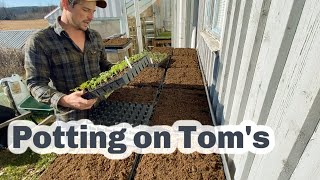
Richard Perkins demonstrates potting-on and transplanting tomato seedlings in his Swedish greenhouse. He shows an efficient workflow: laying out trays (8×8 cm cells), filling them with a strong cow-manure-based compost, and transplanting seedlings using a dibber and finger support while minimizing root handling. He discusses crop planning (aiming for five rows of tomato in the big tunnel, three rows of cucumber), reasons for not grafting or heating with fossil fuels, the farm's no-dig approach to soil health, and practical space/temperature management (use of halide lights and vertical rack placement). The video emphasizes efficiency, time-value tradeoffs, and variety choices (Black Russian, Sungold, Shirley, Ildi, Moneymaker).
Questions this video answers
March 22, 2020
59 degrees north
In theory 640 plants were sown; need 568 for five rows in the big tunnel
8 × 8 cm cells (not 10 × 10 cm)
17 trays initially (plus one extra if needed); 35 cells per tray
Chapters
What's up, YouTube? Welcome back to another episode. Today I want to transplant these tomatoes, pop them on. In theory, there should be one in every cell, but we've had little ragnar helping plants. So there's multi sown cases, but that's okay. We've got, in theory, 640 plants. We need 568 to do five rows in the big tunnel because we're doing three rows of cucumber. So I'm going to make up trays of 10 by 10 pots and efficiently fill all those, get these transplanted. And they're going to get installed actually underneath the bench here where we have these halide lights because we just don't have enough space otherwise. And you can see there's a lot of other stuff going on in here. So that's the mission today. Stay tuned. So I'm working outside just because it's a lovely sunny March day and my process is going to be putting out all the pots like this so that I can just pour compost straight into these. I'm using a stronger compost that I'll talk about in a minute and I'll just fill all these up and then I'll be able to rapidly transplant everything. So I've got 17 trays lined up and I've got an extra tray over here if I need it. But 17 trays will give me enough. 35 in each tray. Just took a few minutes to lay all them out. And with all these sorts of jobs, you want to look for breaking it down into its components by putting all these out first and filling them all and then planting everything, it's way quicker in the end. And we're aiming to do jobs like this really efficiently because farming is made up of just multiple repetitive tasks like this. So I'm all ready to go now. I did tell a little fib. These are not 10 x 10 cm trays. They're 8 x 8 cm. Space is at a premium in the lean to. And so it's pretty important that we can make the best use of the space we've got. Therefore, it's important that they don't take up too much room because we've got plenty of other crops too. Now they're only staying in these pots until they can get in the tunnel. They that varies depending on when we get rid of the hens and also on the weather, which can fluctuate radically here up at 59 degrees north. Now, these are a bit too densely spaced for how you would want to keep them as they grow up. To this sort of height. And so what you would want to do is sort of mosaic them and take out plants like this to give them more room. And we can do that in situ. I'll probably transfer them to the gray crates that we usually pack vegetables in and they get bigger. But the minimum space they can take up for now is necessary is great because at some point we'll be getting spring onions out and they'll free up a huge amount of space just with that single crop. So we're going to fill these now with compost and it's a little bit stronger compost than we typically use for potting. Okay, compost. So this is a heavily cow manure based compost. It's a lot stronger. It's lumpy, it's got bits of wood and stuff in it like that. I'm not going to bother sieving it because I just can't be bothered. But what I'll do if I just turn this around, I'm just going to start in the middle where you can see this. I'm just going to use a scoop to fill these rapidly because I don't want to spend much time repotting. These tomatoes aren't going to be happen until July, August, so I don't want to waste too much time just putting these things on. But by stacking the trays in a way that tessellates like so becomes very quick to fill these pots up. And then when I put the actual plugs in, I'll easily be able to just poke them in with my hands. So again, like any tray, I'll give them a tap and that will identify where it needs more. And I don't mind if a little bit's falling out around the sides because they tessellate pretty well. So I'm happy with that. Now we've got 35 filled ready to be transplanted. So I'm just going to repeat this process and fill up all the trays first and then we can worry about sticking plants in. Now it may be a little bit stronger than you need, but these pots are small, remember, and they're going to be in there for an indefinite amount of time. It's likely to just be a few weeks, but it's really unpredictable with the weather and the hens and so we want them to have enough nutrition to get through that time. So pretty small pot, but this is what I'll do. I'll just fill all these up and then we'll get transplanting. So in most places it's true that the Tomato is a high value crop, but here in Sweden I beg to differ. I actually think tomatoes are a low value crop unless you're heating tunnels with fossil fuels, which I'm not really up for doing. Now. The reason I say that is because profitability is a measure of how long something's in the ground, how much you can sell it for, how many of them fit in, the amount of space, how long it takes to grow them, and the demand for the actual crop. Tomatoes, quite a lot of work getting them going in the tunnels. There's a lot of stringing, pruning. These are indeterminate, so they grow up as a single vine and they need regular pruning and suckers taking off, which you've seen in other videos. These are actually Black Russian, which is a beautiful variety. Basically, unless you can get in with an early crop, you're producing tomatoes at the time of year when everyone is. And the price is very low. Now we're selling direct to consumers, so they hold their value quite well. But if you're heating with fossil fuels, be it propane is a pretty standard way of heating big commercial tunnels. That's a lot of fossil fuel just to grow tomatoes. I'm not even that big. It's not like beef steak or things, so could be a beef steak tomato, I guess, but you know what I mean, it's just tomatoes. It's not like high on the nutrition list for me, but because I'm not willing to use fossil fuels to get really early plants, for me it's not actually a high value crop. When I consider what I can turn over in the same space in terms of salad, etc. It just pales in comparison. And the amount of work is very minimal for those sort of crops. Now we're growing a variety of crops and we want tomatoes. That's why we do it. But I just point that out because a lot of people assume tomatoes are high value crop, but only if you're growing early varieties through heated tunnels, in my opinion, up here in Sweden at least. Okay, so the way that we actually transplant these is give them a good watering the night before. That's really important because transplantation is, you know, it's like you going down to the airport, jumping on a plane, not getting fed, going to Wuhan, waking up there, wondering what's going on. So that's what we do when people are in shock. We give them water and we don't handle the roots. So I use this dibber that you see that's designed for these 64 trays to push the cells out from below. Because a plant can't really be handled by its roots, and you don't want to lift it by its stem. It's not evolved to be lifted from its stem and hold this weight on its roots. It's not designed to do that. Now, you could wait a little bit longer for the root ball to fill the cell to make the transplanting easier. But I'm working on a time basis, and today is the day that I'm free to do this because my seeding calendar is pretty full. But then to transplant, I'm just using my fingers. I'm going to dip in there, push that in, and just firmly push it down. And that's it. I'm going to water these all in really well. But that's as simple as it needs to be. And if I've got a double plant, because Ragnar is helping plant these, I'll just discard that. So because I know I've got an excess of required plants, I'm only going to take the best ones. And I can be quite ruthless in my selection because I've got maybe 15% extra than I actually need. And if I'm splitting a plant like that and I'm interfering with the roots, I'm just going to toss it because it's not worth compromised plants. And if I do the mathematics of the trays, because I've got 35 pots in each tray, I'm still going to have an excess now anyway. So this is the process. I'm going to put the camera off and just rapidly start transplanting these. You don't have to be precious with transplants. When I was growing up, growing on bigger farms, running the vegetable production for CSAs, I would have to do like 40,000 leeks before I started breakfast. And you're not hanging around, your fingers are moving fast. These are young plants, they're very tolerant, and they're not worth anything till they start cropping. So it's really about putting the amount of time that's relevant to the value you're creating. And young plants like this, you should be whizzing through. There's no need to treat them super gently and daintily. It's just not necessary. Okay, next batch is Sun Gold. That's a little cherry tomato. It's important to give all transplants really good soak due to the stress of the situation. You can see we've got them under the halides. Now, these halides I've talked about in other videos, they're More on the yellow spectrum, typically used for triggering flowering, etc. But we got given them and so we're just using them because they allow us to put the tomatoes down here out the way and they get plenty of heat and strong light. And it's been doing well for us the last years that we'll carry on with that. So I've got three more varieties to go. Okay, so this is Shirley, which is just a nice red. And we've got Money Maker, which is another high yielding classic red. And then my favorite is Idli. You'll remember the really highly abundant yellow cherry. And that one, I'm hoping to get a few extra because it's my favorite tomato variety. Having this dibbler allows you to move quicker because you're not pulling any plants out. And I can support the root with my fingers like so. And I'm just dipping a hole that just allows me to sit that in and then just giving it a good press. In this case, I've got two plants, so I'm going to pull out the less vigorous one I'm always supporting. I'm not just letting it dangle on the weight of its roots. That's important. And I'm trying not to touch the roots any more than necessary. And so that's the way that we transplant everything. It's a quick process, expecting this entire transplant to take just about an hour or so. So it's a really quick process overall. Now, at this point, I'll put this tray aside because I'm looking to select the best plants out always. It's okay if I have to use a few weaker ones, but I want to take the best ones I can. And I just label each tray up so that we don't come into any problems when we go to transplant. Now, later on, these will need sticks and tying onto the sticks just to give them another layer of protection. But like all these jobs, it's just about minimizing movements to make sure that you're just not wasting time in the repetition of unnecessary movements. And that's what all farm jobs are. Now, this is obviously quicker when I'm not talking to the camera, but it's a very quick process. It doesn't need to take a long time. And at this time of year, there's so much seeding to do. You don't have time to be messing around making jobs take too long. This is the sort of job that if you're just dilly dallying and chatting with people, you could spend hours doing this job. It's just absolutely unnecessary. It's a one hour job. I'm working outside because it's preferable for me because it's nice weather out here. The greenhouse is pretty hot already. But actually the plants need to get back inside because it's too cold for them out here. It looks warm, but it's actually pretty cold still just a few degrees. It was freezing last night. And so I want to get these inside as soon as I've done each batch of different varieties. So why do I always value things in terms of time and money, etc. Well, you know, I'm working in education and that's a big part of what I share with people, is getting real about the circumstance. But also I'm a very busy person. We have lambs right now, calves right now. We've got a new team arriving, we've got friends here for the weekend. It's, you know, there's a lot going on as well as raising a child and doing all the work that we do online. So that's an important part for just managing life and quality of life is to do things in little time gaps so we have time to eat together and things like this. But I'm always interested in workflows. Ever since I was a child when we did design at school, I was always looking at efficient use of space and efficient multifunctionality and work processes. And it's something I really enjoy, is challenging myself. And it's something I've talked about a lot. It's something that I really try and pass on to our interns, is to test themselves. People coming here for a season have this opportunity to really test in their own experience what their capabilities are. Because if you know that you can do things half as quick as I do them, then you know how to plan your enterprise. And if you don't know where your limits are or how you can push yourself when you need to, you just don't really know how to go about creating a business plan or any of those things. It really requires that intrinsic knowledge. And so it's a big part of my process just because it's fun. But it's also got a very practical implication for farming. I mean, farming is all repetitive jobs. So it's all about leaving things in the right place and having things organized and making efficient little work processes like you see in our videos on how we run the slaughtery or anything that we do here. The same with our bed preps as we start seeding and transplanting out in the garden. Soon that you can repeat and optimize and it just helps avoid mistakes and saves a lot of time. And as I've always said, market gardening is the most time intensive of all farm enterprises. And most people aren't aware of that. Doesn't mean we shouldn't do it. Just means we need to really be careful how we spend our time. And that's part of the reason I wanted to make this video, is just to show like, you know, there's ways to do anything optimally so that they fit into the rest of the jobs we have to do that day, as well as balancing that with the time we want to spend with our friends, family for our quality of life, etc. Okay, we just made three trays. Getting a bit bare on these. They do grow a bit slower. The yieldi, that's the spelling for those of you that are interested. But three trays like this makes up one row in our big tunnel. So glad we got through them. On to Moneymaker, the last variety now. So, following up from a conversation I had last year, people ask about whether we're grafting tomatoes and the answer is no. Now, we used to graft tomatoes and the main reason you would do that is for vigour and disease resistance. But because our season is so short and we typically top off our plants in August, there's no point having much more vigorous plants. It doesn't lead to yielding more in our short season. It would yield more over a longer season if you're a bit further south. And from a disease resistant point of view, I'm not interested because I just feel like no dig means I'm in a very different position to someone with tilled soil who is working it aggressively. Now, we're not even growing these in traditional no dig beds. We're growing them in the greenhouse where the chickens are all winter. So actually starting again kind of from scratch. Every year, we sort of scrape out all the bedding down to the base layer, which is essentially subsoil. We board, fork that, and then bring some of the compost back in and let the rest compost in windrows over the season. But I've got a theory that if you put your focus on biology, you mitigate a lot of disease issues. Now, we did see some blossom end rot, but that's a nutrient deficiency that we dealt with by making kalfos with eggshell, which you bake and react with vinegar in a thermic reaction to make a soluble form of calcium, calcium and phosphorus. And that dealt with the problem. So I think that's totally unrelated, but I'm confident to say that I don't really believe in crop rotation and I don't see the need to graft tomatoes anymore. So I don't do it. And that cuts out a bunch of work. And I don't think it dramatically affects our yield because of our short growing season and the fact that we're not heating the greenhouse to grow tomatoes. So that's worth bearing in mind. But do bear in mind that we're really focused on soil health with our no dig approach. And that's very different in my mind to tillage, even light tillage, where you're causing oxidation within the soil and certainly destroying fungal hyphae, etc. You know, even 1 inch shallow tilting is still breaking up mycorrhizal. That's the first thing it will do. And that's evidenced in the fact that all no dig gardens you go to are full of fungi and you rarely see that in a tillage garden. We see a proliferation of fungi throughout our crops and we know that they are tending to be beneficial in the distribution of water and nutrients around the soil. Probably the oldest memories I have of growing, other than my grandfather who used to always have a garden growing with vegetables, I think a lot more people in the war era were used to that and carried on with that, but was at school at secondary school because we had a farm at our secondary school that closed as I was leaving the school. And that happened in most schools in the UK that had farms, but we had cows and pasture and we had a lot of veg growing and we made a hovercraft down in there was like a tech unit connected to the farm and the school. But we used to spend afternoons in the potting shed doing exactly this potting on plants. So that would have been when I was 8, 9 years old. And they were some of my favourite times. I particularly enjoyed my science teacher and I was particularly into science as well. So they were very enjoyable times. And I just remember the smell of the potting shed. Such a wonderful smell and reminiscent of sweet times and a lot of learning and good school fun times. Okay, all done. Wonderful. That actually took one hour, one minute, which is what I anticipated it would take. That's great. So just to recap, we got Black Russian, Sungold, Shirley, Ildi and Moneymaker. And they're the five varieties we're growing this year. Five rows in the big tunnel where the chickens are right now. We'll do three rows of cucumber mainly. Well, pretty much all English Cucumber, non grafted. These are all indeterminate varieties, which means they're not bushing, they just keep growing up and we prune them to a single leader. I've done less potting on than I expected because I've discarded extras because this is enough for what we need. So let's think that's 15 trays, 35, 525 plants. It's taken me one hour, one minute for the whole process from start to end, including cleanup. That's about, what is it, seven seconds apart. That's fine with me. So these things can be very efficient and easeful. This is not the most ideal setup for these plants having a little nestle under here. This is actually the window to our cellar. So it's colder down here. Now, just to give you an impression of that, here's spring onions on the third rack down, second rack down, top rack. So I go through a process of shifting these around. Now, obviously, obviously, in a space like this, the heat will be lower at the ground. You see, it's quite warm today. We're up at 23 degrees in here because of the sun on a sunny day like this. So I do need to spread my trays around a bit if I want evenness. But I don't really mind, to be honest, with the spring onions because we can just stagger the harvest a bit easier like this. It's not a big deal, but it's something to be aware of. If you're using vertical space, naturally it will be a bit cooler down low. And whilst this isn't the most ideal space for the tomatoes, it's what we've got to work with now. What will happen later on as they really grow up? We'll stake them, we'll tie them to the stakes and we will space them out a bit so you have a bit more room and they will go out. It's hard to know when exactly due to chickens, and that frees up a bunch more space on the trays because I've got quite a lot of space seeding to get on with this week. Okay, that's it for the video. I hope you found that interesting in some way and you can let us know in the comments below. Thanks so much for watching, folks and don't forget to click subscribe and hit the notifications bell if you want to stay up to date with videos. We'll be releasing a lot more now. The season is getting underway and I can't wait to keep you updated about the farm. Like a hero experience and hub that we're creating. So thanks so much folks. You can find out a ton in the links below in our book or in our online training. We'll see you in a video soon. Bye for now.
More from Richard


A review of short and intensive season on a mixed farm and restaurant/event space in Sweden






Alskade Kyckling Exploring complexities of poultry production in Sweden and what we stand for


