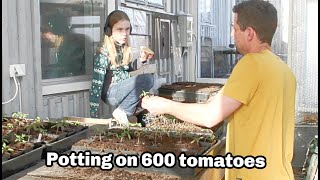
Richard Perkins potts on 630 tomato seedlings into 10 cm containers using a two-layer compost system: high-fertility mix at the base, standard potting soil on top. He keeps daytime temps around 25°C, never below 10°C at night, and removes every other plant later to give them more space before planting out in late May.
Questions this video answers
April 5, 2022.
About 600 tomato plants.
Approximately 630–640 plants (18–20 trays; 35 per tray × 18 = 630).
10 centimetre pots.
About 25°C daytime; keep around 18°C overnight (do not go below 10°C).
Chapters
Okay, welcome back to another video, folks. Today I'm going to start potting out all the tomato plants. It's a homestead year, but got 600 tomato plants here in the big tunnel that I was prepping recently, we're going to have tomatoes as well as English cucumbers, watermelons and melons. Now, by over planting, it allows me to select the best plants. And we've got quite a few varieties here. They're still very small, but because some of them are double seeded, working with the kids, what I want to do is put them out into bigger pots now and give them a bit of fertilization. Now, tomatoes in this sort of setup is very challenging because of space. First I need to clear this bench. I want to have the potted tomatoes on here, and eventually as they get taller, they will go under here where we have lighting, and that's where they will stay till they're planted out towards the end of May. So I've ramped up things in the lean to here, and because of the pressure with things like tomatoes, I've turned the heating up a little bit. I'm trying to keep this 18 degrees overnight. For tomatoes especially, you don't want to go below 10 degrees. It will stunt growth. And you can see we're sitting on about 25 degrees Celsius in the daytime. And I can adjust that by opening the doors and the vents at the end of the greenhouse. So 25 in a day is great, and keeping it above 18 is really nice in the nighttime. As long as it doesn't go down really cold, we should be fine with that. Now, it's a bit earlier than I would normally do this, but I've got a very busy schedule coming up and I'm going away for the Easter holiday. So any jobs that I can tick off now is going to help me. So what I like to do is use 10 centimeter pots for the tomatoes. Bigger would be nicer given the amount of time they're going to be in them. But I've got 20 of these trays to fill, so it's a space issue. What I'll do, even though it's a bit less efficient, I'll actually put a bit of quite fertile compost in the base of these, maybe for the first few centimeters. And that's a compost made of cow manure, broiler manure and peat. So it's giving it a bit of oomph. And then I'll fill the rest with potting mix because it would be a bit of a Shock for them to just get pure, strong compost. Now you can see the plants will be very close together. And so what I do once the plants get a little bit bigger is I put a little stake in and I'll actually take out every alternate plant if that makes sense. And that way I'll double my trays, but I'll give the plants twice as much space. And that's what we've been doing. We've had up to a thousand tomato plants each year and it's always a logistics nightmare when you've got a small vertically stacked greenhouse in a very cold climate. So that's all the trays we've got to fill. These are the potting compost I'm using. This is what I typically use low nutrition as a standard potting mix for most things. And this is the cow broiler manure based compost. So these are both from Rwlande in Sweden and they work fine. Been using these the whole time that we've been here. Okay. So I've got very similar amount since sitting in each pot and now just going to top them off with the potting soil and we can get them inside and start transplanting the tomatoes. Now I'll give the trays a light tap down, but bear in mind I got to fit one of the plants with the 64 cell in there. So by the time I dip a hole with my fingers, put a plant in that's going to be nicely topped. One of the tricks I think with doing this efficiently is to have pots that match up nicely with the tray because then you can be really liberal with the compost. And as you can see, it's super quick to fill all these and 640 plants with equal doses of higher fertility compost at the bottom. It's pretty simple, pretty straightforward. Anyone can do that. Well, we're going to need to clear some room with all of these trays. I actually have boot trays that I can fit on my racks and put these spacers to keep the leeks. You see how the roots just don't grow through there. It's perfect. So I need to set that up on the racks. I think I want to have all of this space clear and even then I can probably only fit most of them on here. I'm gonna need to put some up on the top or somewhere underneath, but we'll get that cleared out and then we can start transplanting. Lastly, Grace's artichokes. Super fun. We're growing a bunch of stuff that I wouldn't normally grow. Not really suited to a commercial setting. Globe artichoke has to grow as an annual here. It's just too cold and too short a season. But there's three beds of it here and Grace is really excited about this. I'm pretty excited about it too. Alright, so I've got my dibbler plate to get the tomatoes out like so to avoid damaging any roots. And you could arguably have a dibbler for the pots, but I like using my fingers. That works fine. So I'm going to very gently tease these out. Now. The smaller ones haven't got very significant roots yet, but they're going to be just fine. And the bigger ones have already root balled up, you can see. So I want to avoid touching roots, but we can safely get that into its pot. And this is actually a double plant. When you're planting with kids, sometimes that happens. So I can gently tease these apart and that way we'll fill in any gaps of those that didn't germinate properly. And that's why we'll roll. Sam. Okay, job done. So I hope that's useful for folks to just see how, you know, what can be a big overwhelming job perhaps can be done really efficiently just by making a little workflow and creating a good process, even at hand scale. So I've got one tray spare. That means I've got 18 trays and these are 35 in a tray. So that's 630. I believe that's more than enough. All the beautiful different varieties we got. I'll talk more about the varieties and old varieties I used to grow. I know a lot of people interested in that, but I wanted just to share that process to inspire folks to think about sort of workflows and rhythms. It's something that I have expertise in and that's been a big part of my job educating people going into farming. How do you break tasks down and just make them into logical workflows? What's the time now? This is now 6 o'. Clock. So I've been going at this about an hour and 25 minutes to do the whole job. 630 plants with equal amounts of additional high power compost in the bottom of the trays. That's perfectly good target, you know, and you can see from the process just simple rhythmical movements. And that's the joy of a lot of farm work, is just repetitive work. It's great time to listen to podcasts. It's a great time to chat if you don't get distracted and Start moving your hands and looking at each other rather than focusing on the job at hand. It's been really interesting over the years training thousands of young farmers and old farmers, but just seeing that, that, you know, it could take someone all day to do a job like this, but can also be done really quickly. Now important thing is watering. The way I like to explain it is if you've just been transplanted, you know, it's very important you get a good drink. So think about if you know, analogy I like to use. If you've just been relocated to downtown Hanoi or you just had a little bicycle accident, first thing people do, sit you down, give you a glass of water. That's what these plants need. They might go into a little stunted couple of days now, transplant shock, it's very common. That's why we want to avoid touching roots, etc. But I'm going to give them a really good soak now it's come to the evening time and in a few days time they will show very visibly a growth spurt from having a bit more room, a bit more nutrition and a bit more space. So that's it, that's the process. So just giving them a good water in and I'll water everything else in the lean to now. But that's the process so far to get this many tomatoes up. It's going to be a little while yet till I start planting the melons and the cucumbers. They grow really fast and we just don't have the space for putting those in big pots which they typically need. We typically put them in a bigger pot because they grow so quickly, but still that's a really good start and they're going to be very happy now in these bigger pots. So keep the temperature about 18 degrees in the nighttime just on the thermostat and we'll have it up keeping it about 25 during the day. It's going to be really fun to see these shooting up over the next days. And it's important we didn't over fertilize them because we don't them growing too rampantly and getting really leggy. There's not enough natural sun so we have to have them under lights. And bear in mind here at 59 degrees, we can't plant these out until typically the last week in May. So keep it cool and keep things looking good. As I said before, we will take every alternate pot out as these get bigger and we stake them. And you'll see that process in later videos. So that's it for now. Signing out to make dinner for myself and my daughter. Hope that was interesting to you in some way. Good luck with your growing and let us know what tomatoes you're growing in the comments below and I'll tell you more about the varieties I've got here in future episodes. In future episodes. Thanks so much as always for watching folks. Don't forget I've written books. I've written a manual called Regenerative Agriculture. It's the most broad based manual of how to do all this stuff economically, ergonomically, from scratch, starting on low budgets. I wrote that book as a sort of recipe that's inspired tens of thousands of farmers in over 100 countries now already. That's in the links below as well as the Builds book which accompanies it as low cost Infrastructure for Regenerative Agriculture with It's kind of like an IKEA manual for how to build eggmobiles, boiler pans, everything you need around the farm, including this lean to greenhouse and the grow racks, etc. All that's in the links below. Thanks so much folks. Don't forget to hit subscribe notifications. Bell. See you in a video soon. Ciao.
More from Richard


A review of short and intensive season on a mixed farm and restaurant/event space in Sweden






Alskade Kyckling Exploring complexities of poultry production in Sweden and what we stand for


