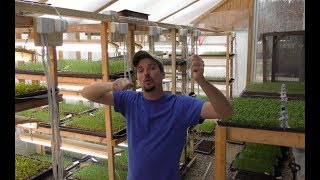
Richard Perkins runs a seeding room at 59°N with T5 lights on chains, stacked racks, and paper pot trays in 3x3 cm cells. He waters once daily, keeps lights 5-7 cm from seedlings, runs them 12-14 hours, and maintains 18°C. A hot-water accumulator and glycol loop heat the space while cutting electricity use.
Chapters
So it's been a very long winter for me. I haven't been on YouTube much. I've been sitting at a screen just pummeling away at regenerative agriculture, which is put down for now. I've sent this out to a bunch of authors and thinkers in the field and want to get a bit of feedback and some comments on that prior to launching a crowdsource campaign when I get back from Germany maybe in the mid April to the sort of last week of April, we'll see. But it's. But today I just wanted to talk a little bit about the changes we've made in the seeding room and then I'm going to be off YouTube again for the next week while I go and do an epic little four day training in Germany focusing on the key parts of regenerative agriculture. So for those of you that don't know about our seeding room here, it's basically been upgraded in a similar manner to how it's been operating before. But we're up here at 59 degrees north where you need lights to start growing early in the spring because there's just not enough sunlight here. For example, we can't grow things in tunnels over the winter here because there's just no light. So we're a cold climate like many of our viewers, particularly those of you in Canada and America. But we're so far north that we, we absolutely must have lights now. One big change this year is we're moving towards the paper pot system. And two of these paper pot trays fit. This is spinach here fit onto our racks. But they only need two of these T5 bulbs that we use. You can see the bulbs are quite high up at the moment because I've just been watering, giving them a good soak because I'm off early in the morning to Germany. But typically we lower these down. We have chains on each of these so we keep these about 5, 6 centimeters off the crop as it grows up and then you can lift them up on a chain to water. I just water in here with a simple hose and we have a gravel floor in here sunk about 80cm into the ground which helps moderate the temperature. It doesn't keep the space warm, but it stops it freezing. And so we can use, it's not turned on, but we can use water liberally in here. And so I'll just tend to push the lights to one side when the plants are young. And then as we lower the lights onto the plants I'll just hook them up quickly and Watering is a once a day job. We'll come and monitor the plants twice a day. I come on in the morning and turn these on and at night turn them off again. And then we monitor the temperature also by opening the end doors. And we have vents right up at the tops at the ends. Now the intention behind this space was to create a really energy efficient, low cost way of doing starts up this far north when we're often starting seeding in late May and then really going for it in April and then May and it can be minus 20. We had a snowstorm late May a couple of years ago when we had young three week old boilers going out onto the field. So you just can't tell in this kind of climate. And I think the further north or further south you go in latitude, the changes in climatic patterns that we're seeing are more extreme. So we have about 110 days without frost where we are here. But that can vary 20 days plus or minus. So we've always used these small condensed racks that allow us to stack all of our trays. They tessellate. So we used to seed everything by hand in 40 by 40 centimeter trays or 60 by 40 centimeter trays. So we could fit either two or three of them on each rack. And then microgreens we did in long trays where we fit one per rack. And the idea being is this little space, which is essentially 8 meters by less than 4 meters, is enough to do all our spring starts. And it's heated predominantly by a little fan up here that's on a thermostat. Because our wood stove is on the other side of this wall and that wood stove is burning for six months of the year basically without turning off. And so we felt like why use propane or excess electricity to keep this space warm when we have a wood stove going all the year round? As we begin to renovate our house finally after five years of really hard graft on the land, one thing we're doing is putting in a hot water system to a big accumulator tank and radiators around the house. Whilst we only have this one wood stove heating the house, it doesn't heat the extremities so well and concentrates a lot of heat in the center of the house. So having a hot water system allows for circulation around the house. And we're also going to put in a heat exchange and a glycol loop that comes out into here that can be turned on and off independently. And in that way we'll be able to run this space totally free of electricity, save the lights that we need in the first part of the year. We currently do have a very small electric greenhouse heater that we use at night times, although that's not even been running the last week and a half because the temperatures have been holding in here. We typically like to keep the seating room about 18 degrees Celsius. That's ideal. And I don't mind if it drops down a bit in the nighttime. That's fine. So the big change that's come has been putting in some better electrics. If you look at old videos, you'll see my dodgy wiring. When we set this up, the cheapest way you could get this many lights was buying these T5 lights as just single units with a bare wire on them. So I just hacked them all together and it wasn't particularly safe way to do it. So now what you can see, we've connected each rack up into one control box with a switch and we're tending to seed a bunch of trays at once. So that's perfectly functional way for us to do it. Another thing we've done here is if you can see, we've put in these shoe racks underneath the paper pot trays and that allows for much more liberal watering without worrying about getting anything wet, which is a really nice upgrade. One thing I do want to think about is whether these plants are going to become too root bound. You can see the roots all matting together. If that becomes too matted, then that's going to be a problem. With the paper pot trays unwinding, they're going to start joining together and not pulling out very easily. Now that's all about timing. However, I think once the trays are resting in midair, they will also air prune and they won't do that so well if they've got a tray under them. So that's something we're going to be learning about through the season. But right now I'm very happy with the paper pot seeding system and looking forward to the speed of transplanting this year. You could use these for bottom watering, but we don't. We water on the top. And I think it's mainly because you really need to carefully observe. You know, a big job of the market gardener is carefully observing every day around the garden, seeing what needs doing, what needs attention, if something needs row cover, if something needs insect protection or whatever. See, they're starting to get through here. I need to do a comparative sort of study of what this would look like if it was hanging without this mat just in thin air like this. Right now I'm not concerned by that but if it gets any, any bigger then I would start getting concerned. But what I will do is put these plants that have been up at the top down at the bottom now and put the ones at the bottom up at the top because there is a height, sorry, a temperature difference, but watering below. I would only really do that if we're about to transplant. So for example, this spinach, when I come back this will be going out and it's really good to soak these. You can see these paper pots come apart really easily. But because they've been moist the whole time, but it's good to give them a really good old soak before they go out. These are quite matted. See they're sat on a flat board. So some of these roots would obviously get damaged. Like it's not ideal to be going away right now when the weather's good outside and I could be planting but that's the way it is and you know, it might knock them back a bit. But I'm not too concerned. Most crops would be in these trays for only two or three weeks maximum. Typically that's longer for onion and that's fine. They're really not over rooted that I'm concerned about them. And these were actually paper pot system was designed for onions originally and they were growing massive ones for transplanting in these tiny cells. The cells are about 3 x 3 cm. So we used to do pretty much all our transplants in these 64 cells that were 40 by 40 centimeters. So 8 by 8 CE and things would stay in here up to a month. But we didn't used to have optimal temperatures. We've been able to keep the temperature in here really stable this year. And I think with the hot water loop system that we're going to put in, it's going to be a two week turnaround. So you're basically putting in sprouted seedlings as opposed to, you know, older plants like here for example, the spinach has already got its first true leaves. This should be going out but it's just a bit of bad timing with me going away and the unpredictability of the weather out here where you just don't know exactly when you're going to be able to start up here. We can have frost up to sort of 6 7th of June. Typically it's like 28th of May around here in our little microclimate. But it's you Know a bit of a shift to get used to this system. So we'll just learn a bunch and share that with you through the channel. But happy with it so far and I'm not concerned about these things. If anything, it will just knock the plants back a little bit, you know, but it's not going to be a major problem. I'm not too concerned at all. This gear that we sell through the farmer's tools, it's super nice having a good dibbler. We only sell the 15 mil one because that's all you need. You can just press it more or less for any crop. You don't really need a different one. Really happy with the quality of the paper chains. They come in 5, 10, 15 centimeter spacings obviously, but they're really good. And I've lost any concern I had about any glue in the material. It's like it's obviously not the source of toxins coming in your soil. They're going to be coming in in your compost or other things in much higher quantities. I'm not, you know, I'm not an advocate of necessarily being certified organic. So some people are concerned about certification. I don't care about that. I want it to be better than organic. And that for me means nothing to do with standards. That means really respecting ecological processes. And that's why we do no dig market gardening. Because that's the only way vegetable production can be even close to regenerative. I mean, market gardening, I've just been summing up in the comparative analysis in the back of this. Like market gardening is where most people are coming into farming because of the low barrier to entry, the small space needed, the low running costs of the business. But it's definitely not the most profitable business you can do on the farm. And it's by far the most labor and input intensive of all farm enterprises. Really, not to say that that's a bad thing, but I just feel like a lot of the market gardening space is not doing anything different than organic growers have done for decades. And I feel like it needs to go many steps further if we want to call it sustainable, let alone regenerative. And I think that's why our focus has been on no dig, because that's the only way I think you can really get there. If you're tilling soil, leaving soil bare, you're in a degenerative situation basically. But yeah, that's another story. Loving the drop seeder. So when I get back from Germany now, we should be getting a new shipment of paper pot transplanters and bits and all the different seed plates, different size holes and also skip plates, which means you can double the spacing of any of the paper pot trays, which is awesome. So you can keep an eye on that. Of the farmers tools, we're out of stock of a few things. We've been sending out pallets all over Europe now for quite a while and I'm out on tilthas and jang cedars and six row seeders until I get back. But they will be hopefully in stock as soon as I get back in a week or so. So for potting mix, we use a ready made potting mix. It's just basically similar to the compost we use on our beds but with a bit of sand and it's finer sieved. It's important to have quite fine sieved stuff so that it fills the paper pots really easily. Now this stuff comes in bags, so it's got lumps, but you see it just breaks down really fine. Once we've then seeded all our trays, we always cover with vermiculite. We use a fine 2 to 3 millimeter vermiculite. This is an expanded clay compound and it just helps hold moisture and a bit of nutrient right at the soil surface. It's very quick to cover the trays with. It's definitely our preference. And I will always use this just to top up the little holes left by the dibbler board here. It's very quick and easy to do and we use it for any tray that was seeding, not just the paper pots. We've got a lot of spring onion and spinaches here. We've got first peas that we're trying to transplant in paper pots this year just to see how that goes. Then we've got our first kales. And you can see these are seeded in alternate rows. It's just by covering up one layer of the holes with masking tape or you get specific drop seeder plates that have alternate skip plates. We're waiting for a shipment from Japan with all the different cedars that we'll be selling through the farmers tools. A lot of people have been tooling up for their market gardening year through our tool shop. But you can see it's a predominantly onion rich thing at the moment. And up on here, this is where we do microgreens in the summer months. It's a lot more spinach and basically a lot of this wants to go off to harden off. It's going to get transplanted when I come back however, Johanna is going to be at home along with Ragnar, her son, who's a little bit sick. And she has a lot of work to do setting up the sales for the year. So I thought we'll keep everything in here and I'll deal with all that when I get back from Germany. You can see all our young tomatoes ready to pot on. We put these. These are chirola. We've got black opal and my favorite tomato, Idli, which is a beautiful yellow cherry tomato that has seven or eight trusses with up to 80 fruit per truss. You might remember some videos from the end of last season. Amazing tomato those trays are. They might look a little bit sparse, but we've just used the paper pot seeder to put the amount of seeds we wanted into a tray because we knew that we were transplanting them on. So it looks patchy. But this is just the amount of seeds we plan to plant of each variety. This is Italy. Here it's a lot slower to germinate, but I'm really liking these changes to the setup. It's really a lot more functional. It feels really safe and tidy and organized. And I'm really happy with this lean to greenhouse. For those that don't know the backstory of this, it's basically built out of free timber that we pick up a lot of free timber to build the farm infrastructure with. And it's bulletproof glass from the Stockholm police station that was obtained for free in exchange for taking it down. And then we basically bought concrete blocks and the gravel. And so we spent about €1500. And then the running cost of it is pretty insignificant. And that's pretty amazing. This, especially once we put the glycol loop through here, will allow us to grow microgreens even when it's minus 25, 30 outside all year round. And in this space you could actually, if you had the market, you could do a family income just on microgreens in this space, you using two racks per tray. As you see here, we don't have anywhere near the market for that. That's, you know, you'd need to be right in the city or on the outside of a big city for that. We sell to restaurants and, you know, might do 5, 6, 7, 8 kilos a week, but we can't sell, you know, 50 kilos a week, for example. But it's one of those things you can fit a lot in a space like this. And I hope that gives you some context for why we've made it such a small space. A Lot of people have heated benches where you can water very easily and that's wonderful. But the only way to do that in our climate would have been to put in the hot water system immediately, which we didn't plan on doing really. And we wanted this small compact space right on the house because we basically take the door out of our living room in the first months in March and April as we're getting going. And it's a very easy process. I'm super happy about it. Got some pelleted lettuces in and today I'm actually just seeding the first fennel and broccolis. We're doing some Romanesco as well this year. That's going to be nice. So I've just been doing a bunch of fennel and more lettuce, etc. The important thing with lights is the time you leave them on. And so we leave our lights on 12 to 14 hours. I'll turn them on in the morning when I wake up, which is typically just before six, and I'll typically turn them off about that time in the evening. I'm not very strict about that because I'm running around doing all kinds of things. But 12 to 14 hours is good and it's important to just keep the lights down and I haven't put them back down yet. But basically you want to, you know, keep the lights low enough that they, the plants are not getting leggy and high enough that the plants aren't burning on the tips. You need to observe, obviously different wattage bulbs, etc. Will affect that in different ways. So you need to look at your particular circumstance, but keep it 5-7cm off as a general rule and you should be fine with that. And back here we just got loads more leeks and onions and a bit more spinach. So this stuff's going to start going in the ground. We've got a very small team coming this year that's going to kick off around the 20th of April and I hope that the book will kick off at that time too. So we're going to launch a crowdsourcing campaign to order pre sales. Basically it's going to be an introductory offer price for the book and it'll be a signed edition available on the carrotsource campaign. We're going to do a €10 flat shipping fee anywhere in the world forever and that's going to be first class shipping. So our last book, it cost basically €20 to ship it outside of anywhere outside of Sweden. It didn't matter if it was going to Denmark or Australia, it still costs the same. And I found that to be honest, the Swedish post service is not great for the large expense that it costs. So I felt like I'm just going to take that cost in and we'll make it a flat rate. And the aim of that is to make it so that things like Amazon, etc. Are obsolete. I don't want to supply these kind of businesses. I want you to buy a book that you deem will be of value from me, a farmer who's giving you a direct transmission of, you know, my lifetime of intensive study and knowledge and integrating the best of all of the farming techniques and approaches that I've been researching for all of my adult life with a quite a high intensity. So I like that model and I think that's the way we're going to roll. And I really thoroughly touched to see, you know, I've read every single name of every person that's bought my book and where they've had it shipped to and I personally touched that book and passed it on to over 90 countries around the world and I find that really touching and it feels really important for me and my process to, you know, it's a big creative process making a book and it's been a really hard slog over the last two winters. So very excited. I've put it down now. I've sent it to some amazing people. We hope that they will like it too. But I'm excited to update you when I come back with that. And we should be announcing the Ecosia funding very soon and I'm looking forward to take you with us on our season. It's going to be a whole bunch of amazing people coming through some amazing trainings and I'm looking forward to just Keep sharing on YouTube as we always do and let you know how all this stuff goes. I'm super excited for spring and for growing again. So thanks for bearing with me all of our regular viewers. I know I've been really absent over the winter, but I like to be able to share in the way that I feel moved to at the time. And this last winter has been totally about writing this book and it's been really emotional and draining but really joyful process and I feel like I never want to get sucked into just doing YouTube for the sake of it. I'm not trying to make clickbait titles and make a bunch of money doing YouTube. I have no need to and I don't want to compromise the the way I want to go about it, which is it's got to be low stress for me. It's got to be, you know, just flowing with whatever I feel like sharing whenever I feel like sharing it and not feeling like it's a job or duty because I already have two full time jobs that I run consecutively and I don't need anymore. So I know that I've explained this in the past and a lot of people really appreciate just the sort of genuine, natural way of sharing. I know some people get frustrated that it's not organized into clear topics and but that's not the way I want to do it. So if you're genuinely interested in following what we're doing, I'm happy to share all of it and go as deep with it as I can and that's the way we roll. So thanks for bearing with us on that and I look forward to sharing the season with you all. It's going to be another interesting year. It's always an interesting year here at the Farm, but quite different year for us. And yeah, I'll see you when I get back from Germany. We're training up. We have a full training over there. It's fully booked out for four days about holistic management, agroforestry, integrated animal systems and market gardening, which is just all the best stuff compressed into four days. So I'm really looking forward to meeting some of you there in Germany and maybe we'll do some kind of little video while we're out there that perhaps we'll put online. We'll see. But I'll catch up with you soon as we really kick the season off and look forward to sharing it with you. Thanks so much for watching folks. Don't forget to click subscribe and I'll let you know as soon as you can pre order the book through here and on Facebook, on Instagram, things like that. And we'll see you soon. Sam.
More from Richard


A review of short and intensive season on a mixed farm and restaurant/event space in Sweden






Alskade Kyckling Exploring complexities of poultry production in Sweden and what we stand for


