RAISING HENS WITH NO GRAIN. Some thoughts...
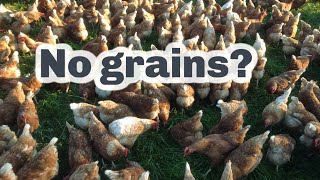
Richard Perkins (pastured-poultry farmer) responds to questions about raising hens without grain, comparing compost/insect-based feeding systems to conventional grain-based organic layer feed. He emphasizes the math and enterprise economics (flock sizes, feed inputs, egg production rates), explains his own farm practices (mobile egg-mobiles, following larger livestock, feed choices), and argues that non-grain systems can work but usually only in specific contexts (e.g., commercial compost operations or small homesteads). He also mentions related training, a book Kickstarter, and upcoming work.
Questions this video answers
October 11, 2019
About 1,200 hens (typical flock size mentioned).
350–400 hens per egg mobile.
Received at 16 weeks; start laying around 18 weeks (ramp to full production over ~4 weeks).
Peak production ~95%; year-round average cited about 85%.
Chapters
Today's video, I want to make a little response about raising poultry without grain and just bring up a few points to contextualize and clarify some things. Because I get so many questions as a pastured poultry expert. So many people come to me with unclear ideas about how things actually work. So I want to just run through some scenarios and numbers and just point out a few things for the benefit of those who don't actually have experience with raising poultry.
So I got prompted to make this video because you wouldn't believe how many times people come to our farm on training. We run specialist pastured poultry trainings for pastured boilers, pastured layers, turkeys, etc. And as well as, you know, long internships, whole farm planning, which has led to a lot of people, especially in Europe, America, Australia, getting started with amazing enterprises. But it's unbelievable how many people come with a question around raising poultry with no grain based on feeding them insects. Or they've seen videos, particularly Karl Hammer's videos by Justin Rhodes or the little teaser that just came out by Curtis Stone about a video he's got on his membership site. And it's a numbers thing. And I just think that I wanted to break that down. I don't normally watch farming videos on YouTube, but I saw that come across my feed and it prompted me because this is a question that was asked to me just last week and it's a question that's repeated so many times I wanted to just speak a bit about it. So I'm totally down with Karl Hammer. He's an incredible man. I loved his podcast on Farmer to Farmer podcast. He's an absolute wizard. And, you know, someone that's been a pioneer in the field makes incredible compost. And there's a contextual point in there. They are a commercial compost manufacturer. They make their money from compost and a little bit of money from eggs. And someone usually comes to the farm saying, hey, I'm really into insects, you know, why can't I grow insects to replace the protein needs in my chicken food? Well, it's a mathematics game in that example, because if you did the mathematics of growing mealworms or soldier flies or any of these things. Well, A, in Europe there's regulations about feeding farmed animals to farmed animals, so you might not be allowed to do that. And B, you would have a couple of hectares of intensive insect production to be able to provide the protein needs for a flock of 1,200 birds that we typically have running at our farm. And so a big reflection for Me is, hey, what do you want your day to look like? Do you want to be an insect farmer? Do you have the space to be an insect farmer and the resources to be an insect farmer? Or do you want to have an efficient laying hen operation and spend your time marketing, selling, keeping the accounts in order, etc. We're all busy as farmers and so we, we need efficient systems. Now I'm not saying I'm against these systems, but I think it's incredibly important to understand the compost system. There's numbers that have come out in a couple of these videos that give us some contextualization and I can break them down for you as a poultry raise in my cell. So Karlhammer's compost operation. I know that they make incredible compost that supplies a lot of amazing growers around the states. They're importing 1200 tons of food scraps, food waste from the community that goes into their compost and that makes up a part of their poultry diet. Now the figures I have are just from these videos, particularly Justin Rhodes and a little snippet that just came out on Curtis Stone's channel. So I may be incorrect in some of my figures, but the thinking is the same. 1200 tons of food scraps is far more imported nutrients than I import with my grain based poultry feed. So let's just take a step there. What do we feed our birds? Well, we feed them layer pellets. We've done experiments with all different feed regimes for our broilers, for our layers. And with layers we used to supplement with some straight grain from our local organic growers. But we buy organic layer pellets. We buy point of lay hens at 16 weeks old. They're just about to come into lay and they're high production hens. They're laying about 320 something eggs a year. And we are raising them in mobile egg mobiles that you'll be very familiar with if you follow our channel. And we raise 350 to 400 in each egg mobile, following behind cows and sheep. And we've done a lot of invertebrate.
Studies you can read about in our.
Old books or in our new book. And we make sure the birds get access to manure full of insects as well as pastoral insects and are moving daily onto fresh ground. And they've been largely responsible for the radical improvement of pasture we've seen. We've built 25cm of topsoil in a few years of being at our farm through using mechanical means like a keyline Plough, which decompacts the subsoil, which allows air and water to penetrate deeper into the compacted ground, which means roots, root deeper. And wherever roots are, plants are pumping out short chain carbon polysaccharides. And so this is a mechanical tool that allows us to shatter up compaction and build topsoil from below. There's videos on our channel about how we've built soil in the past, but a large proportion of that has been down to poultry. And it's why poultry is so important for small farms. You can have many of them in a small space. You cannot do big livestock effectively economically on a very small farm. And that's a big part of our new book, Regenerative Agriculture. Looking at all these nuances and comparing all these different enterprises to different time, places and circumstances, as well as economics. Now, with organic layer feed, it is primarily grain based. Now it's also very scientifically rationed through masses of data collected from the industry because alternative agriculturalists generally don't keep much data. I however, keep very detailed data and I have extensive time in motion studies. So I really have a good platform to do these sort of comparative analysis. Now I select organic layer feed that has fish meal as the protein source. And that's because a chicken is omnivorous. It's originally an insect eating jungle edge bird. Now our modern chickens are very far away from the original birds that lived on the edge of bamboo thickets, just like all our farm animals, very far removed from their ancestors. But a chicken is an omnivore and therefore I see it as a matter of priority and ethical stance to make sure that birds are able to take meat protein and then that is further supplemented by insects on the pasture, etc. But that doesn't make up enough of their diets. They do need feedback. Now it's important to say that hens are performance birds and if you don't keep tight data, you wouldn't understand the important correlation with correct feeding and performance, both health and egg production. Chickens have a three or four day lag time. For example, if I run out of oyster shells, that's the calcium supplement for creating strong eggshells. Three or four days later, a bunch of the eggs will have soft shells. If I decrease my feed by 20% three days later, I'll have 50% less eggs. Now I have very tight records on all these things and so I can tell you things with complete assurance. And it's really important because in the video that just came up on Curtis Channel, you heard Carl saying it didn't keep very tight records. And I think that's important because it plays into the mathematics of running an enterprise very much so. You should look into what feeds are made of and comprised of in your area.
Because a lot of chicken food has.
Got soya or pea as a protein source. Soya is not a great protein source for anything. It seems like the only people that have used soya for a very long time are perhaps the Japanese, who had very careful ways of preparing and fermenting the soy. It's not great human food and it's not great chicken food. Chickens need meat protein. Now you can read in our book about how we did insect surveys and the beautiful symbiosis between herbivores and chickens, mimicking how egrets always follow the water buffalo that you see. If you've seen a postcard of a water buffalo in Bali, it's always got a white egret sat on its back. This is a natural symbiosis that we're mimicking by following our chicken flocks behind cows and sheep. We typically do that about 96 hours behind, four days behind, because that's when the dung beetles, the really beneficial insects, have done their work, left the pile buried organic matter in the ground. And now the fly larvae are just about to hatch and cause a nuisance to the cows. So we bring in the chickens. They act like little biological muck spreaders and take all the Omega 3 and 6 rich bugs out of there, which is supplementing their diet. But it's really not enough for their whole diet. Now, when I receive my hens and they go in to lay, they're about 18 weeks old when they start laying. We receive the hens at 16 weeks old. They start laying over the next month. That ramps up to full production, where they will sit at 95% production until November, December time, when it starts to slowly decrease through the winter. That averages out year round at 85%. That means, let's take the figure of the recent video that Curtis put out, which was 800 hens that they had at Karl Hammer's composting facility. Those 800 hens will lay me quarter of a million eggs. Those quarter of a million eggs I sell for 3.6 crowns. That's about 36 cents, euro cents for those of you in different countries. That creates a value of nearly €910,000 in the year before we cull them and we change the flock over. Now I spend about €21,000, €212,000 on feed, which leaves me with 6,695,000 crowns, enterprise profit without the labour, etc. So that's about €70,000 coming from those 800 hens with a grain based diet. Now we heard in Kurtz's video Karl Hammer was saying that the hens were only laying at 50%. Now, at 50% lay those birds will be creating about 146,000 eggs in a year. So it's nearly half the eggs. Now their feed costs are very low if you take them into the compost business or they're free and they create about €53,000 or 530,000 crowns of value if they're sold at the same price. Now if we say the feed cost is zero, you see it's about €16,000 less net profit from that enterprise. So that's quite a big chunk and it's worth really thinking about that. And in that video you heard Carl say at their best they're laying 85%. But that's a figure you need to be careful of because in the same sentence he also said they're not keeping tight data. Now there's a big difference between the average throughout the whole year and the peak of their production. I have no doubt that astrologs, the breed in Carl's example are able to lay 85% at their peak. Our birds are laying 95% in their peak and they are high production birds. So it doesn't surprise me, but it would surprise me very much if they had an average throughout the year of that much, which I don't believe they do. In fact, whilst Australops can produce very high numbers of eggs and the record numbers produced by Australops are, are as high as any high production bird. They average about 250, which is 68% lay. And so that is quite, you know, substantially different. And those numbers add up because you're dealing with multiple, multiple eggs. So those kind of numbers, the egg price and the amount of percentage of eggs that you can sell, those numbers affect the enterprise hugely and you have to be very careful with those numbers. So whilst I would say probably the data for AustralOps is 68%, you need to then consider that that would be in a high production, high feed input case. Now the data is not out if they haven't been collecting good records on whether the hens maintain that percentage on a compost based diet. Now I have no doubt that that diet's brilliant, you know, natural foodstuffs and insects. That's perfect for a chicken, no doubt about it. But bear in mind you need a commercial compost facility to be able to produce that. And that's not the aim of most farms, that's the aim of a compost producer. So let's say even if they averaged 68%, lay at their best 250 eggs per hen a year, that would create about €73,000 in value of eggs. So it would be about €4,000 more per year than our enterprise that's grain based. So it's slightly better if you are a commercial compost maker making thousands of cubic meters of compost, which most of us aren't, and if they lay consistently year round like this, not just at their peak. So these are important things to consider. Something else to consider with Australops is they take up some six months to start laying, so we have an extra two months of feed that's not producing eggs. Now, I have no doubt that these birds are fantastic and I have no doubt that this is a fantastic system. I'm not putting this video together to criticize it, I think it's fantastic. But I'm just trying to point out that unless you have a name to set out as a commercial compost maker making a huge amount of compost, that then probably this system is not replicable and it's a huge amount of inputs. I would say if you calculate how much land is needed to produce the grain to feed our birds, it's far, far less inputs than what is going into making the compost that subsequently feeds that bird. Now, in a way, they're not worth comparing, obviously they're not comparable systems, but I'm just trying to point out some nuances and thoughts to allow you to develop your thinking process. If you're raising a commercial flock at any scale, you're not going to get by on forage or on any other feed source than making sure you give birds adequate feed. If you try and skimp on your feed costs, you will lose egg production. The data is out on that and it's very clear. Now for those of you that are backyard hen producers and have small flocks, homestead flocks, of course you can raise dual purpose birds with, you know, with very little inputs. But for most of us that are producing commercially and at scale, bear in mind, we typically have 1200 hens. You need a lot of inputs. There is no such thing as a low input, high production farm. They don't exist anywhere on the planet. Despite what permaculture books and other myths might tell you, that's not the way it works. Farming takes a lot of inputs to produce Good outputs. And that's the way it's always been. We can be smart about it. We can integrate as much as we can between different systems, but it takes a lot of energy to produce a lot of food. Now, what's the value of the outputs of the system? Well, in Carl's case, producing a huge amount of beautiful compost that I hear is the best going and that's fantastic. And it's a necessary service. We need more compost. Our hens are doing something different. They're building pasture. You can look back at videos on our channel building 25cm of topsoil. You'll see our cut through profiles where we've gone from 95% root mass in 18 cm of topsoil when we arrived at the farm down to 95% of topsoil of root mass in 45 cm. That's from pulling a key lime plow twice in a timed fashion when grass is at its highest photosynthetic rate, and then letting grass recover and grazing appropriately holistic plant grazing with cows and sheep and lots of regular inputs from poultry manure, both broilers and layers. Now we have absolutely radically transformed our pastures from some of the worst land in the village to by far the best land. And last year, in the extreme drought, you'll remember, we had grass up to my shoulders, photosynthesizing like crazy when everyone else had already gone yellow in June, testimony to the amount of carbon we've captured in the ground holding and storing water. One particle of organic carbon in the soil is holding four particles of water, one particle hummus, four particles water. If I increase my soil organic carbon by 4%, that's nearly half a million liters of water per hectare stored in the living topsoil exactly where plants want it for their processes. And so we've built soil. But then in the winter months when the birds come into the tunnel after the production season for tomatoes and cucumbers, we then bed them down on a deep litter of peat moss as a carbonaceous nappy for their high nitrogen manure. And we produce hundreds and hundreds of cubic meters of compost that fuels our no dig market garden system and mulches all our tree systems in our silver pasture lanes. So we get all those benefits too. So I'm not saying this is better. That is better. I'm saying they're totally different. And it's a little bit blase to chat about raising birds without grain. It's a lovely idea, but it fits very specific context, like a commercial compost grower or A homesteader who's just got a few birds. For those of us raising egg and meat birds on pasture, we reap just as many benefits, if not arguably many more. And the inputs are actually possibly a lower if you do full cost accounting. So there's no right or wrong way to do it. It all comes down to your context, the resources available to you and what you're trying to achieve financially. Now it's a numbers game like any enterprise, but particularly so with eggs. It's all down to fine lines and numbers. Now we've shown it can be very profitable and hugely ecologically rewarding to run birds on pasture, especially behind other larger livestock. I've said in many videos before, never underestimate the power of chicken. It's such a tool for small farmers because of the sheer animal density animal numbers that you can have on a small piece of land. Many of our past participants have gone off and set up great pasture poultry enterprises and I'm excited to go around Europe next year and see some of those and film them for you and share more stories. I know that a lot of you love to see those things. More on that later in the winter. I've got some pretty epic news to announce to you all, but yes, you can find out a bunch more in our online training. We have planning spreadsheets where you can plug in your egg sales price, your feed cost, your bird cost, your electricity cost, etc. And it spits out all the numbers. It's a game changer. Just amongst, you know, one piece out of massive amount of information on that training that's really been helping people all over the world.
So.
So you can find that in the links below if you're interested. And don't forget to plan hard and do good.
Okay, that's it for today, folks. I hope that clarifies a few things, gives you something to think about. Our eggmobiles are retired here in top field for the winter. Hens are in the greenhouse. I'll show you some videos of that over the wintertime. And I wanted to just say we're 10 days left now of our crowdsource campaign for regenerative agriculture on Kickstarter. It's a project we love on Kickstarter. It's very easy to find if you type in regenerative agriculture on Kickstarter.com we've raised quarter of a million euros already and that's an amazing achievement. Thank you all so much for your support and I'm super excited to get that book out to you very soon and just to let people know that.
Books funded in the campaign will be.
Sent out hopefully in December time. You'll get them in December or January. Other than that, if you don't support in the campaign, I won't have books for sale until March or April time, so it'll take a lot longer to get it. If you support the campaign on Kickstarter with an ebook option, then you'll get that in November or early December, so that's the quickest way to get the book. We're also offering combinations of ebooks and hardcover copy books and we have lifetime access to our online training for less than a thousand euros. That's getting a full overhaul next year. Huge amount more content of farms As I go around Europe looking at some of the leading examples in all areas of regenerative agriculture on a big road trip, connecting people and sharing amazing information. Our training will only go up in price and so I highly recommend that as an option to get on board if you want to have lifetime access to that training. We'll see you in a video soon.
Thanks folks.
Bye for now.
More from Richard


A review of short and intensive season on a mixed farm and restaurant/event space in Sweden






Alskade Kyckling Exploring complexities of poultry production in Sweden and what we stand for


