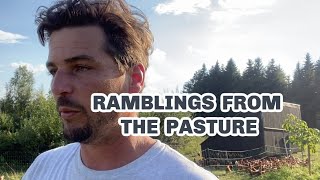
Richard Perkins walks his farm, painting a steep metal roof with a harness and spray gun for about €400, spotting a newly hatched grass snake along the way. He checks on garden produce, pasture recovery under eggmobiles, and mentions an upcoming seminar with Joel Salatin that will be filmed.
Questions this video answers
August 14, 2020
About €400–€450
Joel Salatin
Chapters
Welcome back to another episode, folks. I'm feeling pretty sun kissed after spending the morning up on the roof at my little cottage. Painting the roof. I'll take you on a little walk around the farm in this lovely summer like evening. Okay. Haven't brought you lot to this house for a long time. Haven't been doing a lot in here because it's summer. But we, Gracie and I have been painting the fronts so it looks a bit fresh.
I've done some work inside but haven't.
Been here for the whole summer. I've ripped out on the floor. I've wallpapered the kitchen ready for the installation of floor, painted the ceilings. Haven't done much in here yet. Cut a hole in here so we can make a room upstairs. Got a new kitchen, but today we've got climbing harnesses. Christian's here helping. We're going to get up on the.
Roof, paint the metal roof because.
That needs a bit. So I invested in a working at height safety harness, some good ropes and belay systems so that I can get up there and work up and down the roof. So get all that on. Okay. This is what my harness looks like. So it's got a chest and back mount, really comfy pads. It's a very nice system. Okay. We're going to tie it off on the car wheel. Should hold my little weight. And one thing you'll be very careful with is not inducing a pendulum effect. So I'm going to work vertically up and down, keeping well away from the edge. My spray gun has got an arm extender so I don't need to go anywhere near the edge. But obviously edges and falling off and the string pulling you in. The pendulum is the danger points. It's a very steep roof, much steeper than I can walk on without a rope. So first time for me doing this, there's probably different ways of doing it and probably people have different ideas. But if you were doing this professionally, you would have another fixed line as a backup. But I think this is more than ample to hold my weight. And I've got my little belay device to get me up and down. Oh, that is so nice. I'm really scared of heights and this is a very steep pitched roof. It's not. You can't even scramble up it just see from the side there. But putting all your weight on the rope like that when it's over a ridge like obviously you could put support on the roof to stop any rope cutting. But because we're going over a smooth central bit, we decided it wasn't necessary. The rope's not fraying in any way. Bit of a job. But I'm really happy. It looks brand new again. It's wonderful. This is the old metal sheeting. That's much higher quality than the modern stuff. You get much thicker. Lasts for a long time. So that should keep it going for another while. That's perfect. That's super cool because I really wanted to paint the roof of this house ever since we moved here. Really don't like it and it needs it for protection. But also this house was painted with kind of plastic paints and so the only way to really go over it is cover it with more. And so that gun is going to come into its own paint in this. It's going to be super nice. It's such a good tool having the right tools for jobs. Love it. Yeah. I'm really impressed with airless spray guns. It's really nice tool. Really easy to clean as well. Which is really nice because that's one of the big headaches with big painting jobs. But just doing costing for painting the house and the barns. I reckon this house has got a bigger roof than the little cottage. But this would probably cost about 400, €450 to paint the roof. If I want to paint the house I'm going to have to get involved with a sort of sky crane thing to get over the lean to greenhouse. That's the biggest issue with painting this house is getting up over the lean to to paint the top there. But I'm now confident it'll be really quick and that tool is a great investment for to do all of our barns as well as put on a nice high quality coat of the fallow red. The sort of red traditional paint used on all Swedish buildings will really bring the farm up to looking absolutely beautiful. Better than it ever has for probably decades. So that might be next year's project. The birth of a grass snake. What an incredible thing. See his little eye.
Oh, I saw a little bug right. That was like right here. And then Rod.
Look at the colors on him. What a cool creature.
What a nice apple. That's beauty of bath for my Baileys. Is it a good one? Have you got pink hair?
Wow. Look at his tail just curling out of there. Little tongue going. Taking in all the information. I wonder how many of the eggs are still good. I see a few that look like they've got snakes in them.
That one.
Yeah.
I've learned one thing.
That one looks like a good one.
This one at the back looks like A good one. Yeah.
I kept all the ones that weren't rotten or empty because I figured they might have eggs. Snakes that are just really young that will hatch back not long ago.
Wow, look how long he is all out of that tiny egg. Just for reference. This is my hand.
This is my hand.
W look how long his tail is. It's still curling out. That is so cool.
Oh, I see a lot of food.
T his food sack. Off he goes. Let's cover him back up.
Few kids have found the raspberries. Hidden away. Eating berries. Perfect time of year. Sneaky peek in the lean to store more beets, chards, lettuces, some Asian greens and kales. But pretty empty in here compared to hold the rest of the year. Things are starting to slow down after going over the peak. So kids have got their bird boxes up now. There's obviously correct size holes for different birds and they should be correct distances apart to avoid competition. But kids are kids. You got to put them where they want them ultimately. So we'll see how that goes. It's been very dry, so irrigation has been on again. We've been pumping out a lot of squash and beans in excess. But big thing that's happening now is a lot of cabbage butterflies that are starting to really. They will cause us some problems in the next weeks, I think, but such is life. We're not really into any chemicals or poisons or things. It's Friday night now, so we've got the weekend to recuperate and then next week we're just doing a big cleanup of the yard. We've got Joel Salatin coming. It's been a bit of a palaver with the COVID situation and obviously travel is a bit difficult this time around. But we are super excited to have him at the farm. We've got some amazing farmers coming to the seminar. So really excited for that and really looking forward to talk with Joel about future farming. We're going to film that. I've invited Niels, who was core team with us a couple of years ago, to come back and help with filming because he's also on intensive study after leaving the farm. And I think it'll be a great experience for him too. So look forward to hopefully recording the whole event which will feed into online trainings eventually. Now the berries come out of here. We filled our freezers for some top fruits come. It's been a good year for tree and berry growth. That's. So this fence is about 1.8 meters. You can see our roadside heads route. It's doing a good job protecting the winds that make it over the windbreak right in the back of the picture. Eventually this land will be so blocked.
Up that you won't actually be able.
To see more than about 20 meters in any direction. And that's been my dream and vision for this place is to just keep blocking up the landscape for shelter, protection and capturing all the photons that land on us in this very short growing season.
So our little hedgerow that's growing up double row planted is just. We're leaving it to go wild now.
It's mostly hawthorn.
We're just letting all of the wild raspberries and things grow up under super.
Nice as we pass by the avenue trees. These are oaks and chestnuts. Back into top field. This is where we see incredible regrowth about six, seven weeks later having come through here. And it'll soon that we'll be back in here grazing on some beautiful grasses. 1, 2, 3, 4, 5. True leaves. Lowest yellowing off. Perfect position to be in. It's been hot and dry again. Weeks have really flown by this year. Can't even believe that it's time for the Joel Certain course already. We've got our last batch of boilers up in the field here that we're actually starting to slaughter the day after the Joel course finishes. And we've invited a few of the really keen participants to join in and we'll teach them how that process works and the regulations, etc. Birds seem to be doing good. We're really focusing attention on the top of this little hill here, which is just pure yellow sand under here at the top of nutfield. See the nut trees in the background. But I've always wanted to focus a bit more nutrition up here because this is characteristically very poor. It's a bit like a wildflower meadow and it's had chickens on it far less often. You can see this is what it.
Looks like compared to. There's even an old juniper that might.
Have been out in front of someone's.
House in old times. Quite a lot of flowers, but very poor pasture growth compared to what you see in the recovery over here. So birds are just coming out of here. You can see the second egg mobile.
And you can see the amount of.
Recovery that's happened in the short space of time that we've had broilers and layers running through here. We've still got the old pasture rollers out here and we'll leave them out.
Just to show people how that system works when the Joel course is on.
But I really wanted to get some.
Nutrition up on this hill because this.
Is very poor sandy soil.
And that's been really nice to see what the broilers do. Now, you're familiar with this, but total coverage of manure and then rest, and.
Then we'll see a boom of grass coming back up.
It's pretty hot today.
The sun's down low right now, but.
It'S a pretty sweaty day.
I'm pretty sweaty, and I've been dehydrated all day. I feel like I just can't drink enough water. But the birds are going to be soon in nice, cool condition.
So only these six pens left now. And then the workload at the farm is really diminished. We're basically moving the eggmobiles, cows and sheep and the gardens, and that's it. That's a bit of maintenance, obviously, but it's a time of year when everything's over its peak and it's dropping back down. Just showing you my nut trees again. I've been super happy to see how the nut trees have grown this year. Been a fantastic year. There's a pecan there. So this eggmobile will be passing through to possibly catch up with the others in front field. But they might all be coming into top field. Pekins and hickories down here at the bottom of the field. At least four or five. Then we go into different walnuts, chestnuts, etc. That's been a very unusual year for me. It's crazy that it's moving so fast. I've had a very, very different year to most of the years. Well, to all of the years that we've been here. I've been really taking a back seat with the farm, like a hero tour and doing interviews most days, as well as having our son Ragnar, at home and my daughter here now. So I'm spending a lot more time with the kids, which is amazing. And it's very different not being so emotionally engaged with the team in the way that I would normally. And I feel like the. That's quite relaxing. It's really exhausting to have had so many people here over the years and to be constantly switching between the roles of, you know, team and leader and mentor and educator and psychiatrist and all the different things that come with it. It's, you know, I always say, like, farm work and labor is easy. It's managing people and they're emotional things that they come with and, you know, obviously experience throughout a long time. Most of the time, our core team are here for six months, so It's a big amount of time in a small group doing a lot of stuff and it's all kinds of life experiences come up for people and then they come with all of their different life experiences. So it's. That's the bit for me that's always been super. Yeah, just exhausting is the best word for it. And so to take a step back from that and not be so engaged has been really relaxing and rejuvenating for me and allowed me to get on with other things that take my time and put more balance in my life where I'm just not constantly available for 12, 14 hours a day that I have been in the past. And so that's been really nice. But there are some downsides of not being on the ground in terms of efficacy of doing certain projects where, you know, maybe I'm the one with the main skills or drive to do things. So it's. It's not a thing I would like to do Again, I think the farm, one of the flaws of our business is that it's really been built around me in a way and that's a weakness, but it's also been a strength. So just get. Can't get over this beautiful pasture in top field. Looking forward to seeing the animals reactions grazing through this because they've been on pretty shoddy land up in the forest and now over at the neighbors, but they just go berserk when they get to our land again. It's just so nice. But yeah, yeah, just rambling a bit, I guess. But it's. Yeah, it's important stuff. It's stuff we're going to be talking a lot about at the Joel course. I really wanted to do a training that's not just the typical how to do pastured boilers and all the stuff that we've written in all of our books and shown on videos in intricate detail. You know, you can find all that stuff out there. So we wanted to spend a bit more time talking about some of the things in the background, how we, you know, reflections and insights on managing life. And that's an interesting thing and I'm looking forward to hearing Joel's distillation of 50 years doing that. And it's funny, I've really taken a lot from Joel's book Fields of Farmers. That's a great book if you are considering hosting people. And yeah, I think they're the polyface primer, if you can find that online, of, you know, how they set out their guidelines for people coming to the farm because it's you'll hear it if you ever find the recordings. You know, it's not easy having so many people living in your back garden in that way. And it's really taken a toll on Johanna and I in the last years having no private space. And it's not something we talk about enough. And it's, you know, an ever evolving process that we do different things at different times in different years. But it's important stuff. And I certainly feel, as we get older, and I'm approaching 40, Hana's already PA40, that, you know, we don't have the energy that we used to have and we don't wish to sacrifice certain things that we've always sacrificed here for the benefit of people's experiences and learning. And it's a natural process. You know, it's something I've been bringing up with everyone in the farm, like a hero tour. And I really recommend you join us over there if you want to hear from lots of the best regenerative ag farmers around Europe and their experiences and how they deal with it. Because there's no one way to do all these things, obviously, and the way we do is not necessarily the best way to do, but it's just the way that's been formulated for us. And, yeah, it's interesting. I've been reflecting on it a lot and just really considering, like, where I want to go with things in the future, what I'm willing to offer, what I'm not willing to offer. And a big part of that has been learning to say no, like learning to, you know, put up my boundaries, which I haven't done very well in the past, where I've just been too open access. And that's partly just the way I've been, but it's, you know, I felt like that was very beneficial, but I feel now, as I get a bit more quick to tire and slower to recover, that it's much more important. And, yeah, I've talked about these things in the past, you know, and it's. I'm so happy we've done things the way we've done them, but I'm also really happy now to just really nail down, like, the particulars of what we offer and get more and more refined and specific in that. And I think that's a natural journey anyone working in this field is going to have to do. So, yeah, that's my rambling thoughts on that.
More from Richard


A review of short and intensive season on a mixed farm and restaurant/event space in Sweden






Alskade Kyckling Exploring complexities of poultry production in Sweden and what we stand for


