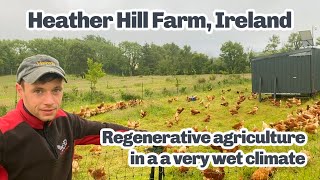
This content was created by Richard Perkins. This content was uploaded by Richard Perkins. This is a YouTube video titled "Regenerative Agriculture in Ireland, Heather Hill Farm with Cathal Mooney" created on June 28, 2022. It features Richard Perkins visiting Heather Hill Farm in Ireland, where he discusses regenerative agriculture practices with Cathal Mooney. They talk about various farming enterprises, including pastured poultry and agritourism, and innovations like the eggmobile and solar-powered milking parlor.
Chapters
Welcome back to another video, folks. It's super early in the morning on a drizzly day here in soggy Ireland and we're at Heatherhill Farm. I've spoken to Kathleen on the channel a few times. Many of you that follow the channel will know who I'm talking about. But we're here at the farm running a regenerative agriculture training.
I thought it'd be great to show.
You around the farm.
Good morning. Tell us about Hell Farm in a nutshell. What is Hell Hill Farm?
Heller Hill Farm is a small scale regenerative farm. We focus on building topsoil, feeding the community and trying to make an honest living doing it.
And what have you got here at the farm? You've got various enterprises.
Yes, we've stacked a lot of enterprises. Our main enterprises are pastured layers, pastured broilers and pastured turkeys. And then we complement that with agritourism. We've got a small beef and lamb herd on the farm and we're milking dairy goats here. And then we've also tried to integrate Soville pasture with fruit and berry production in the farm. So we're biking move our egg mobile this morning. We're on this pasture for two days and we're going to move straight on. This has been grazed four days ago, so it's time to get the. Move. It.
So this winch is connected to the.
Tree right down the end of the line. How, how much does the egg mobile weigh?
I reckon about three tons. With the birds we're on four axles, which is eight days. And that's really important in our context because the ground, we're in mid summer and the ground is still really spongy and that keeps the egg mobile basically floating above the ground. And I believe that's really important in my context.
You're saying the eggmobile you had before is just cutting through the grass?
Yeah. My first egg mobiles I use just a standard like car tire and they're what, maybe five inches thick. And my problem was it would just, it would cut through this top layer of sod and then just the whole thing would sink to the axles. With these flotation tires they just spread the weight evenly and they keep me up even in the wettest of conditions.
So you've got all the battery in.
Eggmobile solar powers on the egg mobile, all the power is coming from the eggmobile and it just means I can, I have a big 120amp hour which is a heavy battery and I can't put that in my mobile, but means I can put a. I've got a 5 Joule Energizer on the end of this which gives me more power for my big fences. We can do this in both the morning, early afternoon. As you can see, we've just joined two pens together here and quite often I'll do this in the afternoon. We'll just simply feed the birds and then you open up. Feed the birds in the new paddock and just roll the egg mobile nice and slowly in and then close up the gate here and we can do it anytime.
So you got this all running off your mobile phone?
Yeah. So I bought just nap my phone which speaks to this box here. So we can, if we can turn on and off the lights, we can open, close the door open, close the nest boxes. And we've also automated the tilt on our nest boxes. And the last thing I want to do, and it just came in the post this week is I want to motorize this belt here and have it on a switch here. So I'm still working on that. We're all working progress.
So here's a view what the eggmobile looks like inside. He's got cameras here so you can monitor the birds from remote. But what you see is they've had to put in a second floor. Same with the boys that we went to visit that I posted on Instagram the other day. And basically the birds aren't using this, but to satisfy the regulators they've had to have this secondary floor that if the birds are kept in for bird flu, they've got that extra space and technically it's scratching space for the birds. As you can see, they don't actually use it. And yeah, those of you that are keeping pasture poultry will know it's a bit of a dance to get around the regulations in many cases. So they started out with Ridgedale Star legmobiles here, but they've had to just adapt to the circumstance, not only of the wet pastures that you get here in Ireland with a couple of meters of rainfall, but also just satisfying the regulators. But Casla's done a super nice job of, yeah, putting the automations in and just getting this to a place where it can be certified for Irish conditions. So catal, this is Egmonbuild 2.0. Give us in a nutshell what you've designed here.
Yeah, so in my context, I needed to get more surface area on the ground, more wheels. I was running two ridge steel style egg mobiles. I wanted to build one bigger unit and I Wanted it to be completely automated and self moving and we've achieved that. One of the biggest things I've done here is I went for all steel construction in this one and that was because I could now afford it and to avoid poultry makes.
And also the longevity, something that's been the case in Germany and here in Ireland is the regulation for scratching space, Right?
Yes.
So you've had to put in the double floors, make a big area.
Yeah. And we're also contemplating maybe doing the section and underneath. At the size and scale I'm at right now, I don't actually need to be certified in this country. And it's something I've just. We designed this egg mobile to have that capacity and we've got those multiple floors to work with and we can meet the square meterage as a big issue in the scratch area, as you mentioned.
So the regulation is about being able to sell to restaurants and shops if.
I'm just selling from the farm gate or direct to the end customer here. And the number of birds I have, I'm basically a hobby poultry keeper. There's quite big numbers before you become a commercial operation. Yeah.
What's the deal with the boilers? You've got these little tripods to keep a net above the fence line.
Yeah, we started this system, more of a free range system. We were having a lot of problems with loitering birds, crows, pigeons, they're coming in, they're eating feed. They're now in the particular when the chicks are much smaller. So we just cover the whole thing with some. It's basically fruit netting and it just keeps them away and keeps the broilers happier, I feel.
So you're not having predator issues with like hawks or anything? It's more sharing a feed with wild birds.
Yeah, sharing a feed and just. I feel like lichenbirds, they can carry diseases and stuff that I really don't want getting in contact with my birds. It. Sam.
This is your little mobile milking parlor?
Yes, this is our solar powered milking parlor. We've got a solar panel on top and a battery there. And we just use little simple 12 volt mobile milkers. Because we're really busy with the training today. We've only actually got one go to milk with kid chair here. So if I want to do something in the morning, if I got to go somewhere, I can just leave the kids on the go tonight. Or if we want to milk, then the kids go into this pen in here and they stay in here at night.
So cattle's put little wind Netting on the side of the turkey mobiles, the gobbledygos and parked together, that makes a decent bit of shelter for them. These are just pasturing, following behind the goats and the cows. So you got a little 12 volt milker from China.
We can actually run two here together and both sides and very straightforward. It'll go better if we have power with goats. Goats want to chew in everything and typically the milk and stanchions in the paddock with them. So I keep everything locked up in this little toolbox because they love to chew and investigate power. These are pulsating machines so they mimic the kid sucking on the teat. You can see now our multi starting to come. I'm just going to pop it right into our yarn here and then we can take this straight in and decant it and get them all cooled down. Now.
Ireland is full of super overgrazed paddocks, super wet soils and sedges. And it's amazing to see what difference has been made through the power of chicken and through planned grazing. The pastures here radically improved to what they were when cattle started. And I think it's a lot of hope here. A lot of the farmers on the training here are into grazing of beef or sheep or dairy cows. And there's a lot of hope for restoring the paddocks around here. But Ireland as well as parts of the UK just really over grazed and time honored traditions. This is how we do things. The pride and arrogance that keeps going through the farming community of doing things like a grandfather did essentially, but super overgrazed when you drive around this landscape. So really refreshing to see the changes that have happened in the past years here.