REGENERATIVE AGRICULTURE WITH CROATIA'S PIONEERS (Bio Zrno with David Pejić)
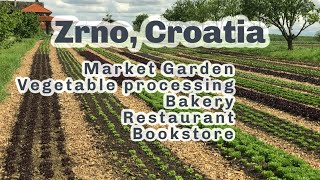
Long-form interview and on-site tour (host Richard Perkins interviewing David Pejić) of Bio Zrno — a multi-activity organic/regenerative enterprise in Croatia. The video documents the family business history and evolution (book publishing, retail, wholesale, bakery, restaurant, education), the farm’s dual production systems (mechanized 10+ ha field production and a 200-bed bio-intensive no-dig market garden), equipment and workflows (propagation, transplanter, plastic-mulch machinery, Teratech Culti-tractor, custom bed-laying trailer), processing and product lines (tofu, seitan, sourdough, fermented goods — ~800 loaves/day, >100 products), staffing and scale (≈200 employees across the group; ~28 on-farm, 11 restaurant), crop rotation and yields (5-year mechanized rotation; ~160 tons total planned production), and strategic challenges (organic-certified compost sourcing, labour allocation between systems, building upgrades).
Chapters
So I'm here with David Page in Croatia and we are just about to run a conference and workshop here in Croatia in the capital. But we're here at the farm and we're going to have a look around and talk to David about the very interesting situation that they have going on here in Croatia.
So I just want to make a quick interlude statement at the start of this video. Forgive my nightgown, but it's hard to get a video like this together while I'm on the road. It's over an hour long and it's characteristic of the long form videos. I want to spend next summer shooting around all the most epic farms in Europe. I think there's a real need to shine a light on entrepreneurial young folks here in Europe. Many of us look aboard to America and places and I think there's so much going on here and it needs to be highlighted and people connected and networked together. So I'm spending a summer touring and taking some rest from the six, seven years of intensive work I've been doing at our farm to really document that and share that with you. So we've had a really nice time here in Croatia so far. Yesterday we had a conference which I keynoted at with some politicians speaking as well as the ambassadors to Sweden who attended and lots of farmers and people connected through the networks here. And it was a really great day. Today we have got a four hour workshop on no dig market gardening, which I'm super excited about. And this video is basically shot with David who, it's got to be said, it's his parents who have built up the complex businesses that you'll see in this video over the last decades. And David's remarkable young man who is taking full responsibility and stepping into the businesses as his parents begin to step out, I gather, and that's amazing. Most young people shy away from such high level of responsibility and I admire and have a lot of respect for David. He's got a very balanced and measured view on the whole thing and is, you know, really a pioneer as well as his parents pioneering work here in Croatia. So it's a very long video but I think there's a lot of great stuff in here and a very unusual farming scenario.
So I hope you get a lot.
Of value from the video.
So David, we're at your farm and maybe you can just introduce for the viewers you're sort of stepping into your family business that's been built up since you were a child here and maybe you can just outline it in a Nutshell, what your family have built up and what you're sort of stepping into.
Yeah, so my parents started in the late 80s, early 90s with macrobiotic education and activities, general environmentalism.
They're kind of pioneers here, right?
Yeah, pioneers in this area, former Yugoslavia, today's Croatia. And so as they were doing these activities and educating, they sort of out of that initial activity, other sort of businesses sort of developed. And this included a book publishing company with a bookstore, a wholesale distribution of organic products and also retail of organic.
Because they, they kind of been promoting macrobotics and then there wasn't really access to those.
Yeah, they would say like, you know, like eat organic brown rice, but there was no in order to buy brown rice so they, they would import it.
And that's how the, they sort of accidentally stumbled upon.
Yes, yes, precisely. Accidentally stumbled upon, you know, commerce business.
And so where's it at today? You've got shops around Croatia selling organic whole.
Yeah, we have 16 specialized organic food stores across Croatia which for Croatia, which is, you know, only 4 million people is a decent size.
Yeah, yeah.
And we have a, you know, a wholesale distribution company. And we, we are pretty much in the center of the organic market in.
Croatia with those activities. And then from this farm, this farm's also got a bakery. You make seitan and tofu from the crops you grow here.
Yeah, yeah. So yeah, to the portfolio of businesses, we added this farm in 2010 and we started it as a model farm to one extent, but also as a support to our other businesses and a competitive advantage as well. So the Zirno farm, this farm farm, which is an hour away from the capital, it has four types of production, the bakery production, the processing, the field production, or just crop production. And it has a farm to table restaurant which is in the capital.
So it's a complex business that's built up over many years of just circumstance.
I guess all across you could say that it's like it's a middle sized business in terms of actual revenue and employees, but it's a huge business in terms of actual different activities. It's a lot of activities in one medium sized sort of business.
Yeah, there's hundreds of employees, right?
Yeah, we're about 200 right now.
Yeah. And you've grown up with this business since being a child. You were just talking about being three and packing whole foods into consumer retail portions. So I guess you've got your head around the whole thing and, and you've kind of come back from you were in filmmaking and studying different things and you've come back to set up a bio intensive element to this farm that we can have a look at?
Yeah, exactly like it was. You know, I was encouraged to go in, you know, any direction that I saw worth pursuing. But ultimately always knew that the setup of businesses and the context that we have here in Croatia was so unique that it would be an incredible shame not to push it forward and pursue it. So at the bottom of my heart I knew I wanted to come back and help develop it. And at that point when I did, it was very clear that the farm needed most of my time or most of my input. So that's how I got here.
It's pretty interesting situation folks. And something that's really fascinating is not only are you folks seem to be right at the heart of pushing these things like you bought Jean Martin Fortier here last year and these guys are really pushing the movement here, but also you've got this incredibly interesting dynamic here at this farm where because of the output of the farm to wholesale and retail, to all of the shops and the bakery, etc. They're doing mechanized production on field scale, but also biointensive on the small scale. And that, that's a bit, a lot to take in because they're two very different systems that have a tension between them. But it's something that you enjoy the challenge of and uniquely posed to find answers for. And so I think it's good if we have a look around those systems here and talk about that in detail.
For sure.
This is a propagation space and you're just about to double the size bit. But you're propagating both for the bio intensive gardens and for the field.
Yeah, we grow all of our transplants ourselves. And this is our relatively new nursery. We're still putting in the heating.
We've got a heating system up here.
Yeah, it's. It just needs the electrical work done.
But this is a sweet. It's a double skinned. Yeah, double skin with tunnel with really nice hanging propagation tables.
The team had a concern about the, the uneven terrain and then we, you know, decided to go with this sort of hanging bed system. And we didn't really have. We just sort of tried it out and it worked well.
It looks awesome. It's such a nice setup. Tell us about your propagation benches. These look awesome.
Right. So we wanted, we wanted an area where you know, the team could see the trays in. You know, it's a low budget system, but it has like, it has a line, it has a flow. Right. So the Substrate is put here on this platform, right. And then it's from this side over here. This opens up, right, and sticks here. And then with the trays, the system fills. There's two rows of seven trays, and then it's. The substrate is just scooped on top of those trays. Then once, you know, that batch is full, it goes to seating over here. This is still not done. We need like a vacuum seater over here. So we're waiting for that.
This is how you shout orders.
Yeah, that's team management skills. Anyway, once the trays are seated, they're covered with the top layer of substrate here, here, and then pushed with that tool over there, pushed to the other side of this plastic film for watering. For watering, yeah.
That's a sweet setup.
Yeah, we, we. Well, credit to. To Michael Kilpatrick's video. We. We were inspired by. By a farm that he visited. So.
Yeah, yeah, it's a very nice setup. So. And so you've got this space and you're about to double it in size and that will be enough. Just give the viewers a numbers of, like, the fuel production and the biointensive production.
We have 200 beds in the market garden, 10 hectares of field production of vegetables, and we grow all of our own transplants. So that's, you know, just for cabbage. That's 20,000 plugs, you know, and so basically we need double of this just to have a space to put it on, you know, organized, and also to irrigate it, to water it. And with these. Actually, you know, there's. There's a slight concern about space usage with these hanging beds, but what's good about it is that you can just run irrigation easily for watering of the transplants.
That's a really sweet setup.
Glad you like it.
Someone else was farming organically here before, right?
Yeah, the ladies that started the farm with her partner. She was also a pioneer of organic in Croatia, and she started the farm also in late 80s, early 90s. But yeah, in 2010, she contacted us. You know, she. We had a collaboration with her throughout the years and she knew that we would be the right ones to take over.
So the buildings here a little bit run down. Then there's plans to have to reinvest here because we've got the bakery in the building behind this one and then some farm storage. And this is actually where kimchi and a lot of processing happens because a lot of the veg you're processing to then go into the stores and restaurants.
Yeah, we have a range of naturally fermented products that we distribute to those channels.
So you're basically saying whole vegetables and then bakery goods. Bakery goods with vegetables, like sandwiches, you've got seitan, you've got tofu, you've got like a whole broad range to supply your shops and restaurants.
Exactly. What we really, what we're really into is this idea of like end to end control with, you know, growing a crop. For example, a great example is soy. Soy we grow in our field production. We turn that soy over there into tofu, that tofu goes into sandwiches that go to the stores or the tofu goes to the restaurant. And we have many examples like that, you know, with the grains and the flour and the fermented foods and so on. Many examples where we really try to. We basically take a crop through multiple stages of production to really deliver a special quality to the.
It's complicated, isn't it? You got 20 hectares here and how many people are working here and what's the division of their roles?
Yeah, so there's 28 people working on the farm full time. Seven are in crop production, about three to four are in processing and then the remainder. So around 15, 16 are in bakery and administration. And then the restaurant in Zagreb has 11 people there.
This is tool storage. Maybe you can walk us through the basic setup for your mechanized. So you've got. So most of this farm is under mechanized production. So tell us a bit about the toolage and pros and cons of working at that scale.
Yeah, so, well, if, you know, actually if we, if we start with primary tillage, you know, we have a plow over there and it's something that, you know, we really tried to get away from. We are fully aware of all the negative impacts of plowing, but unfortunately we had issues of, you know, we bought a chisel plow to replace it, but we couldn't replace plowing in terms of incorporating massive amounts of green manure into the soil. And we wanted to do green manure obviously for all of its benefits, including, you know, coverage over the winter. So in terms of primary tillage, we still do plow. We try to avoid it in certain circumstances. For secondary tillage we use a power harem, a regular tractor pulled power harem. And then we have a plethora of different types of tools.
Maybe give us a quick intro to what they, what they're used for.
Yeah, so this here is, you know, it's a five meter wide tine weeder for blind cultivation. I'm sure people are familiar with how it works, but, you know, it's just, it's great for grain production and soy and anything actually that, you know, you, you have time to use it on. This actually is a plastic mulch lifter.
So you're doing a lot of plastic mulch rows for organic to avoid chemical use?
Basically, yes. So most of the vegetables on our field mechanized production, we grow on plastic mulch. So over there on the other side we have a bed lifter with a plastic mulch layer and we have a transplanter for the plastic mulch. And then this is the third machine in that range where basically when the harvest is over, it helps us get the plastic out of the ground. This is like an inter row rototiller. It has a good use for row crops. The trick about it is though that it, since it know, shallowly turns the soil, you know, you, you don't really, it, it pulls the weed seeds back out, but it's good for cleaning up in between row crops. This is a star potato cultivator that you know, really works well with making those ridges and it has a, and has a tine weeder for the row. So it's a good combo for that.
This is your homemade flame weeder?
Yeah, that's a death star. Could have used the paint job, but yeah, I mean it's a homemade flame weeder that we use for our mechanized root production. So it helps with pre emergence weeding. These are one of our newer equipment acquisitions. It's Teratech Culti tractor. Basically it's what they call like a belly mounted. It has a belly mount and the point of that is that you can add cultivation tools or attach cultivation tools underneath and in front of the operator, which really allows you to cultivate very closely and precisely. So with the cultivation tools that we also bought with this tractor, for example, for root vegetables, we can cultivate up to a 2 centimeter strip which we, you know, we suppose will help us a lot next season. And we also got a solution for cultivating in between plastic mulch rows.
So you can keep it weed free.
Yeah, keep it real. It's a special set of brush hydraulic system and we, you know, we're really putting in a lot of, you know, a lot of hopes that this will help us with the field challenges.
And it's got a lot more sort of visual control now. Like you can see a lot clearer. Yeah, yeah, it works more accurately.
Exactly. We also got like a finger weeder cultivator for really we think like it's going to help us a lot with cultivation especially. The problem is that we really don't unfortunately don't have enough seasonal workforce available, you know, to you know, get 30 seasonal workers and have them, you know, hand cultivate like a huge field, you know. So we, we hope that this will lessen the need for such endeavors. And we also got a cedar for it. So it's a whole system that will improve our production next year. So for the plastic mulch and raising the bed, we use this machine. So it raises the bed, lays two drip pipes, lays the plastic mulch and incorporates manure all in one pass if the soil is well prepared. So it's finicky but if it works right, it saves a lot of time. And then over here we have a two row transplanter directly for the plastic mulch. So two operators with the seedlings on this sort of platform.
And what sort of you're doing like how much produce are you producing? Just to give us a rough idea like in tonnage.
Yeah. So in tons, our current plans we, we go for total of about 160 tons.
Yeah. And what's your growing season like for viewers that are not familiar with the climate here?
So we, we. Our growing season goes from like basically March till October. So sort of like these days the winters are so mild that, you know, some season extension is easier than ever. But generally speaking, especially when it comes to field production, that's the range. So we're at. This is our little sort of experimental shiitake sort of plot. We. So this part of the woods is ours. It's adjacent to our mechanized fields and we have about five or six generations of oak logs here right now. And so it's, it's not a huge quantity of shiitake during the season, but it's really cool for our restaurant and sometimes for our retail stores. So it's. And it's also like, it's a nice sort of point for the, you know, for like farm tours and so on. It just brings, breaks the rhythm a little bit of just like field production and so on. Say it.
Yeah. Tell us again about the like how, how is it actually operating on these Mechanized plots, rotations, etc.
So the mechanized rotation is a five year rotation and the, the five plots are all about the same size, between 1.8 and 2 hectares. And then we rotate so five groups. We do rye and spelt, we do soy and corn, we do root vegetables, nightshades and then cabbage. And so we rotate those on the mechanized plots.
This is going into the restaurant, but also the.
Yeah. For example, rye and spelt. Rye and spelt we only use for our own flour for the bakery on site bakery on the farm. The soy we use for our own tofu production on the farm. The corn we only pick when they're at baby corn size for pickling cabbage is used for sauerkraut. Roots are sold wholesale to our main company or the parent company. And then most of the nightshades like peppers and eggplant, they're also used for, for like processing. We make like a, like the local sort of. Aivar is the name of the like the spread that's made out of it. So yeah, most of the mechanized produce is used for other types of production. So with the two systems of fuel production that we have here, there's obviously like some tension because, you know, the practices and the mechanized plots differ greatly from the bio intensive. And actually it sort of really tells a story of how we even got to the point where we wanted to build a bio intensive garden. The thing was that, you know, we were trying to incorporate as many regenerative practices into the mechanized production as we could. But we basically, you know, we hit a wall of a sort when we really started getting our green manure practices like to the, to the highest level. And we just couldn't combine that effectively with like getting rid of plowing or generally conservation tillage. Not to say that there aren't ways to do it or that there isn't equipment to do it, but it was either, you know, something that we couldn't afford or we just cut, couldn't get to the right level that we needed for, you know, raising beds mechanically, you know, and so on. So basically like you basically had to.
Rely on the plow more than you would like to.
Exactly.
To plow on the green manure.
Exactly. We, to turn in the green manure. We just couldn't find a more effective way for us other than the plow. And it's really, you know, but we are conscious of the, you know, the destructive force of the plow. So thinking, thinking about the needs of our channels and thinking about our soil health, we were just like, let's just, you know, start a new production system, you know, the bio intestine system that with the compost layering method that will allow us to, you know, get away from plowing at least in one aspect of our production.
Right. So that's this no dig beds. Tell us a little bit about this, David. Like how many beds and what sort of areas under no dig over here.
Yeah. So we're right at the edge of our no Dig bio intensive garden. And then right here we have one of our mechanized plots. So the, the bio intensive, the no dig garden has in total it has 200, around 200 beds. And out of those 200 there's 168 that are outside, so not in the greenhouses. And they're organized in 14 blocks of 12 beds. And those are 30 meter lengths. So 168 beds of 30 meter length. And then the ones in the greenhouses are somewhat shorter, maybe 22 meters. And we have a herb garden that also has non standard lengths. I mean it's like a really good drainage here.
Yeah, you were saying that in the, in May this year it was.
Basically rained the entire May. And the forecast for like the general, you know, farming season in Croatia was that it was going to be the worst year in like 10 years.
You had a lot of field crop failures.
We had a lot of field crop, the mechanized crop failures or underperformance. But it was really incredible to see how during that May and during the entire season like this market garden was just incredibly resistant to those conditions.
You can really see here how the wood chip just acts as a sponge.
We had a month of constant rain and the workers, you know, there was no way that the tractor could even approach the field production. While in the market garden here on the wood chips, like the, the workers would, they would just work in like their running shoes like it was, they wouldn't even need boots. Boots. So it was just an incredible contrast. Like, you know, like while everyone else was, you know, they couldn't do anything in their fields, including our field production, this production was just operating normally. It was really, really great to see.
Something I've been speaking out against in the market gardening scene is the use of like big tarps and flame weeding in vegetable production. Because I just cannot subscribe to the idea that that is good for soil care. You were saying when JM was here, he was asking why you have these individual bed covers and. Yeah, what's your thoughts on that in some way?
Like obviously covering beds individually is far more work than just throwing a silage tarp over it, especially with all the pins that you got to put in. But we realized that both have a use in our system. The individual covering is a far better winter prep because once the snow starts melting or it just, you know, starts drying out in the early spring, if you have a, if we had a tarp on it, there's no way that you're moving that huge tarp with all the water on It. But with this individual covering, it just drains. Or the wood chips just retain all.
The water and you can really. It allows a whole lot to breathe. I always think of big tarps, like if I wrapped you up in plastic, there's no way that that's the only.
Time when we use the. The silage tarps is in like the height of the season. Because. Because we either don't have the time to cover beds individually or it's just if we're, you know, if we just want to cover something for two weeks before the next succession, we just do that with a silage tarp. And it also has the added benefit that in. In for us, in our conditions, at least for now, in the height of the season, there are some. There is an increased weed pressure even with the wood chips and everything. So a silage tarp helps there just to sort of. But only, Only during the height of the season.
So this is the wash pack space.
It's just the wash house. Yeah, that's one of like we then take it to another building to pack it and store it, which is not really efficient. But unfortunately it's the way it is.
Right now with the building set up.
Yeah. Because all the. None of the facilities were purpose built and so they were retrofitted to the best of the current ability. But obviously that results in some inefficiencies in the setup. But we'll get around that eventually as.
You start to build. So you just got bubbler and spinner setup?
Yeah, yeah. Just one bubbler here, a spinner that actually, I don't know, those vertical washing machines are not so common.
That's an American thing. Yeah, yeah. So what's this is it.
It's a.
It's industrial.
Industrial. Yeah. It's usually for kitchens.
Yeah. So that's a good option for folks. It's Electrolux.
Yeah, yeah, yeah. I mean, it's a bit, you know, it's a bit pricier, I guess than a retrofitting something.
But, you know, it comes, it's industrial and it's gonna last forever.
Exactly fits the regulation. So extra basket for that and then we. For these, we have these. It doubles up as a drying.
That's pretty sweet. Are these custom made?
Yeah.
That's very nice.
So two for each sink.
You know, it's really nice because chicken wire just doesn't cut it really. Like this looks way easier to clean and way nicer particle size.
Exactly. And one thing that it's also the. The sink is too wide. If you have your bed or like Your, you know, basket or it on this table. Like you actually want it. You want to have your gun here and then the basket here. So it's like everything's close. It's these really help. And you can also double the double double. Use it as a drying table. So the word. And these for picking the salad mix and stuff.
Nice. So tell us about the tools that you're using for the. The bio intensive guns.
Yeah. So this is our tool set basically. So we use these broad forks for aerating. So these are glossier, they're somewhat narrower than I guess, you know. Usually you see them like this.
That's a metal creature one, is it?
This was actually built by a Croatian guy who started starting to make them and sell them. So he gave us one to test it out. We haven't really gotten to it yet. But why we like these is just because the handle is more ergonomic so you can actually apply force down. You know comparing it to just the side pressure and it goes in easier just because the surfaces, the surface of the tines is small. So we kind of like those then.
Pretty standard kit for weeding rakes.
Then this is right, the 74 centimeter.
This is a griddle you've got.
Yeah, that's the three row gritter. We have a four row as well. Just we made those.
So you made them up for marking up? Yeah, transplants.
Yeah, yeah.
It's really quick using a five row Jang. Is that your primary cedar?
Yeah, we were, we really sort of, we were researching it for a while. We thought about getting the six row cedar, you know the one from Johnny's. But supposedly that's really finicky. And then when we realized that we could fit five rows on the triple jank, we figured that would be the best. And it really works really well. We don't really have a need for any others either.
So these are from Teratech?
Yeah, they're from Teratech. 75 centimeter wide. They work great. But there's a bit of a efficiency problem where the things that you want to use them for like I don't know, like direct seeded, like small salads, like greens, like I don't know, arugula or whatever. Like those are also the same crops that you want to put the anti insect netting on and then you put the hoops. So if you do that, those hoops get in the way, you know. So it's like sort of you got to find the right timing so you don't really complicate your job.
I gotta Say David, wherever I go, I'm glad that I don't have as much. Much weeding. Yeah, I mean we don't really, I mean this is the extent of our weeding tools and we basically don't get them out.
I mean we, we don't either to be honest. Like it's usually when, when like the team goes to do some weeding, like the wheat pressure is just so much reduced to that extent with the compost and everything that they just go in by hand and just like go really quickly.
And green sums too.
Yep, yep. Works well. Just I guess, you know it's, it's fast and convenient but just you know, I guess there is a bit of a potential back pain involved but you know it's, it's still a great improvement.
The ergonomics of it from bending over.
The guys told me that they're working on a push version so like a standard standing push version.
So I think that would be nice.
Yeah.
This is a cool dipping tool with heavy metal rods for putting in things like garlic or onion sets.
Leeks. Yeah, Correct.
That's a homemade one as well.
Homemade as well. We have two like it. We have two maintenance guys that build everything.
So in terms of the, the bio intensive no dig setup, the tools are pretty similar to everyone will be familiar with for market gardening. But then you've made your own compost and wood chip application.
Yeah. This has been a lifesaver.
I love it.
Because we had to, you know, we, we basically decided to build the 200 beds in one go and it, we started manually with the carts and everything. But it just wasn't working at all. I mean it was, but it was very slow.
But this thing is ideal. So you've set the wheel spacing up straddle the bed.
Yeah, exactly. The, the wheel spacing straddles the bed. Doesn't touch the, the bed at all.
And then you have a small wheel based.
Yeah.
That can pull it over the path.
Kubota sized tractor that, that pulls it and so we fill it. If we fill it with compost then we use these doors to, to lay the compost directly on the bed.
And then you can side loaded for wood chip.
Yeah. And then these are for wood chips. So actually this door opens.
Awesome. So you basically have someone in there just shuffling out as you go along.
It's a three person operation unfortunately. One person to drive the tractor, one person actually has to be inside because once the, the, the trailer starts emptying out, someone needs to shovel the material out and then one person and spreads it onto the. Either on the side or the bed.
I reckon you could market these if you can make them up.
Probably. Yeah. I mean they really helped us a lot. I think, you know, like it especially with the, with the wood chip application for that. It's really, really quick because those are just, you know, dumped into the pathways and that's it kind of Cool.
So this is a map of the farm.
Yeah, this is the central farm area.
And we're in this building right here. Right here, right here. So, and so out the window here, this is the biointensive bed. So you can see with the green houses, maybe you can't see, but they're just down here.
Yeah, exactly. And then these 5, sector 2, 3, 4, 5 and 6. Those, those are the field crop or the mechanized rotation.
We're going to zoom in of all the different.
Yeah, that's zoomed in of the bio intensive.
So here's, we're upstairs, right there. Bakery.
Yeah.
And then we have the, the basic buildings here for storage and veg washing and packing.
Exactly.
And then over here we've got the crop rotations. So this is the field blocks, right?
Yeah, yeah.
Can you explain the colors? Because we won't be able to make out.
Yeah, so the, the brown is the roots, the yellow is the nightshades, the. The sort of purple is soy and corn and the blue is the spelt and rye and orange is cabbage. So basically. And throughout the years you can see rotating them. And then after each of the cash crop, we either have green manure, which is the green, or the sort of after the cash crop, one one field is under the daikon cover crop. So pretty cool.
We can go downstairs and see like they're making their own tofu and seitan here. So we can go and see some of those pots productions. And then this is a more standard market garden.
Yeah, this is, this is only throughout the years, just according to the blocks. We obviously have like a crop plan for the actual year because there's obviously more successions.
So you guys have about, you have 200 beds, 30 meters long. So that's four and a half thousand square meters outside.
Yeah.
Plus a bunch of these tunnels.
Yeah.
So, so very familiar style that you folks will all be familiar with with 75 centimeter beds and wood chips in the past. And one of your big issues has been getting compost. You're saying Croatia doesn't have compost?
Well, Croatia has compost, but not of the. We call it the first class that's allowed in organic.
These Guys are organic certified, so you need to have. There's special requirements with heavy metals and all that stuff.
Exactly. And unfortunately the closest source of that type of compost is Austria. So we buy it from Austria.
So this has been brought in for now and there's scope to make it here on the farm, but that's the next step. So you guys are doing like tomatoes, cucumbers in the summer months and then it goes through salad. Can you grow all year round in here in this?
Yeah, yeah, we grow all year. We sometimes add extra covers, row covers, but we do grow it's 7 meters wide by 22.
So these are. You're saying they're about €2,000 here locally?
Yeah, yes, about. About 2,000.
And that's a really nice tunnel for the money.
Yeah, yeah.
So, David, you've got 200 of these beds.
Yeah.
And many hectares of field production. And a lot of people would say that's quite an odd approach to have to have mechanized field production and a bio intensive garden.
Yeah.
And what's your, like, what's happened here? Like, why have you started this up in this way?
Yeah, well, we basically, when we were trying to improve our mechanized production, which was at the time the only production that we had, we ran into, well, two biggest challenges. One was that we weren't really happy with the regenerative rhythm of our soil health. Right. So we couldn't get rid of plowing in the short term. So. So there was a problem there. And then the second problem was that we were just becoming more specialized slowly in terms of less diversity of crop variety. And we had our channels, our stores and so on. They needed more diversity throughout the year and at regular intervals. And that was just something that we couldn't do on mechanized. Mechanized was great for like single time, big quantities, but not for like, you know, 10 different varieties.
Salad.
Yeah, exactly.
So you've come back into this with a kind of different. Like, is it you that's brought the sort of small scale bio intensive stuff?
Yeah, yeah.
To your father and family and.
Exactly. It was basically we were. I was trying to solve this problem and then. Then I ran into the, the whole market gardening movement. And then when I brought it, my dad and I had a lot of discussions about it and then we researched together, found out about your farm, of course, and then I sort of developed a plan how to implement it and we. It took us a year to build a garden.
Yeah, it's. You can definitely see having that little cart is super handy for moving material on this scale. And 30 meters seems like a good bed length. Are you happy with that?
Yeah, it fits well. It was the perfect fit for this area that we wanted to have the market garden on. When we drew it out it was just the best way to go around it. Although I think, honestly I think, you know, 10:20 is also fine.
What about the, like. I think some people find it odd that you have this two systems going, but I think it's also very interesting learning opportunity. And like, like what's your. Do you think you'll keep doing this approach with field crops? Because it's obvious that the field crops are necessary at scale for the elements of your business. But this complements it very well. But is it, does it mess with your brain too much having these two things or is it, do you find it complementary?
It is, I think it's, it's definitely the two systems are complementary in their output, but they are sort of. There's a tension in, in just in terms of operations especially since I don't have like a dedicated team doing one and the other team doing the other stuff. It's the same team has to sort of find a way to accommodate both systems. And that's tricky because sometimes you know, like you, you need to really cultivate something in the market garden. But at the same time there needs to be transplanting done in the field crop. And the problem with the transplanting in the field crop takes two days even on the transplanter. So it's tricky just sort of basically delegating the workforce to accommodate both.
And I guess it's a unique problem that you've come up against to, to partly like the labor market here is like a generation ago. A lot of people worked small holdings on the land which has been lost in a generation quite quickly it seems.
Yeah. And we have.
But you've got mainly older employees, right, who have mainly traditional ways of thinking.
Yeah, yeah, yeah, mainly older employees. But it's not their age that's the problem. They're very hard working, great people. It's just there has to be some time for them to learn these new.
Ideas, new methodologies and approaches.
But I'm very proud of my team in the way that they have helped me build all of this and the way they've turned it into something that's, you know, a pioneering project here in Croatia.
Yeah, yeah. It's awesome job and it's amazing what you've put together here with these beds. And do you think that having run that now the like, it's obviously more human input per you know per unit output compared to doing things in a mechanized way. But do you still does that? Like where's your vantage point on that? Do you still think that they are necessary complementary things? The value of the produce coming out of here makes up for the higher labor input?
Yeah, absolutely. Because it's just, it's almost like. It's like the two systems have their weaknesses and strengths in completely different parts. And for example, in some terms the market garden is far more reliable in consistency in its resistance to weather conditions and so on. While if things go very well in the field crop crop mechanized production, then you get like huge yields at once. So again what I mentioned this season has been such a great example of the contrast where we had a lot of rain in May. Big challenge with that. And because of that rain there was no way that the tractor could go into the field mechanized production while at the same time during that rain the market garden there was no delays because of the system with the wood chips and the compost. The, the rain did not interfere. And because there's no need for a, for a tractor to go in, you know, my, my team could just walk in with, you know, with just running shoes and no boots required.
They can just clean working environment straight away. Same. It's exactly the same conditions that we've experienced at our farm. And we were just at Jasper's last week doing the same. You see, it's the end of the season now, so most of the beds are covered up here, but it's wet. I mean if we dig down under here, there's a lot of moisture under here. But this just keeps it workable and keeps the soil protected and intact.
And there's another, another cool thing where there's a difference between the mechanized and the bio intensive is that you know, at least in this area, the, you know, running, operating the tractor and you know, running machinery has traditionally been like a, you know, job for men. Right. So it's sort of, it's sort of. There was a bit of a gatekeeping thing, you know, where like female workforce couldn't really, you know, autonomously work in, in that type of production. Well, with this type of production that's not the case and it really sort of democratized the entire production. It's a subtle point, but it's an important one. It's an important one and it's really the moment when you see your workers realize that their actual hand labor is and can be efficient, which is the case in the bio intensive market garden system. That's such an incredible Turning point. Because, you know, like, after seeing them for years struggling in these huge fields where their labor doesn't really make an effect, you know, switching to this intensive system where every single movement that they make has a direct, you know, effect and is efficient. It's a beautiful thing. Really. Really.
It's empowering, no?
Yeah.
Lifts the morale.
Yeah, yeah, exactly. It really, you know, lifts the energy and. But again, for us, for our context, we're definitely going to pursue both systems and we are excited to see how the interplay between the two develops.
I think it's going to be super interesting for your learning also.
Yeah, of course. I mean, it's such a unique circumstance to be in.
So obviously it's end of the season, everything's closing down. There's not so much to see out here. But we could maybe have a quick look at the bakery and processing rooms and see what's going on there.
For sure. It wasn't so, like overcast. Everything kind of looks. So. Yeah, we have. This is where we do our. In this area here, we do a lot of our sandwiches and Ready to go. Ready to eat salads. Right now they're doing a catering setup. And in the area over here, we have our pastry production. 24 different types of, you know, different types of sweet and savory pastry.
So it's very specialized, like a very high level of diversity in products. Because you're catering for your outlet.
Yes. Since we distribute exclusively to our own stores, we basically have a lot of products in small batch quantities. So they're all sort of artisan and all certified organic, naturally sweetened vegan. All of our products are actually vegan. So it's this sort of artisan approach where we supply a large range of products in small quantities.
Well, as someone on a carnivore diet. Must be weird coming into the thing, but it's pretty cool. You guys make your own tofu?
Yeah, that's our own tofu from around soy seitan.
Super cool.
We do smoked versions as well. And so those, they don't go to the stores as a final product. They're only used in our other products at the restaurant.
Like sandwiches.
Yeah, yeah. So we have actually quite a lot of those in between products that we just make for ourselves, which, again, it's a huge advantage because no one can recreate the taste of those products because it's unique blend that we put a lot of effort in.
Super cool.
This is just the area that we do a lot of our processing and natural fermentation, jarring and so on throughout the year.
Actually, you said it's over 100 different products that you make.
Yeah. When you combine all the, you know, the bread, pastry props, dishes at the restaurant, it's over 100 certified organic products, which is quite a lot. Right here we can see like fresh loaves.
You only make sourdough bread?
Yeah, only sourdough. Our starter has. It's been like maybe 15 years old now. So it's quite a distinct quality.
It's quite an asset.
Quite an asset, exactly. Right. So this is the way.
It'S hot in here and it smells good.
The guy's working hard at it. It's all, you know, with this type of sourdough bread, it's all the. The human touch really makes a difference. Right. So it takes a lot of care and a lot of knowledge to make a good product. These are some fresh loaves ready for distribution. So about 800 pieces of bread daily. Right here we have the preserved fermented products. So sunchoke, you know, pickled cucumbers, different types of those, vegetables ready to eat, salads, muffins, so all types of pastry. Savory and sweet sandwiches in the back. And then the bread over there with 12 different kinds. So all of these products are made here.
They're made different shops. For context. The wash pack station is behind the bakery here and then veg comes to cold storage here and is packed. But the packing is quite different to most market garden scenarios. It's packed to different shops and restaurant. But part of your rebuild, when you rebuild these buildings is going to be making a more linear workflow for all that.
Obviously we want one facility that has a linear stream of, you know, just flow and where, you know, product goes in, product goes out. Right now it's a bit all over the place, but we make it work.
But you like your production in a way can't stop. So you're thinking you, rather than replace the buildings on their current footprint, you'll rebuild and demolish, as it were.
Yeah. The idea would be, when the funds are available, we would build new facilities and then sort of retire the old ones.
But still at this farm as a sort of hub of operations. Sorry, it'd still be based at the farm here as the hub of operations.
All of the production activities that we do, their value comes from being on the farm and made from the farm's ingredients. So it, it doesn't exist without the farm. It's farm based all the way.
So it's sent to Zagreb. This is one of the stores. Is this your Flagship store.
Yeah, it's. It's not the biggest in square meter, but it's flagship in terms of location. Right in the city.
Center city.
Yeah.
Yeah.
And it also has this. Only two of our stores have the. This cafe area, which is also stacked with the products from the farm. So all of these.
This is from the bakery we were at just earlier today. It's pretty cool. These guys are basically representing. Most of you in Europe are familiar with a lot of these products, but they're the only people in Croatia selling. It's cool. It's just. We've just come from dinner with your mother and father. These guys are. They're vegetarian, essentially, and macrobiotic. Yeah. So I've just had some wagyu beef, which is amazing. But no one sells good meat in this country. It sounds like.
Seems that way to us.
There's just now two producers of organic eggs in this country, and there's no. Like, a lot of people have connection to the countryside, so they have access to sort of backyard sheep or pig or whatever.
Yeah.
But the scope for young farmers doing high quality meat, I think. Cool, Cool, dude. It's cool to see that, you know, you guys created organics in your country.
Yeah. This is where the, like, this is the bread stuff. So basically the brand is just this leaf you see here. So everything with that leaf is from the farm. So the preserves here and all the stuff in that fridge that we passed.
So.
Yeah, around 4,000 products in total in the stores, and over 1,000 of those are Croatian.
Okay, so just around the corner from the shop, this is. Tell us about this. This is the educational institute that you set up.
Yeah, this is Makar Nova, the education institute, the brand under which my parents started their activities way back. This is Tamara.
Welcome.
Your contact.
Thank you.
I'm Tamara. I'm person behind all those emails.
Ah, okay, I see. Oh, look, there he is.
Also here, the things. Yeah, this is a, like a publication that we do and distribute in the stores and all of our business venues, which sort of. Because we have a lot of activity going on all the time. So this is sort of like for our customers, wherever they come from, to sort of see what's going on in the, you know, throughout all the business.
Yeah, yeah. So this is a space used for, like, your parents built it up for like, it's bringing their educational stuff, but now it's branched out into.
Yeah, yeah. It can be like rented out for activities.
So it's being used for yoga right now.
Yeah, yeah. And there's also. We use it also for in house training. So all of the retail staff and all of our staff generally has to go through education programs here. So it's also an in house training facility.
Okay. And tomorrow we've been emailing you. So you, you're the manager.
I'm a director of educational institute.
Yes.
And I'm in charge of organization, leading the team and making the program.
So thanks to you a lot. Thanks to you that I'm here.
Yeah, thanks to Zlatka was the one.
And then David, what are all of you.
Yeah, so I was organizational support.
Yeah.
And this is where we'll be for.
The workshop on Saturday.
You can see part of the hall.
Cool.
Let's go here. So we can't open it to see the full space, but it's. This is the smaller part of the hall.
It's like a double sided.
We will open this part and actually you will stand on the other side because it's much nicer.
So this is what this is.
So this is part of the education institute. Just a small sort of demonstration kitchen for different types of workshops. Cooking. Cooking workshops mostly.
And teaching people how to use like new ingredients.
Yeah, because we have a cooking school program. Like it's. I think it's spread out over something like eight weekends or something like that where people can learn how to cook, you know, whole foods and plant based diets and so on.
I mean it's really like. I'm hoping that this video we're putting together will really capture sort of the, you know, you're in a unique place compared to a lot of our viewers who are, you know, looking to start up a little growing on a small thing. It's like you're wanting to do that, but in the midst of it you're also taking on this huge responsibility, taking on the family business, which is complex obviously.
And yeah, it has many sort of like just avenues of activity. And it's sure in a way from, you know, looking from a point of view of, you know, just wanted to have a market garden, it seems, you know, too complex or too distant. But in a way it just, it all sort of followed naturally from one thing.
And you've grown up with this level of complexity also, haven't you?
Yeah. And I would say that like for us it all came from education, but it's not so inconceivable that for someone else a lot of these activities could come from farming.
It's like a truly holistic business.
Yeah, yeah. I mean a lot of farmers, they do education, right. So it's just, you know, you can conceive that you can take that education further and turn it into a business, and then maybe there's some commerce involved as well with open opening one retail spot, and then suddenly you're already halfway there.
Yes. It's basically, you could say, yeah. And your parents didn't plan it this way. It kind of happened.
Yeah, it happened by some inadvertent sort of going step by step and just being true to what they were passionate about and what they believe in.
It's super cool, David, to see, like, that instilled in you. And, you know, I just can see that you're really, you know, really actually up for that level of responsibility which most young people would shy away from, I think.
Well, yeah, I don't know what it is about me that makes me, you know, so dedicated to it, but for sure, I know that I am. That's really cool. I guess.
So we're around another corner in Zagreb, and this is your bookstore, right?
You guys are crazy in a way. I don't know if we're crazier than you are, but somewhere.
But you translated all of the. This is like alternative books about mind and spirit and eco stuff, right?
Eco sustainability.
I recognize many of the books.
Yeah.
Here, look. This. Who's down here?
That one we Translated. So it's JM's.
That's JM's book. You guys translated it?
Yeah.
Updated it with.
Yeah.
Nice. There you go.
So the. The idea behind the book publishing company and the bookstore is that it sort of shares the same values as the other parts of the business and promotes the ideas that, you know, surrounding, you know, ecology, sustainability.
What about regenerative agriculture? It's about this size, dude.
Well, you know, it's gonna take a while to translate. I've heard that the guy who wrote it, he's not really into the standard, you know, publishers, all of that. That model. So there's a problem there.
You have to talk to my.
We might just. We might just order books directly from him and then sell them at twice the price.
Just.
All right, Last part of the empire. What's this? This is the.
This is our Farm to Table restaurant. Farm to Table rest is a farm.
And can I film as we walk in here? Cool.
So obviously the terrace is. Is closed.
This is for summer dining.
Yeah.
Super nice grapes.
Yeah.
Okay. Organic vegan restaurant. And we're stopping here. They. I don't want to film people, so I'm just going to pan through. Hey, Time. So, David, maybe you want to say a Little bit like where, where's this place going to be in five years and what are you, what's your day is going to look like?
Yeah, well, so quite a few developments that need to happen in the next five years. Hopefully we build new facilities for the bakery and processing production. Just new buildings and kitchens then for the field production. I think the biointensive garden is not at full capacity today and that can be improved. We have far more successions that we can add plantings. Right. And the mechanized production. Obviously we would love to grow our own wheat for our own flour for the bakery, but we cannot really do wheat with 20 hectares. We need, we would need more area. So hopefully we create the circumstances for that to be possible. Meaning both workforce, equipment and extra land.
Right. But you're up for keeping working with this sort of dynamic with the small scale biointensive and the trying to optimize the field crops?
Yeah, obviously having both like the bio intensive and the mechanized field crops, it's a challenge with sharing the workforce and the systems. It seems like they have their own different rhythms and lives. Yeah, I mean, I think it satisfies different channels and different needs. And obviously the mechanized allows us to grow bigger, larger quantities of like smaller amount of crops and then the biointensive helps us grow a more diverse range of crops in relatively smaller quantities. So combining those two, we can actually satisfy a lot of the specific needs of our channels and our business as a whole. So it's something that we are committed to exploring despite the challenges.
So congratulations. If you stuck through that, I hope you got some value out of that. It's been really great. And we've got an exciting day tomorrow with our workshop and I'm going to meet some seed savers and tool developers and then I'm off to Poland to visit the printer and I'll bring you a video of regenerative agriculture in print, which is going to be super exciting and some. I look forward to seeing you in a video soon. Bye for now.
More from Richard


A review of short and intensive season on a mixed farm and restaurant/event space in Sweden






Alskade Kyckling Exploring complexities of poultry production in Sweden and what we stand for


