Regenerative Farming Explained: Pastured Egg Mobiles
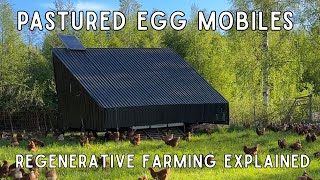
Richard Perkins (with team) presents a how-to and business overview of a pastured-layer enterprise using Ridgedale-style eggmobiles. He describes low-cost construction (≈€11,000) of three eggmobiles and infrastructure to run ~1,050 layers, production metrics (≈85% flock lay rate; ~90% grade-A eggs), pricing and sales channels (4.83 SEK/egg ≈ €0.45; trays of 30 sold by subscription at 110 SEK/tray ≈ €11), and an annual revenue/cost breakdown (≈1.3M SEK revenue; ≈530k SEK feed/other costs; ≈770k SEK gross for salary/overheads). He also covers daily labor (≈20 minutes per morning move, moving every 2nd day; ~15 minutes egg collection twice daily; ~740 hours/year on 3 ha), feed regime (≈130 g bird/day split into three feedings), nest-box and eggmobile construction details, packing/quality control practices, and processing/sale of spent layers (birds kept ~16 months; stewing birds sold ~75 SEK ≈ €7.5). The video situates eggmobiles within regenerative goals (soil carbon, animal impact, concentrated grazing) and offers practical workflow tips.
Questions this video answers
About €11,000.
Approximately 1,050 layers.
About 85%.
About 90% or more.
4.83 SEK per egg (≈€0.45); 110 SEK per 30-egg tray (≈€11).
Chapters
Welcome back to another video folks. And I'm taking this opportunity to dive a little deeper into our pastured layer enterprise to show you an overview of all the numbers and facts and figures to inspire you to see how this enterprise could fit into your regenerative farming. I wanted to take this opportunity to invite you to a free webinar on Thursday 23rd of October at 8pm Central European Time. You can find that in the links in the bio. And we're going to cover the five foundations of profitable regenerative human scale farms that I think are often behind the scenes but are foundational in my mind. But let's get into it by looking at an overview of the enterprise that we set up here that's been copied from farmers all over the world. Now we've seen Ridgedale eggmobiles in nearly 100 countries. So a very low cost startup. And all the enterprises we set up on this farm were designed to pay off their investment costs in the first year whilst making money. Low cost, modular scalable enterprises is what we focused on because we're also not just a farm, we're also here to empower other people to get started in their journey.
So we used a lot of scrap.
Timber and took apart old caravans to get the chassis for free. And we built three eggmobiles along with a certified egg packery, all the poultry fences and energizers for about €11,000 to set up these enterprises, which allows us to run 1,050 layers. We average out about 85% lay across the year and 90% of those eggs or more are grade A sellable eggs. Now in Sweden, for five or six months of the year, the birds are indoors in the greenhouse on a deep litter system that in turn produces about 60 cubic meters of compost for our no dig market gardens, as well as mulching trees, et cetera. That's another topic that we won't get into. Here we sell eggs in trays of 30 and we sell to subscription customers and on RICO rings. You can find out more about that in other videos. And we sell eggs at 4.83 crowns per egg in trays of 30. That's about €45 cents. We keep those birds for a year and then we either sell them on or process them as stewing birds. So the birds are 16 months of age. When we replace them, that creates a revenue of about 1.3 million crowns, which is about €130,000. And 530,000 crowns or €50,000 is feed and other costs, leaving 770,000 crowns or about €75,000 to pay salary as well as other farm overheads. But bear in mind this is only taking about 740 hours on 3 hectares. So it's a very part time job. You could be running pastured broilers, turkeys, running a market garden or doing something else as well. So it's a very good level of economy. And eggs are a fantastic gateway product. It's still one of my favorite enterprises for its ecosystem benefits, its profitability and also the introduction, as I said, a gateway product that allows people into the farm who will then tag on beef and pork and vegetable boxes, etc. I think it's a fantastic gateway product because if people eggs, they're going to keep returning and buying your eggs. And good eggs are hard to buy in the shops. In fact, we tested all the eggs available in the marketplace and ours are just incredible compared to the eggs you can buy in the store. So let's go back into the archives and have a look at how it is to run this enterprise on a day to day level. It's about 20 minutes in the morning to move and feed the eggmobile and we're moving every second day. So when we're running at three Eggmobiles, we move two one day, one the next, and then it's about 15 minutes to go collect the eggs. And we do that twice a day, splitting up the feed into three parts in a day. It's really important in my mind to get birds hungry in between their feeding because they forage a lot more and that forage does not cut down your feed needs, but it gives them vitamins and minerals. That means healthy birds, vibrant eggs and really good nutrient dense product. And that is the future of small scale, local, intimately marketed farm produce. We're looking for nutrient density, freshness and quality that large scale producers just can't compete with.
So now we're in a new position.
I'm trying to just always park in a slightly different place than last time. And now I can let it off on the back. Now if all the birds happen to be sat at the back of the eggmobile, this will just come flying off the tow hook. Right now they are feeling like they're quite evenly distributed. So I'll come along now and working with someone else means Toby here can just start putting up the next fence and I can get the eggmobile secured and put the feed down, fill up the oyster shell and we have a nice little coordination there. Because the main aim of the game is getting these birds out before they get too agitated. And to get the nest boxes open now, if we're having any issue or we're running late, I can open this up and I can get in there and close the door from the inside and I can open the nest box up now. We're early today, it's only six o' clock now, so I don't need to worry about that. But I'll come along and put the feed down while I'm here. Just minimizing distances and carrying things from A to B. So I'll put feed down in a.
Long line.
And we come and we put two buckets of feed in the morning when we move. Then we do one bucket at egg collection, which is after breakfast, and one bucket at 3:30 and close up the nest boxes. And it's good to spread the feed out. I like the birds to get a little bit hungry in between feeding because then they forage a lot more. And that's much better for the bird's diet. If you just have an open feeder the whole time, the bird can get easy access to high energy feed. It doesn't bother foraging as much and therefore it doesn't get all the vitamins and minerals that we want it to have. So I'm parking here, ready to go next to the turkeys. So always thinking about little things like where to go next and where's the optimal place to put things. And that's what makes workflows efficient. We're always connecting the gates first because that's where it's going to meet up. And then working backwards to the corners so we know everything's meeting up. And so I'm walking around because the chickens will follow me. And I'm actually walking around to get to the back door to open the nest boxes and it keeps the flow of chickens coming out. And so now I come in the back door, they don't even bother really looking to come out the back door. Then I just open up the nests and there we go.
So we're in the process of constructing two new sets of egg boxes, which is each set is three of these units joined together with long pieces acting as perches to jump up in the nest box. But then allows us to close them at night time like you've seen in the other videos. Now These cost about 4 or €500 for a set of three of these. That's enough for 400 hens in an eggmandeel. Now in most countries the regulation for their nest is like a 30 by 30 by 30 space. So each of these levels is enough for four hens. So this is enough for 12. Sorry, this is a 12 nest box equivalent. But each nest box is good for a few hens to share. That will depend on your local regulation, so you need to look that up. So four and a half boards in, you know, in Europe, that's still standard dimension. It comes in at 1.2 by 2.4 typically, or 2.5. This is the back piece, 1.2 meters by 1.2 meters. And then you've got your two end walls that make up the slanted roof that helps keep the nest box clean. That's 120 by 104 and 30 wide. And then all of the plates that.
The shelves for the.
No, hang on, that's the roof, isn't it? It's 34 by 120. And then the actual nest plates are bigger because you need this space for the roller to get the eggs away from the birds, keep them clean. So that's 1/17 and a half by 49 and a half. Then we're using timber. It's 28 by 45 millimeter. It doesn't have to be exactly that dimension. What's important is that as they stand up, it's tall enough for an egg to sit under there. And what's critical is the bar that supports the flap that keeps the eggs clean is placed high enough up that when you have your nest mats inside, the eggs can still roll under it. So you need to determine the thickness of the mats you use, measure that and then measure some standard size eggs or an extra large egg and add 5 mil. It's a bit of a balance because you want this to be as low as possible so the hens don't reach down and pick the eggs as well. You want to definitely go for industrial quality nest mats. It's not an astroturf, it's specifically for eggs and that allows you to get a pressure washer in and clean this properly.
Hey, again, I'm just popping in to let you know that the Regenerative Agriculture Masterclass, which is our eight week online training with myself and my amazing team of mentors, is kicking off for sales tomorrow for five days only. And that's to join the winter cohort running from January till early March 2026. We only open the cart once a year and this is by far the best value furthest reaching training that I can offer you, where we walk side by side for eight weeks, designing your the land base as well as the enterprises, answering your questions in regular weekly Calls with my mentors and then I have a follow up Q and A every week as well. So you make sure all your questions are answered and we leave you confident in moving forward with your existing business. Or if you're starting and designing a new farm, you can gather the wisdom and experience of our team from decades in this field, pioneering innovative methods for regenerating soils whilst producing really good incomes and doing a great service to our local communities. The cart's only open a few days. You can check that in the links if you want to join us. For the winter 2026 cohort, we wanted.
To build these cheap. €1500, €15,000. Each of these eggmobiles is turning over €35,000 in a year. So it's three and a half meters wide, it's 4.8 meters long. And that accommodates a four meter roof sheet, which is the standard size roof sheet here. That just is easy. This is about two and a half meters. What's important with this? So it's a caravan chassis, and caravan chassis are super light. They're just one tube on each side. And it's good to have a really strong jack on here. This is like off an IFR Williams trailer. It's just good quality British thing. But you imagine you can build this nice balanced trailer and then There might be 400 chickens all at this end, and they weigh 6, 700 kilos. And you can't lift that off the rhino, so you need a jack that can lift a ton and a half to comfortably deal with that. I like having the doors on the bottom here because the birds don't crush each other like in the other eggmobiles, where they have a side entry they can squash up against the door. The only downside is it sticks out here, which you could smash it on the gate post if you're not careful. This is all free timber from the timber yard that we get all our wood from. I bought the metal mesh. This is 4 mil wire with 40 mil gaps that you need that it supports all the feet so you can see when they walk on it, it supports their toes, but it's big enough to let all the shit through. You don't want to have a small mesh or it'll be dirty in there. So we never clean this out, really. It's like totally dropping through where you want it.
On the pasture.
We've put double wheels on each of them because it helps it from not sinking. That's the other thing with four wheels is they're all in line so it can Sink still, it's much better to have spreading wheels this way and then it doesn't sink in the mud. When it gets really wet, this clay gets really hard and compact, but when it's wet it gets really soft and mushy. It's very expensive clay, so we don't want it to sink. But I reckon this probably weighs 7, 800 kilos. You can see I can just move this by hand. This one. It's very light, so it makes it easy to move with an atv, which is what I wanted. If you know you're going to start hens and then build it up, you want to plan around, well, how many will I have one day, if it all goes well, and build it bigger than you need. If you're starting with 100, but you think you'll go up to 350, then build it for 350. The process we're doing now sets up the process of egg pack and sorting. We'll be looking at the egg packery and what you need for a certified egg packery. If you just want to sell off the farm to private customers, you don't need an egg packery. An egg packery is a regulated space. It's paperwork. You have to pay fees. It's not such a big deal. You'll find like, things like the slaughtery, like once you've done it, like, ah.
That'S quite easy actually.
But it can be a bit of an overwhelming barrier in the beginning. Like, what's an egg packery? How does it have to look? And you don't really know and no one can tell you, you know.
So it's a bit funny.
We're getting over a thousand eggs a day, so it's a lot to handle. And the picking of the eggs now makes the packing much quicker. So we do a bit of work in the field and that saves a bunch of time over there. So we're taking up feed. So I was saying we're giving the birds 130 grams each a day. That equates to two buckets each eggmobile in the morning, one at feeding time. Now that will help distract the birds. And Then one at 3:30 when we close the nests up. So this will help keep them out.
Of the egg mobile while we're packing away.
These egg crates are industry standard. You buy them in Italy and Europe and they stack like this. So you can fit six trays, 180 eggs in each one and you can't put more than six trays in. If you put seven in and then.
Put that on it will squash the whole 30.
Each tray of eggs is worth €11. So every egg counts. Like we were talking about. The eggs that go down on the ground like a few each day is.
Normal because there's birds that lay too.
Early or too late at night or whatever. But you need to keep real detailed.
Records because, you know, five eggs a.
Day, 35 a week, times that by a year, it all starts adding up. We don't sort the eggs by size. Like you can see, some eggs are bigger than others. We just sell by flats. It's much easier. You can buy a tray of eggs from us, it's 110 crowns. That's €11. And you can't buy six, it's too much of a hassle. So buy 30. They last for a month. So if you don't eat many eggs, just buy one a month. And if you eat loads of eggs, buy two or three a month. So we sell by subscription three months at a time, so we have more customers than we need. So we say, hey, you know, you want the best eggs? Then you can only buy them three.
Months at a time.
And that helps us deal with cash flow. So there's two ways to hold hens. One is to support the keel and wings. The other is to hold them by the feet. It doesn't hurt them and they relax. Any bird hung upside down will relax. You can walk a few hundred meters comfortably. It doesn't hurt it, it just chills out. It holds its head up so the blood is not concentrated in its head. But that's a standard way to catch birds, is catch them by the feet or hold them to support them that they're not flapping their wings. And it's interesting to feel these birds like, look, you can see the keel.
They are tiny, they have no breast.
This is about 1.6, 1.7 kilos. We've never lost a bird inside the pen like this. We've lost two predators that came out the fence. So you see a couple escape because we didn't bother putting the pegs in proper. Sometimes we're a bit lazy. It's like if we don't have to put pegs in, we try not to because it just saves time. It's more, you know, it's double the bending over to pick up all the pegs. It doesn't seem like much, but when you're doing all these manual jobs quickly and running around doing all kinds of things, then it's, you know, we avoid it if we can, but it does mean Some get out now, I said yesterday, I'll say again, there's 400 chickens in a small space, 250 meter nets. So this strip is 9 meters wide. That means it must be 41 meters long. So what's that, 3, 6, 400 odd square meters. So that's how much space they have today. That changes obviously according to the width of the fence. But basically I've got two 50 meter nets and that's good for up to 400 birds. But you should move them every day or two if it's like really wet. I might move them every day just because they'll be impacting the ground a lot more. But we've never lost birds to predators in this scenario because I think it's just too intense, you know, it's too confusing and too risky to dive bomb this many creatures. And also I trained them with a drone and I also trained them by going now they're still scared. They're often not scared of me because.
They'Re like, ah, yeah, it's him.
So they just don't bother. But in the first days they come, they've come off a barn floor, they've never seen grass, they've never seen an egg mobile, they've never seen someone like Niels. And you know, they don't know what's going on. So what we do when we introduce birds is we put them in the egg mobile, we put some food and water in there. They're mostly just startled and they don't.
Want to eat and drink much anyway.
They just want to sit there and we just leave them overnight and we let them out in the morning. And then that night we put a light inside, just like a battery powered lamp. And first night they're all in roosting. There's no way a fox can get them. They're inside the eggmobile with a mesh floor and a closed door and they've got an electric fence. So you're totally predator proof in that scenario. Something to say about this regeneration of soil and grass is that it only works well if you have enough animals. And that's why poultry is so important to small farms, because you can't have enough cows or sheep to make an impact or make a living. You can only do it with poultry on the small farm because you can have thousands in a small space.
And.
So you really see the results very fast. But if you only have 50 chickens, you're not going to see results. You need loads of animals in a small space. If you only have 50, then you put them in a really small space and move them much more concentrated because it's that concentration that's important. Like when we work with animals, we actually have three tools. One is grazing, the actual eating of plants. We know that plants are photosynthesizing, making sugar and pumping it in the ground to feed the soil food web in exchange for minerals and things. So that's one way carbon gets into the ground, through carbohydrates. But what happens when it's grazed is that plant will shed off some of its annual roots and that turns into long chain carbon that's super stable in the soil. It can stay there thousands of years. What we didn't talk about yesterday when we talked about grasses is perennial bunch grasses can live up to a thousand years. Like, we don't think of grass as living for a thousand years as a 9 meter rooting superorganism, you know, but they are. We all get attracted to old trees because they're big and they're grand and they're architecturally very present. Whereas grasses are things we just walk over.
We don't think about them so much.
But grassland ecology is fascinating thing. Yeah. So when I come along and graze animals, I'm putting long chain carbon into the soil. Very stable form of carbon. Carbon is what holds water. One particle, hummus, holds four particles of water. Water is the limiting factor of all life, your 70% water. So is that grass, so is that chicken. So if I can hold more water in the living topsoil where plants want it, I can grow more plants. When plants grow, they release carbon into the soil. It can hold more water. This is regeneration. It's an exponential upward spiral as opposed to decay. If I take animals off grasslands, it goes into an exponential decay that leads to desertification. Like we see quite close to us, Spain, Portugal. Here, we don't go desertified because we're in a humid climate. That means I can dig a hole and I come back and one day I'll be a forest again because I'm guaranteed rainfall. Typically in a brittle landscape, that's a dry, hot landscape. A dry land is one where evapotranspiration exceeds precipitation. Rest is not at all. Rest leads to desertification right here. Rest leads to regeneration. So this is another tool. We have grazing, actually eating plants that releases carbon into the soil. We have rest that is letting the plants recover and putting back things in the soil. And we have animal impact. Animal impact is the snuffling around with hooves that smash up dead matter and put it on the ground as mulch and shit and urine. And as we graze animals in tight bunches like they did in nature because they're being moved by predators, we get even coverage of manure and urine everywhere. And the animals get a much more varied diet because they're eating everything, not just cherry picking the best bits. So healthy animals, healthy land, healthy consumers, everything's good. We've got to keep deepening our awareness into these complexities that we're working with, like we don't know anything. We can always be learning the rest of our lives.
Right.
And so we need to be humble in how we approach the land, because however complex we think it is, it's much more complex than that. There are no ecosystems on the planet that don't have animals. Animals drive fertility loops, right? They're feeding the soil that makes plants grow, that feeds the soil that captures carbon water. So when we bring back enough animals, we talked about how there were a hundred million bison running around North America or enough antelope on the plains in Africa that you could shoot 3,000 in a weekend. Well, that level of impact and movement, that's what drove grasslands with 9 meter deep roots and topsoil. It's now all that carbon in the soil is in the air and there's desert. So we created most of these deserts by mismanagement, by not understanding patterns. Big things are happening here. More than just eggs. Yeah, we're capturing carbon and putting it in our ground and we're regenerating this soil. And so these are just a tool that we can use to move towards our context. And in our context, we're trying to regenerate the land, produce profitable business and create food that you can't buy in the store. So the basic setup I have here is a bucket underneath me and any eggs that are going to break, I drop in here, not on the floor. I'm trying to keep the floor clean and tidy so that one can go to pigs later with any veg scraps from dinner or whatever. So I've got a bucket under my feet, I've got a sandpaper block. You can use different types of sandpaper blocks, but these thin ones are nice because they're very flexible. I've got my egg stamp, which is our production number, that once the egg's the right way up, blop makes a little stamp. And so you go, and I've got some tissue paper up here in case I do drop anything. I can wipe it up. I've got egg cartons up here. I've got eggs everywhere and that's all I need. I've got some masking tape so I can write the dates on things and I've got my record keeping up there. I've also got scales here to weigh each tray and I've got a candler for looking inside the egg and I'm looking for micro cracks. Can you see the air sack there next to the light? That will grow as the egg gets older. So you can tell the age of an egg by seeing how big the air sac is. But this will detect micro cracks that your eyes can't see. But personally I can feel them. If I handle an egg, I don't use it very much. Technically you're meant to. But what they do to check that is they come and check like 400 eggs and they will look at each one and if you have more than like two cracks, then they can shut you down. But when they come, they never find cracked eggs. And that's because I've got like a sensitivity of handling. You know, if you do this every day for a couple of years, you, you know eggs like no one knows eggs. So now I'm focused on full trays and I'm looking above any that need my attention. Like this one's got some yolk on it and I can just rub that off like so. And I'm going to do the same for the bottom half. So all the down has hopefully gone, but this one didn't get done. It's got dust on the top, it's got down on it and you see down just flies around. So you imagine if you had all the down on all the eggs and the door's closed, it's just going to be like. And it ends up back in the eggs over there somewhere. So it's no good. So I'm basically scanning through everything. I can see the sorts of eggs that might have a micro crack. Now if I'm collecting eggs, I know I haven't put any cracked eggs in because I'm feeling them as I pick them up and I'm, you know, I'm picking up six at a time, but I can feel and hear if they bang together, I can hear sonically, that's not good. So if I've done the packing, the collecting, I know what I'm dealing with, as it were. Basically, I'm ready to flip these.
I'm happy with that.
I'll take a tray and you pop them on top, flip them over, make a stack with them. So they're all stacked up nice. Now I've got a Cracked one on the bottom, that's a bee egg. So I will start a bee egg collection over here. And if you are unsure of cracks, you can really see them. Can you see how the little hairline crack comes out? Now if you just look at this, you see that middle bit, but you.
Don'T see the hairline crack.
But you get used to feeling hairline cracks where there is no big crack. But these are bee eggs. I can eat that. The membrane's not broken, it's not losing air or, you know, no bacteria can get in. So I'll eat that for breakfast tomorrow. So that's my bee tray over there. And now as I turn them over, I see dirty ones like that's too dirty for me to clean in here. This one's fine for me to clean in here. So that just got rejected to be egg status or whatever. I'm taking off any down. This one is dirty too. There's quite a lot of dirty ones here. And I'm taking from my spare tray over here to fill them up. And now these eggs are certified. So I'm saying these eggs are all good. And I stamp them like. So once I've stamped, I'm stacking up these and they go different ways each time. So you just got to learn like the visual thing of like, aha, this one is going this way and we get to stacks of six and then I can put them back in these white crates.
So today we are slaughtering the spent layers. So we have had Leias for two seasons and we take them and sell them as stewing birds and we sell them for 75 crowns, which is seven and a half euros. It's the cost of buying a 16 week old bird. So we get the money back for the bird and it's a little different eviscerating a laying hen because it's got the oviduct and eggs. See, this one has a full egg ready to come out and so it's a little bit messier because the way that the chicken produces eggs is it has a few weeks supply of egg yolks up at the top of the oviduct like this. And they are very fragile obviously, so they spill inside the guts. I'll just take this egg up. There's a perfectly formed egg in here ready to go. So these are birds that are laying an egg every 26 hours. So there will always be eggs in there. And they're very small birds. They dress up maybe between 1 to 1.2, 3 kilos and they're Very much tastier. They're full of really dark yellow fat. So they make a really tasty bird, but more suited to like. Older generations are familiar with eating this kind of chicken, whereas younger people have typically only eaten broiler chickens for meat. So you have to cook them a bit longer and slow, cook them for soups and stews and things. But it's a very nice part of the process to be able to recoup the cost of the actual bird in the process. It just takes a little bit more time. We're probably running at about half the speed of when we're eviscerating broilers due to the extra work. The oviduct is attached to the spine. I don't know how clearly you'll be able to see this, but you see all these little future eggs that you'll find a series growing up to like a full egg yolk size. And it's only then that the yolk starts traveling down the oviduct and the albumen and the shell are formed on its way down in this spherical motion. So there's one full egg often in these birds, but then the next egg that will come out 25 hours later is just a full size yolk. So little birds, but tasty and good for students.
So we're not processing birds anymore. We used to do that, but it's quite hard to sell those birds.
We have students that are seasoning the.
Birds and selling pulled cooked meats and that seems to work well for them. But actually in more recent years, we found it's much better to sell those birds on at a discounted rate to other farmers who can keep those birds, or homesteaders, people that want a few birds for the backyard. Now you can basically recover the cost of the birds. We tend to put the price down a little bit and just sell them rapidly because we've got new flocks coming in. That's the better way to manage economy. Everything's tight margins in farming, so detailed record keeping and finances are critical to making empowered decisions like this. If you're interested in this kind of stuff, we go into detail in much more detail in our online regenerative agriculture masterclass, where there's over 80 hours of unseen videos, downloadable spreadsheets and HACCP plans, and all kinds of resources to help you get started. Started Smart. As well as a peer to peer network all around the globe. You can join our community. It's lifetime access and we're here to answer your questions and empower your journey forward. You can Also join us for free for the webinar on Thursday, 23rd of October, 8pm Central European time to learn more about the five foundational principles of planning regenerative human scale farms. Thanks so much for watching folks. Hope you got something out of that. Don't forget to subscribe. Follow us on social media subscribe for more tips and experience in regenerative agriculture. See you in a video soon.
More from Richard


A review of short and intensive season on a mixed farm and restaurant/event space in Sweden






Alskade Kyckling Exploring complexities of poultry production in Sweden and what we stand for


