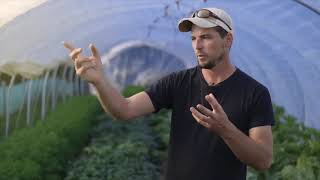
Richard Perkins runs a 25-acre diversified farm in Scandinavia and uses REKO, a Facebook-based direct-sales model where producers post weekly offers and customers pre-pay for pickup at scheduled town drop-offs. A single hour can move €5,000 of product with no marketing overhead, and one REKO group in Karlstad has 10,000 members in a city of 70,000.
Questions this video answers
About 25 acres.
Approximately 1,500 square meters.
About 1,200 laying hens.
Between 4,000 and 5,000 meat chickens per year.
About 20 minutes' drive.
Chapters
We're quite rurally situated. We're in a triangle between Oslo, Stockholm, Gothenburg and relatively very remote. And that's probably the main reason this farm has attracted so much attention, is that we are driving a very high level of economy in a very small space in a very short growing season in the middle of nowhere. And so we're not on the edge of a city with a million people. And you know, we're making it work in the middle of a rural setting. And that's what's what I find most impressive about it. So we are about 25 acres and this farm is half forestry and half pasture. So we run market gardens on 1500 square meters, which is not a very big market garden. We run about 1200 laying hens typically and 4 or 5000 meat chickens in a year. And we were able to turn over the value more than the value of the farm and the investments we put in the farm every single six month season that we run. Something that's been really interesting with our farm is we've set up quite a unique sales model that's really efficient. And the most efficient sales model I've come across, which we started off as, as buying clubs, mimicking what Joel Salatin in America brought about. So having our customers meet us halfway because we're busy farming hard. And so we would have people come and meet us in the local towns. For reference, we're about 20 minutes away from a town of 5,000, so it's a village where I come from. And then our biggest selling point is Karlstad. That's about an hour's drive, 70,000 people. And we have another marketplace, a town of about 15,000 that's 45 minutes away. So that's for context. We're pretty rural and it's not a huge customer base and there's not a large amount of restaurants in that area. Meat products and eggs sell throughout the year, the vegetables just in the summer months, obviously. And what's amazing is those sales points have now transitioned to a model called Reco, which is a phenomenon that came out of Finland. And it's all based on Facebook and we've helped spread that in Sweden and it' now spreading across Scandinavia and some of our students are moving that to South America, South Africa, America and Canada. And it's a really cool model. So it's all based on Facebook. And we as a group of producers get together and we put a listing up and we get all the people in the local sales area to join that group. So for example, In Karlstadt, there's 70,000 people and we're up to 10,000 members in this Facebook group. So one in seven people is looking for local, well made food. Like integrity food, you could say. So you make a rule, a set of rules for the group of how you want to conduct yourself, whether it has to be certified organic or whether it just has to be local. And you decide together how to do. And each week there is a meeting at a set place. And so because we set these groups up in the local towns, we set them at the time, we already did our drop off. And what happened is we just basically exposed ourselves to everyone else's customers. So it worked really well and didn't change what we were doing. And each week you put up an advertisement. It can be video, photos, you put your sales price, etc. How people can pay you. And here in Sweden, it's a cashless society, so everyone pays with phone apps and stuff like that. But the fact that you say I want to buy some eggs, some chickens and a vegetable box like this, the fact that you say you want that on Facebook means it's technically a contract. So this gets us around the trading laws. So we can do this in a car park in the middle of nowhere. And this runs for an hour in summer and half an hour in winter. And we're turning up dropping €5,000 of products in an hour back to the farm. So it's super nice. Everyone's prepaid and they actually pay on the spot with a payment app. And it just cuts out all the job of sales. And I think a lot of people are shocked to start growing things and then realize that actually sales, marketing, it makes up half the job of the farmer. And it's to find efficient ways from the get go and then be able to support others to jump into that has been, it's been amazing. And we've seen the amount of people starting small farm businesses has risen with the growth of this sales model here, which is really fantastic. So it gives us access to, in a very small catchment, we have access to a high percentage of the local people, which is really supportive. And something I would also say is having a broad product portfolio really helps. When we have fresh chickens for sale in the summer, it's much easier to sell vegetables. And that seems to be a key to the success of this farm is we have a very broad range of products that it's much easier, and I remember those words of Joel Salatin, it's much easier to find 100 customers that will spend a thousand dollars with you than to find a thousand customers that will spend $100. And that's certainly my experience of running a mixed, diverse.