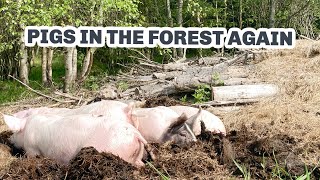
Richard Perkins walks through his regenerative farm operations: moving pigs into a forest paddock, managing mobile chicken systems, composting evisceration waste, and testing an SRI-style rice planting method. He covers electric fencing, tunnel cropping, and practical infrastructure decisions.
Chapters
Welcome back to another video folks. It's a big day. We've got pigs to put in the forest for the first time in some years here at the farm. It. Welcome. This is your new little panic home. What do you think piggies? You gonna go for it? Who's the bravest? You're not sure, are you? So this is the first time these pigs have ever been outdoors. It. So we haven't had pigs in here for a couple of years now. So we've cleared the line. We've got three and a half thousand volts through the forest but the bottom fifth wire is taking power from somewhere still that should be enough. It's nicer to have 5010 would be super ideal. Pigs will often run forward when they get shocked, but being high tensile it should hopefully keep them in. This thicket has got plenty of shade and potential water holes. So if you see back on old videos when we used to have pigs. This is a laneway that connects six paddocks up around the forest. And we used to rotate our Linderud pigs, the heirloom Swedish pig. We cut down the big forest as you've seen if you follow the channel and to let the trees recover we decided not to have pigs for a couple of years. My freezer is empty of pork and bacon is one of my favorite food. So this year I wanted to have homestead pigs again just to raise up without any breeding animals to be able to have good slaughter weight animals by the end of the season. So if we look at Google Earth this is actually from the drought year 2018. You can see the major impact on the second round with the birds overgrass that hadn't grown for 110 days. This is the paddock that the pigs have gone into now. So, so this is the old forest that's cut and this is where the electric pylons go that the government have just been cutting today actually. And then we have the paddock where the trees are cut up here as well as the original pig paddock there. And then this is where the cows live over the winter so we could run them through there. There's only four pigs this homestead scale just to fill our freezer so they won't need so many rotations. But like all things we'll just observe the ground, see what they do and we can move them through all the different fence paddocks. We've been around clearing the fence lines so just a little bit of work to get them back up to speed and three and a half thousand volts should be okay. I'm happy with that. Chickens in the smoke now, some people ask what happens to evisceration waste. This is what happens. This is actually taken and burnt with fossil fuels somewhere. Unfortunately, the gut truck was broken down last week and as you can see, these buckets are fermenting. We've had very hot days. It was probably 28 degrees yesterday. Not a very nice smell. And that's the way it is. You can compost, but you need a certified compost facility and that has to be fully closed on all sides, which if you know about compost, that does not make good compost. So we have ladders, we tip it up and that's the way it goes. You never know what you're going to find in there. There can be a zebra, a few dead cows, whatever. So you can see the sort of impact the birds are having here. We started to expand the size of the pens. Now we're using 50 meter net along the back and then we're just having to use a 50 meter net to give a bit more space between each of these structures. Once we get into the new row on the other side of the tree, lane will widen it up to the whole width, which is 9 meters wide, to give them more space to move around as they get bigger now, but nice. This is starting to come into its own where the birds become self moving and you see that in the clip where they start to come towards the food first thing. And this is the time when this model is far superior in my mind to Salat and Pension. Just one automatic waterer. Once the birds are big enough and you can move them in 10 minutes flat. A thousand birds, very useful, no back pain, very nice. And they get 30%, 40% more space as they grow. So it's. Yeah, it's my favorite approach for doing a thousand birds. Well, summer is really upon us now. Dandelions are out, hens are happy, they've settled in very nicely to their rhythm. We're pretty much in full egg production now. A couple of percent that are still not laying yet. But the birds are doing great out here. We've actually moved their timing back to 7 o', clock, doors opening so that we don't get up before 6:30. Although this year it's only taking 15 minutes to come up as two people and feed one egg mobile and check the nests are open on the automators and then move the other one. Used to take 20 minutes before we had the automations, but 15 minutes works the charm. So up at the Turning circle. Sheep have been up in the different forest paddocks, but they've come back down here now and we decided not to put the pigs in here because it's such a nice spot now, we don't need it digging over. And because we've only got a few pigs, they have so much space up in the forest there. Interestingly, they cut a bunch of the trees in the foreground here, but you can still see the smaller ones in the background. Ours are just really rampant now with the benefits they get from animals passing through. But that's the whole point of having the pigs in the forest. Pigs are the natural climatic trigger for the forest ecosystem. It would be wild boar here and they will come through and have a massive impact and then they will not come back for a long time. And that allows different species of trees to germinate and you end up with a higher diversity of trees than you found there before. And that's exactly what we see behind me here. We've got eight or nine species in this patch compared to three just across the road, just from the impact of pigs and then cows and sheep bringing their gut flora and fauna and they've created this beautiful pasture underneath and all the forbs that you would find in the pasture. Whereas on the other side of the road it's still blueberries and brashwood and it's a very different scene. Beautiful. I love this spot. It's one of my favorite little spots behind me here on the farm. So boil is gone, tunnel is emptied and this hopefully will remain quite weed free. Now just put a little bit of bedding down on top and that's helping to lock down the nitrogen left behind. But this has always been a very weedy tunnel. It's also very wet. We haven't put drainage around it, which we should do because it's sitting on heavy clay. But what we thought we can just grow some crops to get this in production this year, probably some winter squash. And hopefully with the good six inches of bedding on here, it should help it become a much more functional space again. I was planning to make a tree nursery here this year, but not going with that idea. Very nice to have it empty of birds. I for sure can say I am not willing to raise birds in a tunnel again. It went very well considering, but I just felt anxious, nervous and a bit heartbroken about the whole thing. So definitely not something I would ever consider again in the future. Coming along. It. So in the past we've had cooperation with the local village brewer who's brought us spent grains. Now we have small amounts of grain coming from local organic farmers. And what happens with the mill station where we're milling a lot of bags for the broilers here? As they get bigger, they start to really consume a lot of grain. So we crack it in this old mill and there tends to be a lot of spillage. This is what just comes out from the process of milling so much. Now, it's important to keep this swept up because there are rodents, potential rodent problems. And you can see here at the feed station actually been quite messy. So there's a lot of scraps of chicken food. You've got broiler food here, layer food here. This is a bit messy. I like to keep things much tidier for the sake of vermin. But all that can go to the pigs and that's fantastic. We also get a lot of broken eggs, eggs that are soft, shelled or cracked and that aren't saleable. Now, we obviously eat all those eggs, but there can be some that go to the pigs. And then we've got all of our market garden scraps. So trimmings from harvest and packing or crops that have gone over or whatever it is. So all those things will go down to the pigs. And they obviously have areas in their forest paddocks full of vegetation where they can get rooting around, doing what pigs do, going through, getting worms and grubs and roots and grasses and forbs, etc. So they'll have a very happy life there. Really nice for me. I really miss having pork in the freezer. It's one of the things I miss the most. We always have an endless supply of chicken and then at times a lot of lamb and a lot of beef. But when you eat amazing food, it does. You take it for granted and it gets boring after a while eating chickens. And so it's really nice to have different meat and stock up the freezer like that. Extremely hot in here in the tunnel. First chilies out, but cucumbers have to wait for now. And we'll put in two. Two rows of cucumbers should be plenty. Philip and I are fixing up the public roads. We just got gravel mixed with very coarse sand. So we're just filling in the holes up to the end of the road here for the benefit of everyone. Very nice. Stops bumping suspension on the vehicle. So much. Time to get the paddy field on. So in a kind of SRI system of rice, intense style, we're going to plant these individually at further spacings. Typically when I was in Thailand, rice would be planted eight or ten at a time, back breaking work that the women did while the men sat around drinking whiskey. But this one, we're going to plant individual plants and plant them about 25cm apart and let the plants express their physiology so they will grow much taller, much broader. They'll be able to photosynthesize down to the base of the plant. And it's technique developed in the 60s and spread all over Southeast Asia and rice grown regions to use less seeds, less water and get a much higher quality hardy grain. Now, we tried these rices before. We've got rice to set seed, but our season is so short that it didn't mature and harden for storage. I would say that's probably the furthest north on the planet that rice has ever been grown outside and created seed. But this is just fun, silly experiments. And rice is quite photosensitive, so it needs certain darkness in the summer to produce seed. So we use night blankets to help promote that. Now someone commenting on the channel did mention different varieties that are bred for reduced photosensitivity, but I haven't got access to them. I'm mainly growing Chomrong rice which is from 2,300 meters up in Nepal. And there's a few grains of other trial rices that I've got from research institutes, but mainly this chomrong. So we'll see. It'll be fun. That's it for this video folks. Just wanted to show you around what's going on. As summer really comes in now and it's perfect weather after a long cold winter. It's felt really long start to the year. This year we are running a summer edition of the Regenerative Agriculture Masterclass. We've had to cancel a bunch of the trainings here due to ongoing travel restrictions and complications. And so I decided to run our masterclass. It's an eight week intensive. You can find out in the top link below. We've got a free mini series running for the next couple of weeks, ending with a live event in conversation myself with a bunch of our old students who are running incredible businesses. You need to sign up. There's limited spaces for that and there's a whole bunch of free downloadable giveaways, including our book from the Hero series last year. So make sure you check that out in the link below. See you in the next video.
More from Richard


A review of short and intensive season on a mixed farm and restaurant/event space in Sweden






Alskade Kyckling Exploring complexities of poultry production in Sweden and what we stand for


