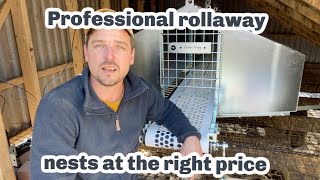
Richard Perkins and Bruno from Green Tools Tech built a prototype rollaway nest box for an eggmobile, targeting €1,200–€1,500 versus €6,700 for commercial units. It includes rollaway egg belts, automatic doors, and potential leveling actuators. Perkins also covers Sweden's bird flu outbreak, which culled over 2 million birds, and upcoming regulations that could ban outdoor grazing for poultry.
Questions this video answers
Approximately €1,200–€1,500.
€1,500.
Over 2 million birds.
About €300.
About €30,000 of eggs a year.
Chapters
Welcome back to another video, folks. Today I'm working on the build of our new professional low cost rollaway nest boxes. And I'll talk a bit about the bird flu situation as well as what we're planning to do. So if you've been following our channel, you know all about this project and you're very familiar with our eggmobiles. If you're new to the channel, these eggmobiles have become somewhat iconic. We've seen hundreds of them built around the world now. And what I've decided to do a few months ago is see if we couldn't get together a design and a fabrication of a low cost rollaway nest box. You can see the frame of it sitting here behind me. Now, I've been working with Bruno from Green Tools Tech in Croatia and I met him when I was on a training over there with David Page. And he's doing some great work in the market garden space and is looking to branch out into other machinery like a no till seeder and hopefully producing nest boxes like this for people doing pasture poult. Now, a unit like this will set you back €6,7000 for a professional model. And that's just out of the league considering this egg mobile cost us €1500 to build, including our old style nest boxes, and it kicks out about €30,000 of eggs a year. Now, if you've got the capital up front, investing in a professional model might not seem such a big deal, but for most people starting out, it's too big an investment. So we're trying to produce a model that will be saleable for about 12 to €1500. And that's certainly within the bounds of most people doing pastured poultry, certainly on a commercial scale. I funded this project. I sent Bruno some rough designs and said that I would pay for the prototype and help promote it and test it. And if it works, then hopefully we can roll them out later in the summer that people around Europe can get their hands on them. So my job today is building this nest up and building it in situ in the eggmobile. I've ripped out the old nest already and then I'm going to try and automate. Okay, that's where we got up to now. A couple of these at the other end are sticking. I'm gonna take the angle grinder and just work these edges. You see this one catches here and that the same on this one here. So that's no bother. I can easily take that out with a, with a angle grinder. It will destroy the galvanizing, but we can always put a dab of paint on there. That's no issue. But I think that gives you a good sense of what it looks like. We've got all the tin sheet, obviously got to put some perches on and we've got the whole nest assembly here. Sorry, the roll away system here. I'm going to put that on next, but not in the final position yet. I haven't decided exactly how to do this. Now, each of these beams can take my weight and I think this is about 60 kilos fully built. So that's less than me. And it's going to be spread across at least four beams. So that's no issue. But I haven't decided the final position here yet. I want to determine that with the eggs so that it's an ergonomic standing here at the door. It's an ergonomic egg collection. So we'll get into that. So in order to get egg belt on, there's a way of weaving egg belt using a plastic string to get it into a loop. What I'll probably do is set the loop up with this a little bit, set back, put it on and then tighten this in by cranking it like with a wedge out this way. Tightening the bolts onto here and we should be good to go. These rollers will keep the belt level and it will sag a bit underneath. But we want to have enough room up here to collect a good amount of eggs also. Now, this doesn't have a front bar, but that's easy to fix. I need something essentially that sticks across the front like this to stop eggs falling off. They're not going to fall off the side because the belt will be below this. If these are a bit sharp, I've got some tape. I can just cover those up so that they're not sharp edges. One little design thing that we've got to check out is the nest mats are going to be sitting. They're about 20 millimeters high, so they'll be falling down onto the actual egg belt. So we'll have to see how that goes. But it'll be cushioned enough? Maybe. But maybe on the edge of the mat we might need to put some cushioning, but we'll get there when we get there. So where are we going to all this trouble, you might be asking? Well, it's going to give us multiple advantages. Now, there's nothing wrong with our old wooden handmade rollaway nests that many people have started on. There's no problem with them, they work fine. However, they do Require two egg collections. Now I showed in a recent video a way to adapt those to make it possible that you could do one egg collection because when you have a layered system, most of the hens lay at the bottom, some in the middle, few at the top. So you can easily extend the nests at the bottom. So that's an option. But this will allow multiple benefits. One, only one egg collection because all the eggs will collect up in the central belt and it can't overfill. Two is that the nest mats will hardly ever need cleaning. They're on top of mesh racks and there's only a single layer so dirt can fall through. And then when the nests close upwards, if there's any egg residue from a broken egg, the birds can peck that off and that will keep it clean. So very little maintenance on that. And then we'll have automatic opening, automatic closing, automatic lights, automatic main door as well. So this means we can go down to two eggmobile visits a day. And it's not a big job running the old style nests and having no automation. It's still a part time enterprise that can make a family income. However, this will just make it super streamlined with all the other jobs we have going on at the farm. Sam. Sa. So nest mount on looking good. There's one issue though. It's very closely engineered, so this is all just fitting. And so when you get a double layer of mat here, it hooks up under these sides. So what I think I need to do is get the angle grinder out, shave off these sides. Shaving off a bit of the metal here seems to have helped as well as trimming these corners off to soften the material coming through, but that works. Might need some tweaks over time, but I'm happy with that because it's getting all the way through. Does the job. Okay, so update on progress. I've put in chains now to get this secure onto the roof beams. And because I've got these middle chains with two that prevents the whole thing moving backwards and forwards. It's got a tiny bit of play, but it basically can't move. And just putting in these side panels now and the roof panel slots behind this and makes a gap for the eggs to roll through. I've decided though, because what I was talking about earlier, the nest mats are 2cm thick, there's a bit of a drop onto a metal ledge probably just on that edge. So I'm going to stick down some tape before I put the metal sheeting in. It's easier to access. Looking good. Feeling good too. It's got a nice solid. Yeah. See that thick join comes through no problem. Bounces a couple of times but it's no big deal. Very nice. Okay, so I've stuck that foam down on the metal bar under here all the way along so that when the eggs drop about here, at least they've got a bit of cushioning there. Should be fine. Okay, now the camera died so I'll just try and do this one handed. Basically these top pieces have all got little holes in that join them together and I've just got to get this rivet in. Not so easy with one hand. There we go. And you see there's a hole ready for the next one. So just put all these on. That leaves a nice gap for the eggs to roll away and then we can put the top sheet over the top. Then we're going to think about next steps, building cages. Okay, that's done. Top panel's going on. They just rivet on the same and that gives us ship free nests. So this will be the perch which will then somehow got to automate this. But it will close up. Doesn't have to close up all the way. I mean the chickens, even if it goes this far, they can't get in. Doesn't need to go vertical. Very nice. Don't even need a poo sheet anymore. Alright, that is the nest pretty much done folks. Got to put the roosts on and I've got little rivet holes along here that I can put little curtains if I wanted to make it darker in there. So bird flu. Bird flu is always an issue around springtime because we have migratory birds coming around the west coast of Sweden. But this year seems particularly bad. Now in the past we've had to think about what we would do if bird flu bans were still in existence. But they've always lifted around the time we get our birds. Now this year it feels worse than ever and there's been over 2 million birds slaughtered in Sweden. There's been outbreaks near the hatchery where we get broiler chicks. There's been outbreaks at the Reco Chicken. It's an organic large scale chicken producer. I always said that we were the original Reco Chicken producers, but anyway it looks bad and it looks like the ban will continue for a while. Now you can apply for an exemption to be able to have birds outside for welfare issues, but they're not going to give that easily, especially if there's outbreaks nearby. So what are our options? Well, I've heard Some of our students, the Gond girls in France, they've got away with putting a net over the entire egg mobile. It's about €300 for a 2,000 square meter net. And it seems a bit ridiculous because that doesn't stop wild bird droppings and it obviously prevents contact directly, but they seem to be allowed that. But it seems like that will be unlikely to pass here. So our only option, we're going to apply to the authorities and ask them about the net, because that would also pertain to the boiler pans and it seems like even boiler pens will be out of the question here. So our only option is the tunnel. Now, do we want to raise birds in the polytunnel? Well, we don't put our plants out till late May, typically. So what we would hope is that window of keeping birds indoors until then. A, the tunnel is not too hot, so it could work out, and B, usually around that time the ban would lift because the ecology gets going at the start of the season and then the virus seems to dissipate. That's happened every year so far, but as I said, it does seem worse this year than ever. So it's clinch time. We've got two tunnels. That's enough to hold birds, including some broilers. And we can turn broilers on and off relatively easy compared to the laying flock, obviously. But this is not an ideal space when it gets hot. We've got venting on the sides and at the end walls and the apex of the roof as well as the doors, so we can keep them vented. And we'll just have to park the eggmobiles up to the tunnel. It'll be a bit logistical because it's very tight space. We can make some kind of tunnel, perhaps, but it's not ideal. Now, obviously, if you have big barn spaces, that would be fine as well. And a lot of people here are just going to have to keep their hens indoors this spring and maybe through the summer too. Who knows? Some people I've heard of having to cull their flocks because they just don't have facilities to keep them. Other options could include like an outdoor marquee space, some kind of tented space, but it's all logistics and it's all further costs that we can't really afford to be doing so. So we'll see. We're going to hear back from the authorities this week, hopefully. But we have our tunnel spaces and that's what we're going to have to default back to if nothing changes. But I don't expect the bands to lift before our birds come, which is in a week from today. That is a thing of beauty. Big shout out to Bruno at greentools Tech and he's been so accommodating to make this project and it came beautifully packaged. He has been super busy and put a huge amount of work into this. I funded this project for you guys, those of you doing passive poultry. I just feel like in Europe there needs to be innovation in this field and people need access to good quality tools. This benefits from the metal sheeting. It's not going to attract mites, it's going to be much more hygienic and just a better all round job. If you can buy this for less than €1500, then any commercial parsley poultry keeper can afford that. Now we're trialing it and in the next few months we'll get to know any little tweaks and things that need adjusting in the design. We'll obviously be documenting that here on YouTube, but I want everyone to give a big shout out to Bruno, go visit Green Tools Tech on Instagram and on Facebook. I know we put a lot of work into this just to appease me essentially and to, you know, hopefully come up with a collaboration that would be fruitful into the future for the benefit of everyone doing pass through poultry. But this all came packaged beautifully, super professionally and it's just a work of art. I love it and I think Bruno's such a wonderful guy. He's hoping to open source the CAD plans basically for donations starting at zero on his website, so. So that those of you outside the EU can just make those, or anyone in the EU too. And then hopefully he'll be able later in the summer to be able to start production and get these out to people once we find out the kinks. But big shout out to Bruno. Bruno, thank you so much. If you're watching this, it's an amazing thing to see a dream come into fruition like this and I couldn't think of a better person to work with on this than yourself. So big shout out to you and I know Bruno is also hopefully making us some drop seeders like we have with the paper pot system. I ordered drop seeders for 64 and 144 square solid plastic trays. He's making custom made drop seeders. So if you need market garden tools, board forks, gridders, drop seeders, then greentech tools, that's where to go to. And big shout out to Bruno, go send him some love, folks. It's really important to shine light and appreciation on people that are moving and shaking in this field. So things that we have achieved. This is a good ergonomic working height and it's easy to reach this handle and it leaves room for egg crates so we can easily collect the day's eggs even if it's raining. There's room to put the crates in here. There's also room for birds to get under which is important. It's not huge amount of room but it's over 20cm and the birds will get through that I'm confident. What else have we got to think about? We need some kind of door system. So what I want to have is some kind of mesh here and possibly a door somewhere here that allows us entry if need be. Now we're not hardly ever going to have to come in because you can visually inspect everything from here and obviously collect eggs like this. So what we do need is a way to get the birds in when they come in crates and be able to get in. Also I'm thinking I will possibly imagine if the posts here and I've got some mesh screening so the birds can't get into this front bit. Maybe I'll have a door that swings just to this corner to open like this and that will allow us to sneak in. You'll just be able to make it through but that's fine because we're not coming in very often. So I'm going to sleep on that and talk about it in the next video. I want to be able to reach my control boxes so that we can deal with leveling. I'm thinking to use these actuators to be able to adjust the level of the nest boxes because we've got the chains, it doesn't really move forwards and backwards but it can obviously level on its own. But I don't want it wobbling as birds jump in. And so I think by attaching two actuators on one side we'll be able to put a level spirit level on the front here and you'll be able to just quickly press the button and level this off. I think that'll be smart. I've got to come up with a way to to lift up both sides of the nest. That will be easier once the roosts are in place because they'll all be connected. But I haven't got a smart way to do that yet. So I'm going to think about all these things overnight and in the next video we'll get into the automations and building this front canopy and then test it all out, see how it goes. See you later, chickens. Just got to find a way to attach the actuator to enable it to open and close like this. Fun stuff. All right, well, that's it for the video folks. Thanks so much for watching, as always. Don't forget to go and hit up GreenTools Tech. Show some love there. If you want to support us, then the best way to do that is by my book, Regenerative Agriculture. It's been dubbed the most comprehensive book in the literature in the field of regenerative agriculture. Check it out in the links below. There's loads of stuff down there. Links, links, links, links, links. See you in the next one.
More from Richard


A review of short and intensive season on a mixed farm and restaurant/event space in Sweden






Alskade Kyckling Exploring complexities of poultry production in Sweden and what we stand for


