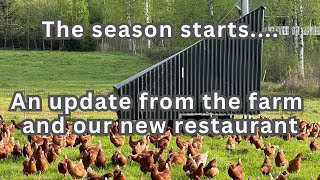
Richard Perkins provides a first-person update (May 14, 2025) on Ridgedale farm and the new Sillegården farm-restaurant project. He describes regenerative grazing and pasture improvements, current livestock and cropping activities, the on-farm team and staffing changes, tight finances and licensing/permit challenges for the restaurant, upcoming courses and concerts, and operational details about poultry, market garden crops, and kitchen/bar build-out.
Questions this video answers
May 14, 2025
300 purchased (counted 301 present when counted).
About 3% mortality.
Mid June (year of the video).
Nine-day regenerative agriculture training; six-week autumn internship; pastured poultry and market-garden/no-dig masterclasses (durations not all specified).
Chapters
Welcome back to another video, folks. It's been a long time and I thought it's high time I gave you an update of what's going on at the farm as well as Silly Gordon, our new farm and restaurant project. Well, where to begin? It feels like it's been a long time and I've just been flat out busy. It's been the same kind of energy feat feeling for me as starting up the farm with the restaurant as well. It's just a lot of unknowns, a lot of planning and calculating, and the excitement and possibilities of last summer soon gave way to a lot of stress and a lot of bureaucracy. Working with the commune for alcohol, license and fire departments, police department for concerts and all this sort of stuff. So a lot of new territory and a lot of very small slow back and forth that led us to have to cancel a lot of our plans this summer because it just felt like we don't even know if we're going to be able to open in time. But more about that later. I don't think I've ever had such high pressure on me as I have now. It's been a massive financial burden. I've had to remortgage my house and I'm putting everything on the line to make a cultural fun project possible. But it may not work and I'll tell you more about that in due course, but a little bit about the farm. So of course, with Silly Gordon opening up, we want to focus a lot of our production to the restaurant. But we scaled back our ideas for this summer just to keep a level of sanity. We've got the whole array of animals and plants going as normal and we had a really early start this year getting the cows and sheep onto pasture. We're working more towards a kind of total grazing system. And it's very. You have to be careful in this climate to not hit the grass too hard really early in the season because you kind of stunt the growth throughout the whole year. Then we've had a very hot but quite dry spring, so much earlier growth than I can even remember since I moved here, and we risked kind of running out of grass. But I think it's really interesting. You might have seen on Instagram where I've been posting a lot more frequently. When we look at the drone footage, you can see the areas that we have grazed are actually looking the same as the neighbors first growth of grass once we've already been through with all our animals grazing it. So it's quite remarkable the difference we have in our pastures throughout through the transformational power of good grazing, keyline ploughing, the additional inputs from poultry, etc. But pretty remarkable. And I'll be showing drone footage of the photosynthetic rate and recovery throughout the season. Now, initially, we were planning to have all livestock up at Siligorden as well this year, but we've decided to keep more at the farm this year. So we've brought boilers out and before our training programs even begin, we've got the boilers out on pasture. We've got pigs running in the forest again, and we've booked already sheep and pigs for slaughter. We've also been busy with a home slaughter of a bull that we didn't want to carry over and to help restock our domestic freezer. And we've been getting used to the new team. We've got David here as a market garden manager and he's been busy seeding and transplanting out crops. And we've got Leanne here as a chef who's been busy pickling and going through our freezers and making chutneys and jams and making wonderful food. And we've got to focus this year on really making do with what we've got. The constraint of our budget is very tight, and it's been amazing to watch her just take the bull by the horns and really use what we've got and craft incredible food. We've been eating a lot of beef liver and stocks every day. And that's what I really love about this place. We're eating nutrient dense, super high quality food every meal, every day. And that's the life we want to live and also what we want to bring to the restaurant here. So we have been planning Neapolitan pizza for the restaurant, and so we've been putting out a thousand San Manzano tomatoes. And we've also wanted to have padrons and that kind of style pepper for the restaurant to freeze and to have next year. Those plans may be changing. I'll tell you about that soon. But we've got crops in here for both the farm and for a small garden at Silligorden because we want to have some demonstration elements of all the things we do here to help educate people as well as part of their dining experience. Now, it's very windy today, but something I'm particularly excited about. And those of you following our channels will know, the sand garden here, it's in its second year, so we actually built this exactly one year ago. And so the plants are coming up strong and they're in their second year of growth so we expect to see it really come into its own. This year I'm going to play some shots so you can have a look around without me in the way. I think you'll agree it's looking beautiful and it's weathered the winter really well. And this is going to be very interesting to follow throughout the season. This year we're going in the south and half the north beds and we're filling this tunnel with peppers. And the big tunnel is already planted out with our first spring greens. Soon it's going to be full of tomatoes. So this is Victor. Victor was here as an intern last year and then stayed on as farm manager. And he's now a right hand man here, living in the village close by. Close by just the other side of the small lake here. There at the lake we go and swim and barbecue in. Victor and his family have bought an incredible place at the exact opposite end of the lake, overlooking the sunset. It's very beautiful place and Victor's helping with everything around the farm and with Siligon. So you'll see him a lot in videos this year. I'll be there more often. Yeah. We passed our 200 mark on the X238 today. 238. So they've been laying for about 10 days now. And we're just waiting for salmonella testing that's mandatory here. And also the eggs are very small, so we're just eating these for our kitchen. But soon we'll have eggs for sale again. So in north beds here, the first few crops have gone out. There's a lot of direct seeding and transplanting to do. And we're putting back the caterpillar tunnel for the first time in three years. Now, as always up this far north you have to be careful putting things out too early. And we like to put tomatoes out mid to late May because it can always come the island nights where we get hit by minus degrees. So tomatoes are going out pretty soon. But we've got a lot of Asian greens and radish spinach and most of this is for our courses and for us to eat. But this is interesting. So this was grazed about six days ago. We're running here in front field between different types of berries and fruit trees. And we'll look and compare this in your mind to this neighbour's land that we'll see soon that hasn't been grazed at all. So here we are at the neighbours and we've got to take the animals up here now. Just to try and give us a little extra recovery time. But this has not been grazed at all. So you saw back on the aerial footage on the drone, our grass has been fully grazed and is so much more heavily photosynthesizing. And that's the power of regenerative ag. And if you've read our books and followed us over the years, you know we've built 30, 40 centimeters of active topsoil and that's allowed us to become drought proof and it's also, conversely, allowed us to become flood proof too. So all of that carbon we're building into a healthy active topsoil. Carbon is what holds water and it allows us to mitigate any limitation or excesses of that. Look here. So we're up in what was the winter cow paddock and sheep paddock, and we've got some forest raised pork in action. They are very curious and want to sniff at the camera. Hey. Hey. This is the patch of land that I always highlight and compare with the neighbours on videos for the astonishing difference in tree growth as well as the species complex. Over 100 oak trees germinated here per hectare. Where you don't see oak trees around in the landscape and where the cows and sheep have browsed, they really allow a lot more sunlight down to the floor. And this will green up now with only a few pigs in here, and we'll be grazing through here later in the season. This is where the hens started their journey and they sat here far too long because we had way too much going on. But this was totally bare, basically. So this is two weeks of recovery at this time of year here. So here's some of the crew behind me, and we're down now at the bottom of Nutfield, where we also have the boilers and layers starting out, and we're right near the bottom now. So we're going to actually head up to the neighbours and hopefully get four or five days of grazing across their land before heading up to our forest paddocks, which are very sparse, but will give us a little extra recovery time in this dance that we've started that we need to manage quite a lot ahead of animals on a very small farm. Now, we do have extra land at Silly Gordon and we're renting even more land beside it. But as I said, we're not taking animals up there this year because it's just adding to the logistics and we want to just take things step by step. So, new flock of hens in the classic Ridgedale Eggmobile. And this has probably been one of the most curious flocks we've ever had. They came out within four or five days, whereas they can normally take eight, nine, 10 days. They're very keen to get out and about and they laid eggs earlier than I predicted. I normally predict when the first eggs will come and these guys jump the gun. So, new for us, we're going to be trying to sell eggs, vegetables and sun broilers, etc at the restaurant after concerts, we're going to have a little stall there with a little signboard and we have sign boards with information around the farm telling people about regenerative agriculture in really, you know, more layman terms about no dig growing, about holistic grazing and why we want to do regenerative agriculture, why we want to eat nutrient dense food locally and in season. And so hopefully we can, you know, send people home after a really good meal, an enjoyable concert and go home with a bit of the farm too. We don't know how that will go. We don't know how anything will go with that this year, so we're just testing it out. But we'll also have eggs, veg and meat for sale on the Ricoh rings, perhaps, or locally at least. And so if you're an old customer that wants to get back in touch and purchase products, then get in touch and you'll probably find this on the Rico in Karlstedt. As anyone knows, that's been to the farm, this is Nutfield and I'm passionate about finding nuts that don't normally grow this far north. In Sweden we've got pecan and hickory and sweet chestnut, different walnuts, and we actually had our first. Now that's nothing particularly special for many of you farming further south, but there aren't many chestnuts that produce fruit this far north. And so that's very exciting and not holding my breath, but my life's work is finding a chestnut tree that provides reliable fruits every year. That would be fantastic. Behind me is a Malus aversii, the original Kazakh apple. And you can see this year it's got a lot of blossom, so I'm excited about that. We've only had a few apples off them, not enough to get a sense of whether they'll be good. They might be rubbish apples, they might be great for ciders, they might be great for eating, but chestnut here, and we've got some very interesting trees that. This is just a pet project of mine for fun, to create a savannah, like planting above the pasture. It's not an economic part of the farm, but it's Fun. And that's what I like to do. First batch of boilers is doing very well and we've been very impressed because we had super low mortality, about 3%. And in the first batch of boilers, the season you'd expect to have the highest mortality, when there's no biology in the deep litter system that we use. But what's been really interesting is when we counted the birds to pen them, we actually have more birds than we purchased. So we actually, we bought 300 for this batch and we have 301 still. So I'd say that's exceptional. That happens sometimes when they're filling the boxes, but they're going really well, they're growing really well. And we will have fresh birds available in mid June. So I plan to make videos as much as I can and be back on YouTube. I know a lot of you have missed the updates and the hustle and bustle from this incredible place and I like to share that process as well as document it for myself because so much changes so fast here. But don't forget, we've got a library of hundreds of free videos that detail, you know, how we do all these different processes as well as our books that you find in the links in the bio. And there's a lot of information resources for you to get started or to improve the ways you're doing things, just as thousands of people around the world have done already. And now I want to take you on a little trip to Siligorden and things have changed a lot there. It's been very high stress, as I said, and we just haven't got the money to start a thing like this. I really utilized all my borrowing power to even purchase the place. And basically the day that our chef that we've been planning with for eight, nine months was meant to fly in, he's decided to quit on us and we are three and a half weeks away from opening. Bit of a dick move and I can't even fully understand or comprehend it. It's too stressful to even get stressed about. So we put our filers out there and thankfully we got a chef flying in in time to prep, make a new menu and change the way that we're going to do that. So we've had a bit of a vision of what we were going to do based on the amalgamation of a few businesses that I loved and have been planning this kind of vision for, for many years in the background. But I really want the chef to express their unique sensibilities and their insight in their Art with the amazing produce we have at the farm. So we're probably going to come up with a brand new menu two weeks out from opening and we've got incredible concerts and that's really a big part of why we're doing this whole project. The intention for me in buying this place was to make a collaborative business that's fun and can give us a low stress, low workload into the future where the farm can be tailored more specifically to the restaurant. And we put a lot more energy into community and events and having a lot more fun. It's something that's really missing for me as an Englishman living in a very rural setting in Sweden, which is, you know, let's say ultra conservative. And it's, you know, I've been missing that a lot. So for me, this isn't a business to make money. I have a secure livelihood in my work here. I don't need any more work and I wasn't intending for the amount of work to fall on me that has. And that's okay. I'm pretty resilient, as you've probably noticed over the years. And if I'm passionate and excited, I like to throw myself into things and I love solving problems and finding solutions. So that's the way we are. That's what we show people how to do in their farm life. And we're just applying it to this side startup that we've got going on. But let's go up there and have a look around. So we've got the flag flying finally. And this is the Vermland crest. That's the county of Vermland where we live in Sweden. And I like the flag, it's a beautiful eagle and we've been making a patch here. So we decided to turf this patch you might have seen on little clips on Instagram. And we've done that to be able to have a fresh start with with a no dig bed. We're going to set that up in the course that's coming up starting at the end of the week. We've got a whole array of courses on this summer Pastured poultry masterclass. Learn everything about pastured layers and boilers. We've got market garden no dig masterclasses, nine day regenerative ag trainings and we've still got a few spots on our autumn internship which is a six week super intensive plan your farm and business and define your context and life and a supportive group of people from all over the world. But this has been fun process and looking forward to get that going and this is a project for another time I'll tell you about. But we've been working a lot in the gardens and on the stage and bar as it starts to green up here, you really get a sense of this amazing place. And we have the fields on both sides down to the lake Freeken, the mighty lake Freeken. There's very deep lake for Swedish lakes. This is a beautiful old dance hall, but we can't use that in our serving area. The alcohol laws are very strict here. So we've had to put this fence up, which we've enjoyed doing. It's a very nice process. And we have our bar truck. So this is turning into an outside bar. And there's going to be drinks served there and food and drinks on the inside bar, too. We've been to a lot of auctions. Like we picked up tables and benches for 300 people that fold. And we've been restoring the gardens. Nora took down the entire stone wall and put it back neatly because it all collapsed. And that really frames the front of the restaurant. We've got a lot of bulbs, a lot of planting pots, flowers to go in. And what's really cool is we've managed to set up this stage which we were supposed to start roofing today, but it's just too windy to roof that high up. And I've got a friend in the south of Sweden who I met on the first course I did when I first came to Sweden, who makes beautiful massive paper flowers. But we're having them that are framing the stage. And we've got a local sound company who are coming now to be able to put up sound system. This room is going to be the green room for the artists. And then the company we're working with are going to hang speakers on the outer side of here under the rain protection, and then beautiful lights and some drapes in the background so you see through to the lake. But we can light up those screens and make a really beautiful ambiance. So this beautiful old structure is actually a model made for the Vermland Opera. Very expensive model where they could have actually bought a real truck for the price of it. The wheels are not even wheels. They're just sitting here like this. And it's all made of wood. But it was sitting at Almaluf, which is the Museum of Unexpected Arts on the other side of the lake, where my friend Stella runs and asked her if we could have this to make a bar. And then I've stuck in an opening door. I've built some basic Cupboards, we've got fridges in there and we've got a very interesting set of drinks to serve alongside the food. So we met with Vin Stereo and Nico came up from Gothenburg. Super fun tasting. And the reason we want to work with them is they have an incredible array of organic, biodynamic and Swedish produce. What I love about that is they have nature wines and they have no sulfite, no chemicals added, except for a teeny bit of sulfite in the bottling. And for every single wine they have on offer, there's a page of information about that farmer, the way that they grow, what else they do on their farm, how they ferment, how they bottle. It's all natural yeasts. They have prosecco, they have a gin, they have different fruit liquors, they have Swedish beers made with organic grains and Swedish hops. They have fruit ciders. And they have this whole arm of drinks that are from the waste stream coming out of supermarkets. And we had in that tasting, sort of more like an English cider, which is very different to the sweet Alco pops that they serve in cider here, but flavored with quince. And that's a Japanese quince that we have up here, so quite lemony and with plum and pear and fantastic drinks. And we had a great time and we really like the ethos of that company. So we're basically trying to tailor all of our drinks through them. That also makes ordering and purchasing more streamlined. But I'm really excited by that. I want to have a whole array of things that people have probably not seen before, and then QR codes upon all of them, where you can see the farmer and really have that personal connection which ties in totally with the farm, with this direct to consumer mentality that we've always had. There is still a lot to do, but I've been building this fun little tap that I've still got finished so that people can fill their own drinking water. We got a new welcoming sign that will go onto the car park where people can read about the history of this place as well as the farm in English and Swedish. And we've also been doing a lot of work just fitting the kitchen and sorting it out. We've been to auctions where Nora and I drove all around Sweden picking up gear. And we've basically had to start a restaurant with no money. But we've got an array of fridges and freezers. We've got the full new dishwashing station with a really high quality dishwasher. We've got Mixing machines. We've got a very high quality Ceva Dalen 500°C oven that's suitable for Neapolitan pizza or breads and things like that. We've got good cookers and we've got different equipment that we need and probably we need some more. But we've done really well for the budget we've spent. And I think this kitchen's really great because it's just so voluminous. There's a lot of space and light and that makes it really nice. So I think we've done well. And it may not look like so much has happened, but a lot has been having to happen to get to this point. We're trying to keep the character of this place, but add our own little touch. We've made this artwork that you may have seen in the winter and we've changed the color of the walls because we didn't love the original color. But we are sensitive to the artist that created this long time ago and also built all this furniture. So we're trying to keep things intact and respect the beauty and craftsmanship that is here, but also make it our own and go back to the past by bringing the farm up here again, but also into the future with better ways of farming. We're going to put up fencing around the fields this year. We've got funding for wolf protection fencing, which is a big thing here, and that will allow us to bring sheep and cows up here. But I think for this year we're just going to cut winter feed here and then next year we'll be ready with a lot more knowledge of how to run this place and the right sort of people around us to do this in an easeful, fun way. There's obviously a million things I could tell you about and I can't fit an entire update of the time it's been since I made the last video. But maybe I'll leave you by saying it's been, you know, a big ride. And what I'm really excited about is some of these concerts we've got happening this year, some incredible artists, and we've got a lot of exciting plans for the future. We've got one more artist to add to this, which is Nick Mulvey from the uk. It's like a modern day Paul Simon or just an incredible singer songwriter. So I'm really excited for that and all the other concerts. I hope to be able to take you along as much as possible this year. Make sure you follow us on Instagram, where I post daily it's much easier to just put up little clips of what's going on, but I do hope to make long form videos. As always, you can find my books in the links below. We ship them all over the world. You can find details of trainings, you can find our online stuff. And yeah, look forward to hear your thoughts in the comments and I'll hopefully keep you updated regularly throughout this year. Thanks as always for watching folks. I know it's brought a lot of enjoyment as well as learning to people all over the world. So I love to hear your comments, even if I don't have time to respond to them during the busy season. But I hope to see some of you here and to celebrate and to eat and feast together on the best produce possible in a beautiful location. See you in a video soon.
More from Richard


A review of short and intensive season on a mixed farm and restaurant/event space in Sweden






Alskade Kyckling Exploring complexities of poultry production in Sweden and what we stand for


